
Living in central Gaza, conflict was something Samar and her young family had grown used to.
“Sometimes there was bombing and shelling, but we continued life, with the kids, with work and schools... Life didn’t stop,” explains the special education and Montessori teacher, who previously taught at a school for the hard of hearing in Palestine, helping children to communicate through sign language.
But when hostilities escalated in late 2023, any semblance of normality vanished.
“We were heading to the schools to drop the kids off, we were just standing at the door when we saw the rockets and we didn't understand what was happening,” she recalls. “But we could see that something big was happening.”
Days turned into weeks as the shelling drew closer. During this time, Samar lost her husband, the home they shared and the life they had built together.
“The war changed our entire life as a whole family,” says Samar. “The work and the house and the life and the father – everything in an instant. Suddenly all of this goes away, not just part of it or something, it all goes away.”
After months sheltering in a besieged area, often sharing a home with up to 65 people, Samar fled Gaza for Egypt with her children. In August 2024, they arrived in Perth. For the first time in years, they felt safe. But the future they faced was full of uncertainty.
Like many newly arrived families, Samar was navigating an unfamiliar system while carrying the weight of loss, grief and displacement, as well as the responsibility of caring for her young children as a single mother.
“When I am the father and the mother and everything, and I have four children under 18 years old. I don’t have the language and I don’t have money. And I don’t know what I should do or what to think,” she says.
“Who’s going to pay the house rent? The language – how will I communicate, what about my children?”
It was at a support group for women in Perth that Samar heard about the emergency financial support Australian Red Cross offers to refugees and migrants facing extreme vulnerability. Samar applied soon after, and the money she received helped her to pay bills, buy groceries and send her children to school.
“It was a relief to my financial pressure as I was able to pay my rent with the money,” she says. “It helped me settle in the new environment. We felt supported.”
That help made a difference in a critical moment. But Samar still needed support to continue rebuilding her and her family’s life.
Soon after, she was reconnected with Australian Red Cross through the government-supported Humanitarian Settlement Program (HSP).
“They contacted me… and they told me what the steps were. What procedures we can do with you.”
From the moment people arrive in Australia through to the point they can navigate life on their own, Australian Red Cross provides specialist support that meets migrants where they are. Through the Humanitarian Settlement Program, Samar received tailored, practical support shaped around her family’s needs from a caring case worker who could speak her own language, which helped Samar to feel more comfortable at an overwhelming time.
“At the beginning it was helpful, when you meet someone who speaks Arabic. I mean, I could communicate with them.”
“The doctor, assistance with translation for all matters. Doctor’s appointments. Children, schools, they help us with them… Support if you need anything for the house, furniture for the house.”
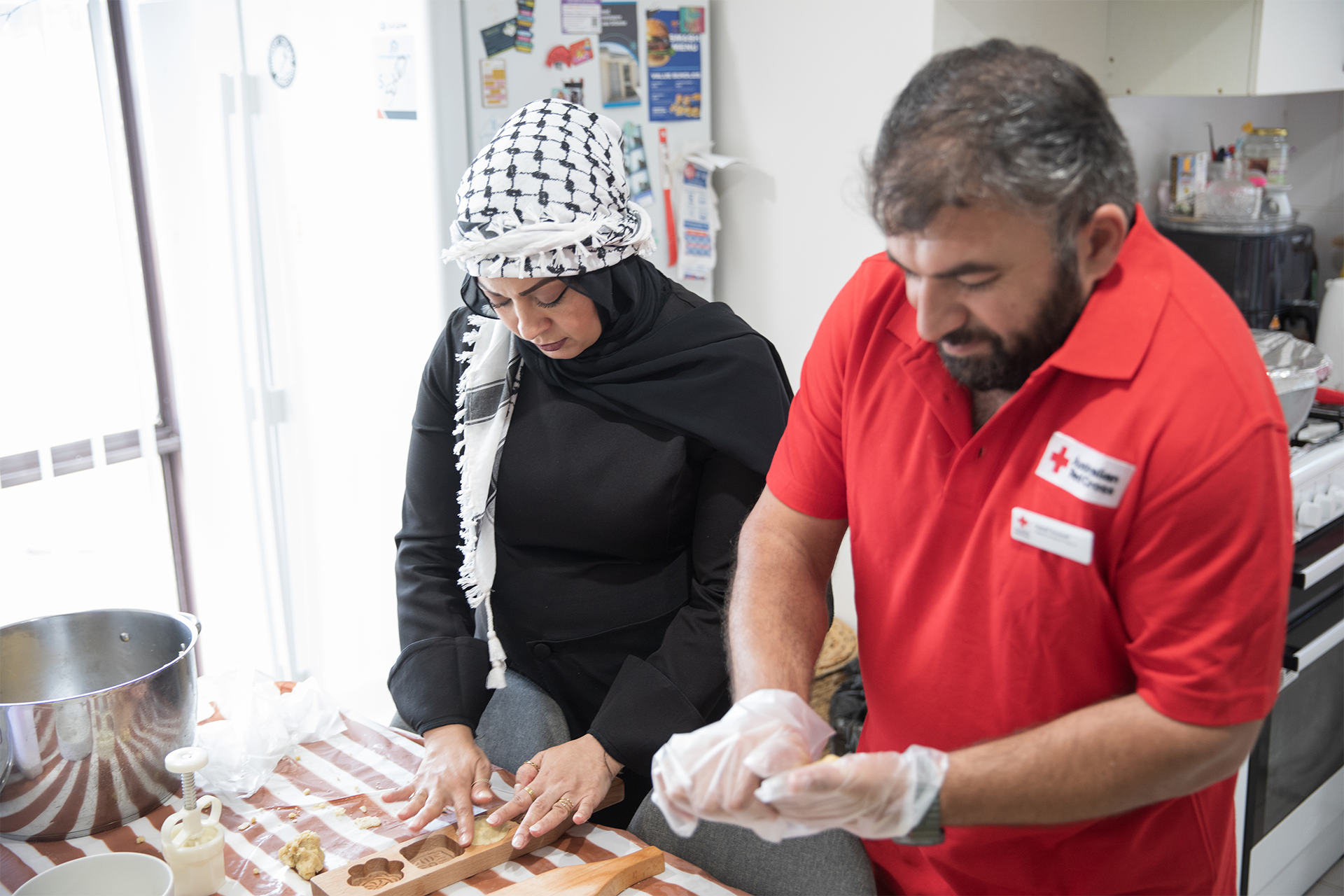
Aatef, who is from Syria, was once supported by the Humanitarian Settlement Program at Australian Red Cross. Now, he helps others just like him.
For Aatef, a Humanitarian Settlement Program support worker with Australian Red Cross, this early support is essential.
“We support the new arrival families to settle in the new country. From the first day we welcome a new arrival in the airport, then we take them to the accommodation that we prepared with essentials, like furniture and food.”
Once families are settled in their new homes, those first few weeks are spent helping them navigate essential services. “Centrelink, health, appointments, local transportation and orientation,” explains Aatef.
More than just meeting immediate needs, the program is designed to help build the foundations for long-term independence. The impact is profound: 86 percent of families from conflict zones supported through the Humanitarian Settlement Program report improved overall life satisfaction*.
Aatef knows this firsthand. He grew up in Syria but fled to Iraq with his family when conflict became too dangerous, later arriving in Australia.
“I was a client with the Red Cross Humanitarian Settlement Program when I arrived… it was about two or three years ago that they supported me with the essential services, me and my family. Then after I graduated from the program, I volunteered with Australian Red Cross… After that, I find a way to work as a support worker with Australian Red Cross.”
Today, he supports others at the very beginning of that same journey. “The main goal is to build the capacity for the clients… to know how to manage their life… so when they are not with Australian Red Cross, they can continue.”
Samar is positive about the future. “You have to continue to be strong in this world.”
For Samar, that journey has taken time. "It was hard… it took effort from me, maybe a whole year until my children were able to settle psychologically and socially at home and at school. Especially since I'm single with the children, something like this creates anxiety for you to provide the rent, provide the basic matters, schools, things like this.”
But gradually, with the right support, a new sense of stability has begun to take hold. “We can say we've reached 40 or 50 per cent of stability,” says Samar. Despite everything she’s been through, the love she has for her four children continues to give her strength. “You have to continue and you have to be strong in this world... one must continue and not stop because there are kids behind you.”
Today, Samar is looking ahead towards rebuilding her career and creating a safe and secure future for her children. “I’d love it if I get the opportunity to improve my English… to complete a course in the Montessori field as a teacher,” she says with a hopeful smile.
“There’s a goal in front of you and you want to start again because you must have ambition from within.”
* (Safety Net Program Survey, July-Sept 2025, n=163)
Australian Red Cross provides limited emergency relief to some people on temporary visas who are experiencing financial hardship and vulnerability.

Australian Red Cross acknowledges the Aboriginal and Torres Strait Islander peoples as the Traditional Owners and Custodians of this land, their ancestors and Elders, past and present.
Learn about our Reconciliation Action Plan and how we can all make reconciliation real.
This website may contain the images, voices or names of people who have passed away.
All donations to Australian Red Cross are tax-deductible in Australia. Site protected by Google Invisible reCAPTCHA. © Australian Red Cross 2026. ABN 50 169 561 394