

Picture this scenario: a community is preparing for the season ahead, one marked by rising temperatures, unpredictable weather and the growing threat of extreme events. There is a shared commitment to staying safe. People want to take action early to protect what matters most. But to do that they need tools that make planning easy — knowing where to go, what to take, and how to stay connected — empowering them to act with confidence and clarity.
But communities cannot be prepared unless they are adequately equipped and informed in advance.
That's the driving force behind the QBE AcceliCITY Humanitarian Challenge – a global search for technology solutions that help communities become more resilient, navigate recovery and respond together when disaster strikes.
The QBE AcceliCITY Humanitarian Challenge brings together Leading Cities, QBE and Australian Red Cross – three organisations whose unique capabilities rarely converge.
As humanitarian challenges grow in complexity, urgency and scale, no one organisation can solve them alone. Collaboration is essential to deliver meaningful, scalable impact.
Leading Cities bridges innovation and implementation, helping cities and innovators overcome procurement, regulatory, and scaling barriers. Through a global network of 600 vetted solutions and engagement across 16,000 cities worldwide, Leading Cities accelerates community-level resilience through cross-sector collaboration.
QBE Foundation brings expertise in risk management, and a focus on using funding to drive innovation, support early-stage ideas, and foster collaboration across sectors for lasting impact.
Australian Red Cross brings people and communities together in times of crisis, drawing on proven capability in community engagement, building on local strengths, and mobilising the power of humanity to support recovery and resilience.
Together, this partnership identifies and scales inclusive, community-driven solutions that help reduce disaster risk and build long-term resilience.
Unlike traditional accelerator programs, the QBE AcceliCITY Humanitarian Challenge doesn't just fund ideas and send teams on their way. It connects tech innovators directly with frontline communities as partners, not just end users, and offers the ability to build a pipeline of clients worldwide to further drive impact. Selected participants receive:

Training on working ethically in humanitarian settings.

Guidance from specialists in disaster resilience, community engagement and sustainable growth.

A four-level certification that builds the skills and credibility needed to work with cities and scale impact.

Direct access to cities as clients through structured matchmaking and project pipeline development.

Access to connections across the Red Cross Red Crescent Movement, QBE and Leading Cities.
Winners receive up to AUD$100,000 in pilot funding to test their solutions in real-world settings with Australian Red Cross and Red Crescent partner communities. This co-design process transforms good ideas into trusted tools.
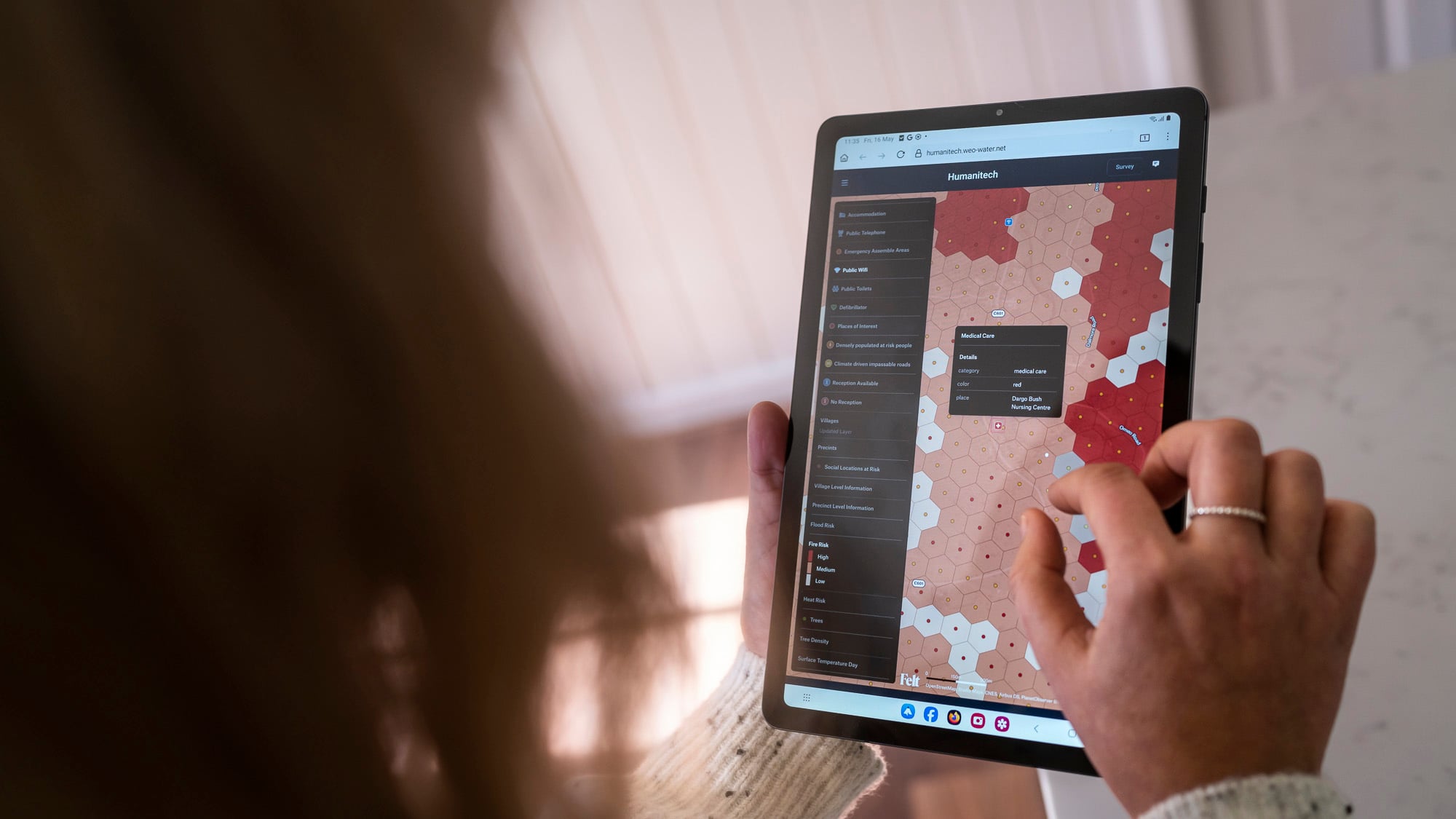
In Dargo, a small Victorian town repeatedly hit by fires and floods, the 2024 challenge winning team, WEO, has partnered with locals to refine their climate risk mapping platform. By combining satellite data and AI, WEO helps communities better understand and prepare for disasters. Crucially, the accuracy of their technology was significantly improved through direct community input.
Not all technology helps. Well-intentioned disaster tools can fail communities when they:
This is why the challenge is partnered with Humanitech, Australian Red Cross' initiative dedicated to exploring and testing technology for humanitarian good.
Humanitech ensures that innovation is ethical, inclusive and shaped by the people who will use it. Humanitech works with communities, innovators and partners to design solutions that respect local knowledge, protect privacy and serve genuine needs.
The approach recognises something fundamental: communities aren't passive recipients of technology. They're experts in their own context and the best solutions emerge when that expertise shapes the tools from the start.
Climate change will continue reshaping how disasters unfold. Communities are adapting in real time, but they need tools that work with them; tools that respect their knowledge, protect their privacy, and serve their actual needs.
The QBE AcceliCITY Humanitarian Challenge is proving that when humanitarian expertise, commercial insight and civic innovation work together – and when communities lead the way – technology can genuinely help.
Not just because it's sophisticated – but because it's trusted.
Help bring trusted, community-driven solutions to the places that need them most.

Australian Red Cross acknowledges the Aboriginal and Torres Strait Islander peoples as the Traditional Owners and Custodians of this land, their ancestors and Elders, past and present.
Learn about our Reconciliation Action Plan and how we can all make reconciliation real.
This website may contain the images, voices or names of people who have passed away.
All donations to Australian Red Cross are tax-deductible in Australia. Site protected by Google Invisible reCAPTCHA. © Australian Red Cross 2026. ABN 50 169 561 394