
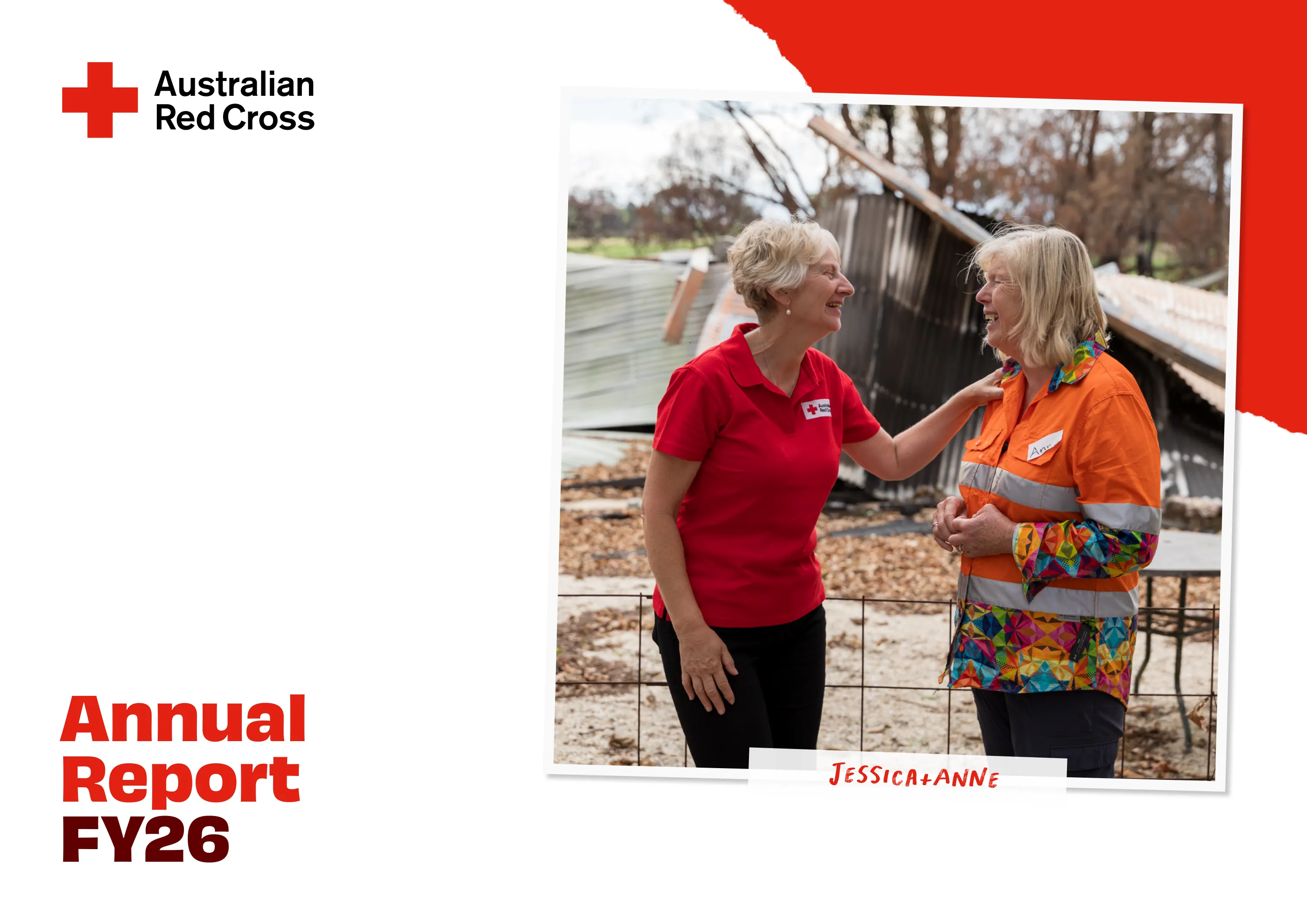
Annual Report FY26
From supporting communities through disasters and conflict to helping people find safety, connection and hope, FY26 was a year that demonstrated the power of humanity in action.
Across Australia and around the world, Australian Red Cross stood alongside people facing crisis, uncertainty and change, while helping communities build resilience for the future. Through disaster preparedness and recovery, migration and settlement support, international humanitarian action, community programs and the life-saving work of Australian Red Cross Lifeblood, we continued to support people through some of life's most challenging moments.
This impact is brought to life throughout our Annual Report FY26. Behind every statistic is a person, family or community navigating change, and behind every achievement are the volunteers, members, employees, donors and partners who make our work possible. Together, they show what can be achieved when humanity is put into action.
The year at a glance

20,681
Australian Red Cross members and volunteers acted for humanity. *

213K+
people received support before, during and after disasters.

30K+
people from 84 countries helped through our migration support programs in Australia.

4.7t
of humanitarian aid products were provided to Solomon Islands as part of the Tropical Cyclone Maila response.
607K+
people participated in the Australian Red Cross Lifeblood donor community.
* Total includes Australian Red Cross Humanitarian and Australian Red Cross Lifeblood members and volunteers.
Helping communities before, during and after disasters
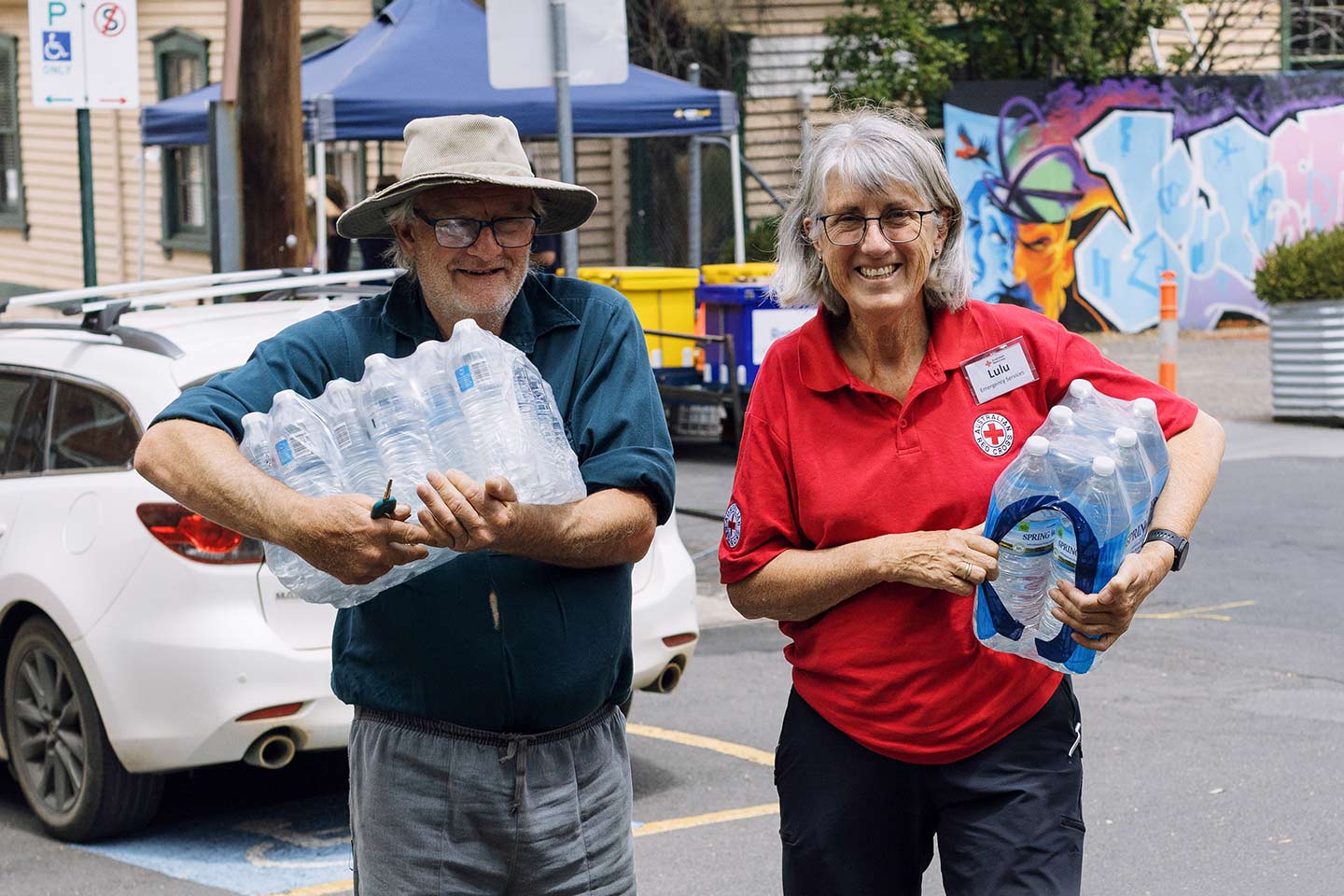
As disasters become more frequent and complex, Australian Red Cross continues to help communities prepare for emergencies, respond during times of crisis and recover for the long term. This year, we supported more than 213,000 people affected by disasters and emergencies across Australia.
Nothing exemplifies this more than the aftermath of the Bondi tragedy. In the days and weeks following the event, Australian Red Cross Society volunteers provided practical support and Psychological First Aid to hundreds of people, helping create spaces for connection, reassurance and healing. Register.Find.Reunite helped reconnect loved ones, Australian Red Cross Lifeblood broke donor records with an extraordinary community response, while volunteers worked alongside communities as Australians came together in solidarity during an incredibly difficult time.
Whether supporting communities after floods, cyclones and bushfires or helping people get ready for future disasters, our focus remained on helping communities build confidence, connection and hope.

16.2M+
opportunities to hear or read disaster preparedness communications.

27
emergency activations across the country.

121K+
people accessed disaster recovery activities, including psychological first aid, through community events, workshops, and training across Australia.
29K+
people strengthened their preparedness and social connection by attending an Australian Red Cross-facilitated workshop.
Supporting people seeking safety and belonging
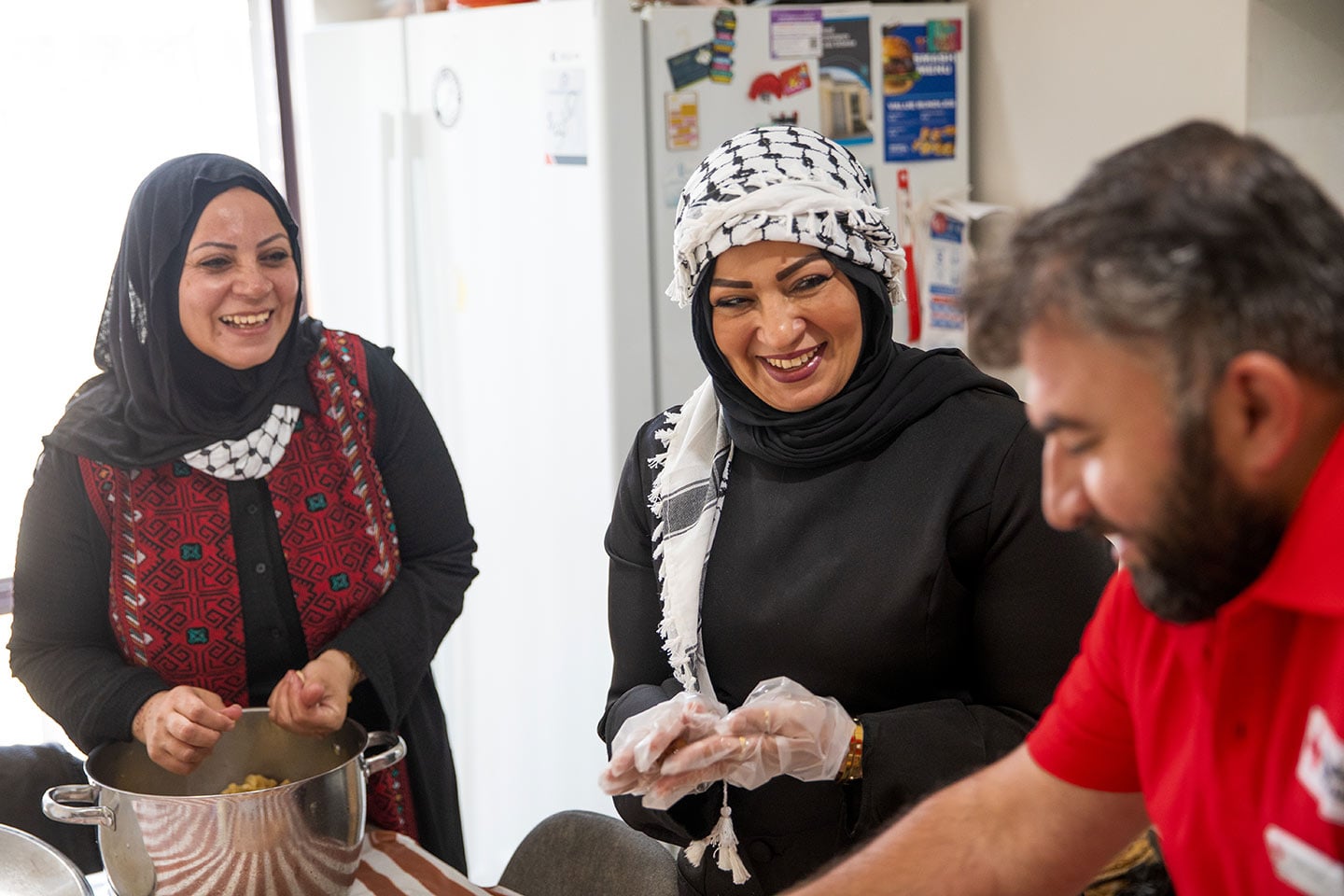
For people rebuilding their lives in Australia, finding safety is only the first step. Through our migration programs, Australian Red Cross supported more than 35,000 people from 84 countries as they settled into new communities, reunited with family members and accessed critical support services.
Among them was Samar, who arrived in Australia after fleeing conflict in Gaza with her children. Through the Humanitarian Settlement Program and emergency support services, she received assistance to navigate housing, education and healthcare while rebuilding a future for her family.
Her story reflects the resilience of people seeking a fresh start and the importance of community support in helping them succeed.

11K+
people accessed our Work Rights Hub website.

4.6K+
people participated in In Search of Safety community education sessions.

2K+
people from 32 countries were supported throughout their settlement journey within the Humanitarian Settlement Program.

377
people received assistance via the Support for Trafficked People Program.
Delivering humanitarian support around the world
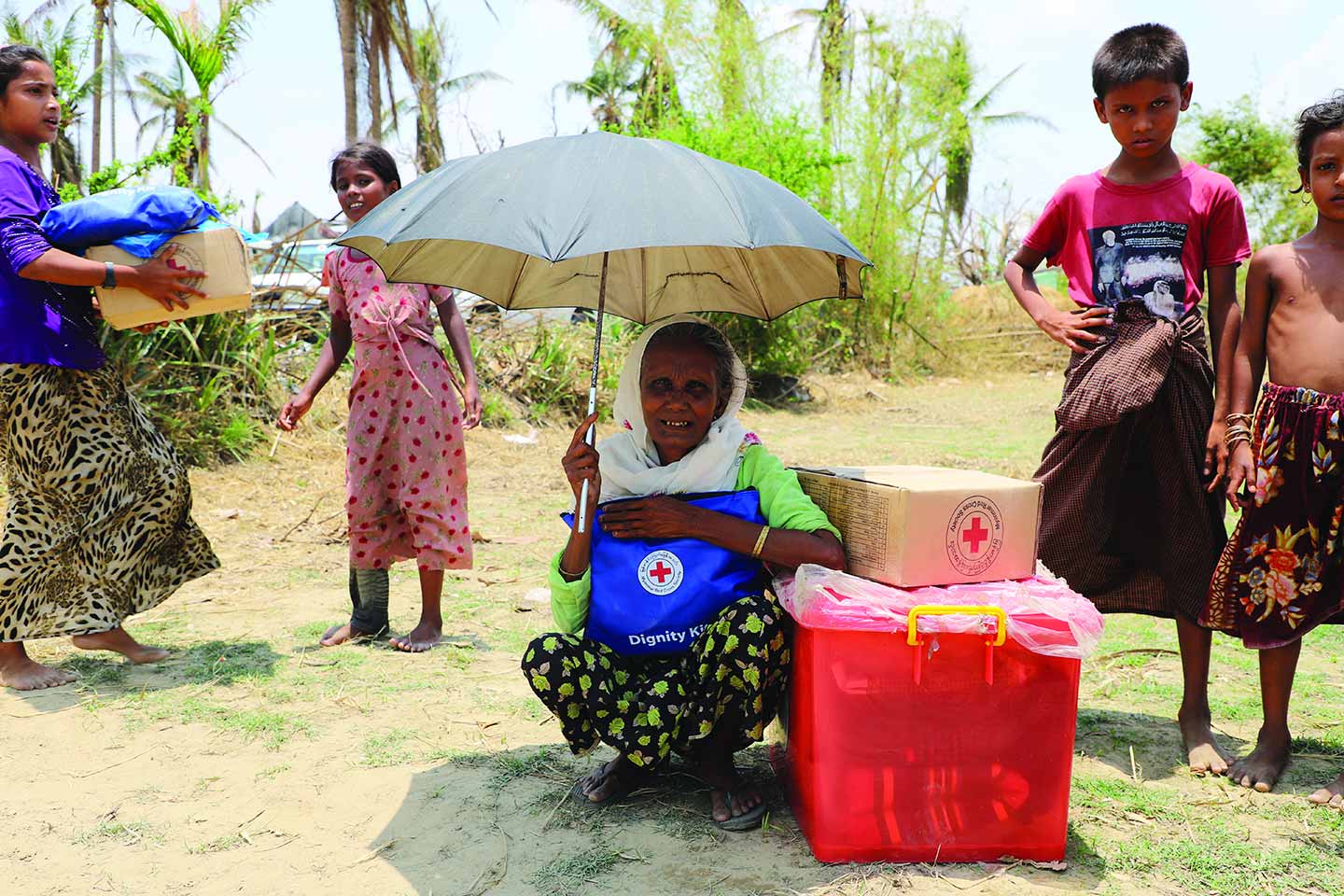
Humanitarian needs continued to grow across the globe as conflict, disasters and displacement affected millions of people. As part of the world's largest humanitarian network, Australian Red Cross worked alongside Red Cross and Red Crescent partners to support communities across the Asia Pacific, Middle East, Africa and Europe.
For communities across Myanmar, recovery began in the wake of a devastating earthquake that caused widespread destruction and displacement. Working alongside local partners, Red Cross teams delivered critical health services, safe water, shelter assistance and psychosocial support, helping people meet immediate needs while laying the foundations for long-term recovery.
From supporting hospitals in Gaza to helping communities affected by disasters in Indonesia and Myanmar, Australian Red Cross remained committed to helping people access safety, dignity and hope when they need it most.

19
international disaster and crisis response operations received Australian Red Cross support.
44
Australian Red Cross international delegates were deployed to 26 countries.

1.17M
displaced people in Cox’s Bazar supported thanks to the generosity of our supporters.

10
National Societies received Australian Red Cross support to prepare for, respond to, and recover from disasters.
Giving the gift of life
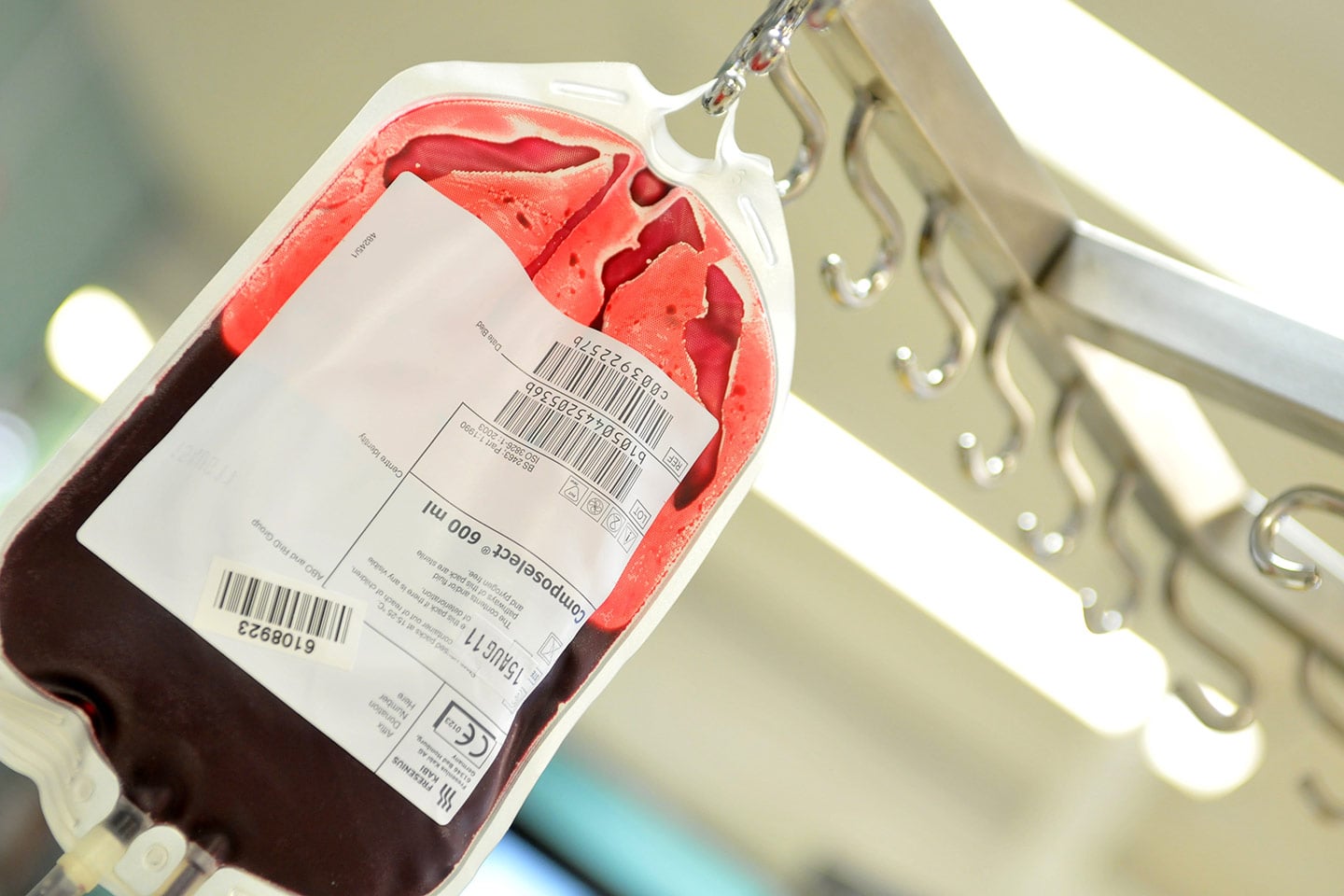
Every day, Australian Red Cross Lifeblood helps save and improve lives through the generosity of Australia's donor community. In FY26, more than 607,000 people made almost 1.74 million donations of blood, plasma and platelets, helping provide life-saving treatments for patients across the country.
The extraordinary response following the Bondi terror attack highlighted the strength of this community. Nearly 50,000 people donated blood or plasma, and more than 120,000 future appointments were booked, demonstrating the willingness of Australians to help one another when it matters most.
Throughout the year, Lifeblood also continued investing in innovation and inclusion. From advancing lab-grown blood research and launching new serum eye drop treatments, to introducing more inclusive donor eligibility criteria, Australian Red Cross Lifeblood worked to expand access, improve patient outcomes and ensure Australia's blood supply remains among the safest and most reliable in the world.
1.7M+
individual donations of blood, plasma, and platelets by Australian donors.
940t
of plasma was delivered to CSL Behring for use in life-changing products.
8,996
people in Australia joined the stem cell donor registry.

65K+
bottles of breast milk were delivered to support some of Australia’s most vulnerable babies.
The heart of Australian Red Cross
Across every disaster response, community program and humanitarian effort featured in this report is a network of people choosing to make a difference.
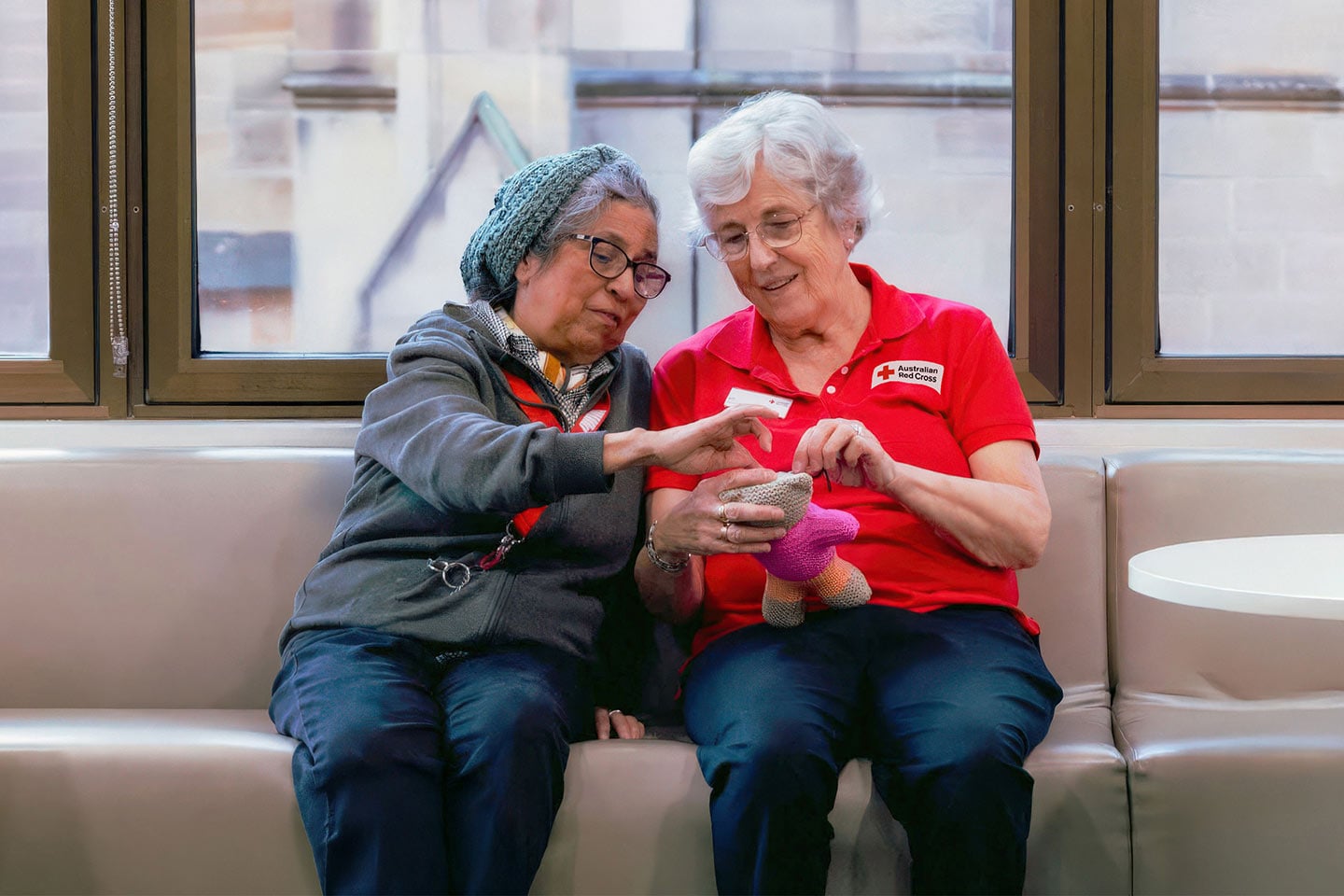
This year, more than 20,000 members and volunteers contributed their time, skills and compassion to support communities across the country through disaster response, migration support, social connection programs, retail operations and fundraising activities.
Whether supporting communities through disaster, helping people settle into a new life in Australia, knitting a Trauma Teddy or offering a friendly connection when it's needed most, our members and volunteers are the heart of Australian Red Cross.
Their commitment, generosity and belief in the power of humanity make everything we do possible, helping create stronger, more connected communities across Australia and beyond.

75K+
volunteer-made Trauma Teddies brought comfort to people in crisis.
414
Australian Red Cross branches, units, clubs, and Friends of Red Cross initiatives.

843K+
social connection calls made to older and vulnerable people.

150K+
meals were delivered to 1,463 older people.
Behind every number in this report is a story of humanity in action, made possible by the people who choose to stand alongside others in times of need.
As the challenges facing communities continue to evolve, so too does our commitment to helping people prepare, respond and recover. Thank you for being part of that journey, and for helping us create positive change in communities across Australia and around the world.
For the best experience, view this report on a larger screen such as a laptop or desktop computer.
-
Text of page 1
Annual Report FY26
-
Text of page 2
Contents
- The year at a glance3
- Impact8
- Members and volunteers23
- First Nations communities25
- Innovation and thought leadership28
- Retail, first aid, and mental health30
- Partners and donors32
- Our people36
- Governance and risk39
- Safeguarding46
- Modern Slavery46
- Environment, social, and governance48
- Environmental impact48
- Financials49
-
Text of page 3
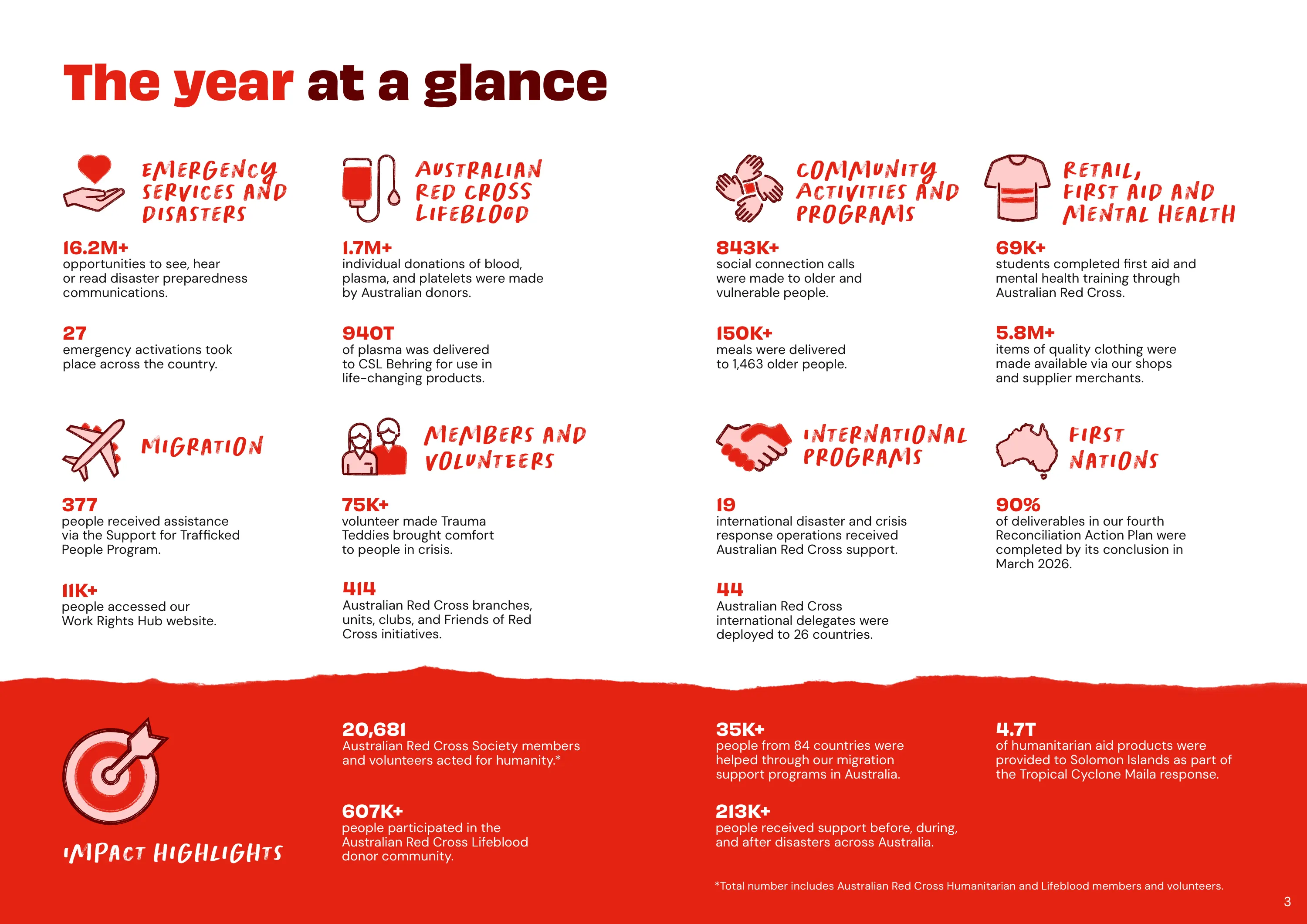
The year at a glance
Emergency services and disasters
16.2M+ opportunities to see, hear or read disaster preparedness communications.
27 emergency activations took place across the country.
Australian Red Cross Lifeblood
1.7M+ individual donations of blood, plasma, and platelets were made by Australian donors.
940T of plasma was delivered to CSL Behring for use in life-changing products.
Community Activities and Programs
843K+ social connection calls were made to older and vulnerable people.
150K+ meals were delivered to 1,463 older people.
Retail, first aid and mental health
69K+ students completed first aid and mental health training through Australian Red Cross.
5.8M+ items of quality clothing were made available via our shops and supplier merchants.
Migration
377 people received assistance via the Support for Trafficked People Program.
11K+ people accessed our Work Rights Hub website.
members and volunteers
75K+ volunteer made Trauma Teddies brought comfort to people in crisis.
414 Australian Red Cross branches, units, clubs, and Friends of Red Cross initiatives.
International Programs
19 international disaster and crisis response operations received Australian Red Cross support.
44 Australian Red Cross international delegates were deployed to 26 countries.
First nations
90% of deliverables in our fourth Reconciliation Action Plan were completed by its conclusion in March 2026.
Impact highlights
20,681 Australian Red Cross Society members and volunteers acted for humanity.*
607K+ people participated in the Australian Red Cross Lifeblood donor community.
35K+ people from 84 countries were helped through our migration support programs in Australia.
213K+ people received support before, during, and after disasters across Australia.
4.7T of humanitarian aid products were provided to Solomon Islands as part of the Tropical Cyclone Maila response.
*Total number includes Australian Red Cross Humanitarian and Lifeblood members and volunteers.
-
Text of page 4
Acknowledgement
Australian Red Cross acknowledges Aboriginal and Torres Strait Islander peoples as the Traditional Owners and Custodians, valued Australians in the heart of humanity. We pay respect to them; to Elders past and present and to those who come, for you hold the memories, the traditions, the culture, and hopes of Aboriginal and Torres Strait Islander people across this country. Australian Red Cross acknowledges their ancestors were first to walk upon this land, are survivors of war and conflict, have preserved their culture, and have cared for and protected this continent for over 60,000 years.
Australian Red Cross Society
Australian Red Cross Society (ABN 50 169 561 394) is incorporated by Royal Charter and is registered with the independent national regulator of charities, the Australian Charities and Not-for-Profit Commission. Australian Red Cross Society is comprised of two operating divisions: Australian Red Cross Lifeblood and Australian Red Cross Humanitarian Services. This Annual Report covers both operating divisions. For the purposes of this statement, “Australian Red Cross Society” refers to both operating divisions, and “Australian Red Cross” refers to Australian Red Cross Humanitarian Services.
About this report
This report has been prepared in accordance with Australian Accounting Standards and Interpretations and complies with other requirements of the law and the Australian Charities and Not-for-Profit Commission Act 2012. Australian Red Cross is a signatory to the Australian Council for International Development (ACFID) Code of Conduct, which is a voluntary, self-regulated sector code of good practice. As a signatory we are committed and fully adhere to the Code, conducting our work with transparency, accountability and integrity.*
We demonstrate transparency by preparing general purpose financial reporting statements, similar to those required by large for-profit entities. Our Annual Financial Statements are externally audited and more than 30 of our individual grants are separately audited and acquitted to funders each year.
Our Annual Report 2025-26 provides an integrated overview of our humanitarian activities and impact, as well as our financial, social and environmental performance for the end of the financial year ending 30 June 2026.
*See Notes to the Financial Statement section (page 58) for more details
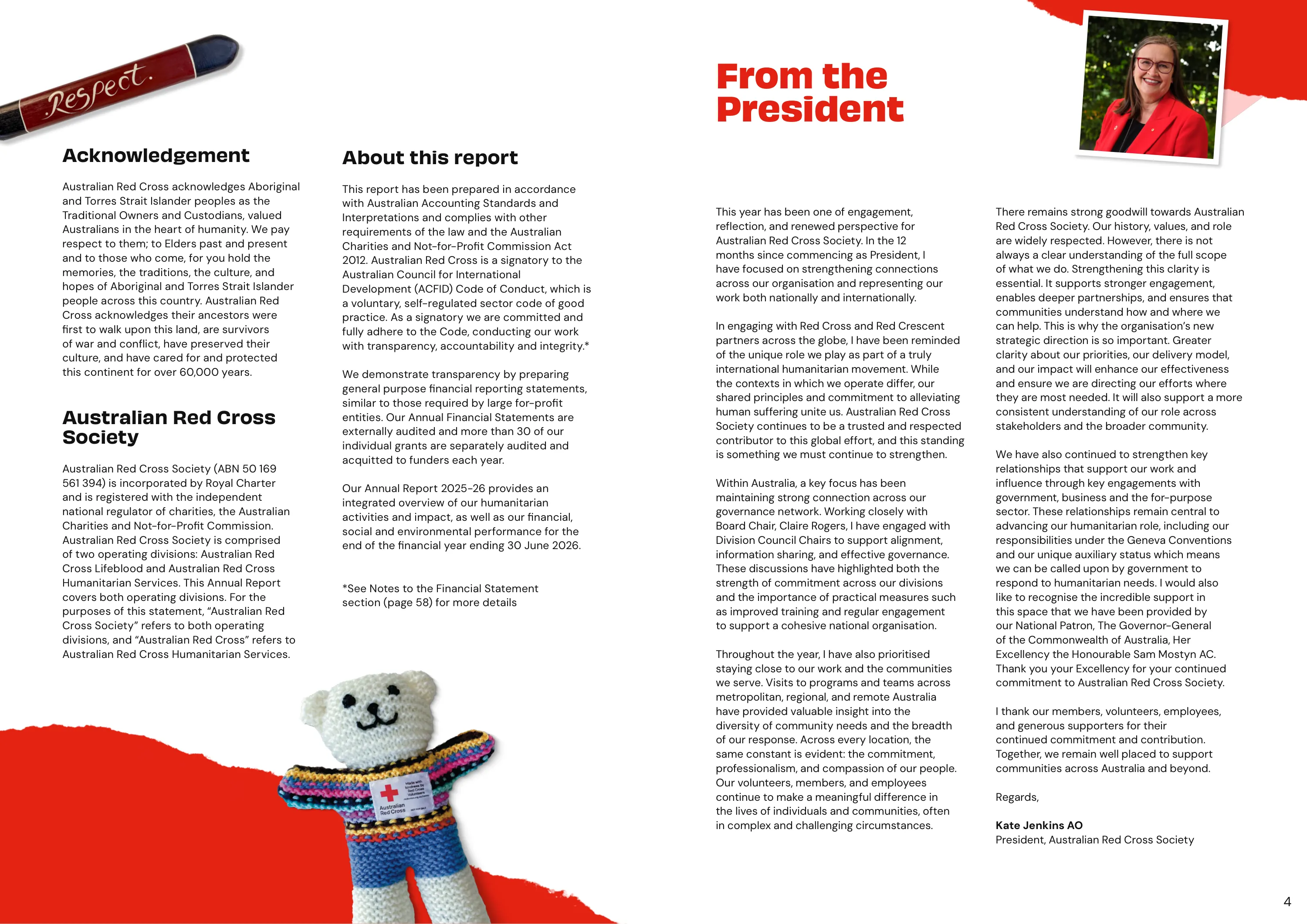
From the President
This year has been one of engagement, reflection, and renewed perspective for Australian Red Cross Society. In the 12 months since commencing as President, I have focused on strengthening connections across our organisation and representing our work both nationally and internationally.
In engaging with Red Cross and Red Crescent partners across the globe, I have been reminded of the unique role we play as part of a truly international humanitarian movement. While the contexts in which we operate differ, our shared principles and commitment to alleviating human suffering unite us. Australian Red Cross Society continues to be a trusted and respected contributor to this global effort, and this standing is something we must continue to strengthen.
Within Australia, a key focus has been maintaining strong connection across our governance network. Working closely with Board Chair, Claire Rogers, I have engaged with Division Council Chairs to support alignment, information sharing, and effective governance. These discussions have highlighted both the strength of commitment across our divisions and the importance of practical measures such as improved training and regular engagement to support a cohesive national organisation.
Throughout the year, I have also prioritised staying close to our work and the communities we serve. Visits to programs and teams across metropolitan, regional, and remote Australia have provided valuable insight into the diversity of community needs and the breadth of our response. Across every location, the same constant is evident: the commitment, professionalism, and compassion of our people. Our volunteers, members, and employees continue to make a meaningful difference in the lives of individuals and communities, often in complex and challenging circumstances.
There remains strong goodwill towards Australian Red Cross Society. Our history, values, and role are widely respected. However, there is not always a clear understanding of the full scope of what we do. Strengthening this clarity is essential. It supports stronger engagement, enables deeper partnerships, and ensures that communities understand how and where we can help. This is why the organisation’s new strategic direction is so important. Greater clarity about our priorities, our delivery model, and our impact will enhance our effectiveness and ensure we are directing our efforts where they are most needed. It will also support a more consistent understanding of our role across stakeholders and the broader community.
We have also continued to strengthen key relationships that support our work and influence through key engagements with government, business and the for-purpose sector. These relationships remain central to advancing our humanitarian role, including our responsibilities under the Geneva Conventions and our unique auxiliary status which means we can be called upon by government to respond to humanitarian needs. I would also like to recognise the incredible support in this space that we have been provided by our National Patron, The Governor-General of the Commonwealth of Australia, Her Excellency the Honourable Sam Mostyn AC. Thank you your Excellency for your continued commitment to Australian Red Cross Society.
I thank our members, volunteers, employees, and generous supporters for their continued commitment and contribution. Together, we remain well placed to support communities across Australia and beyond.
Regards,
Kate Jenkins AO
President, Australian Red Cross Society
-
Text of page 5
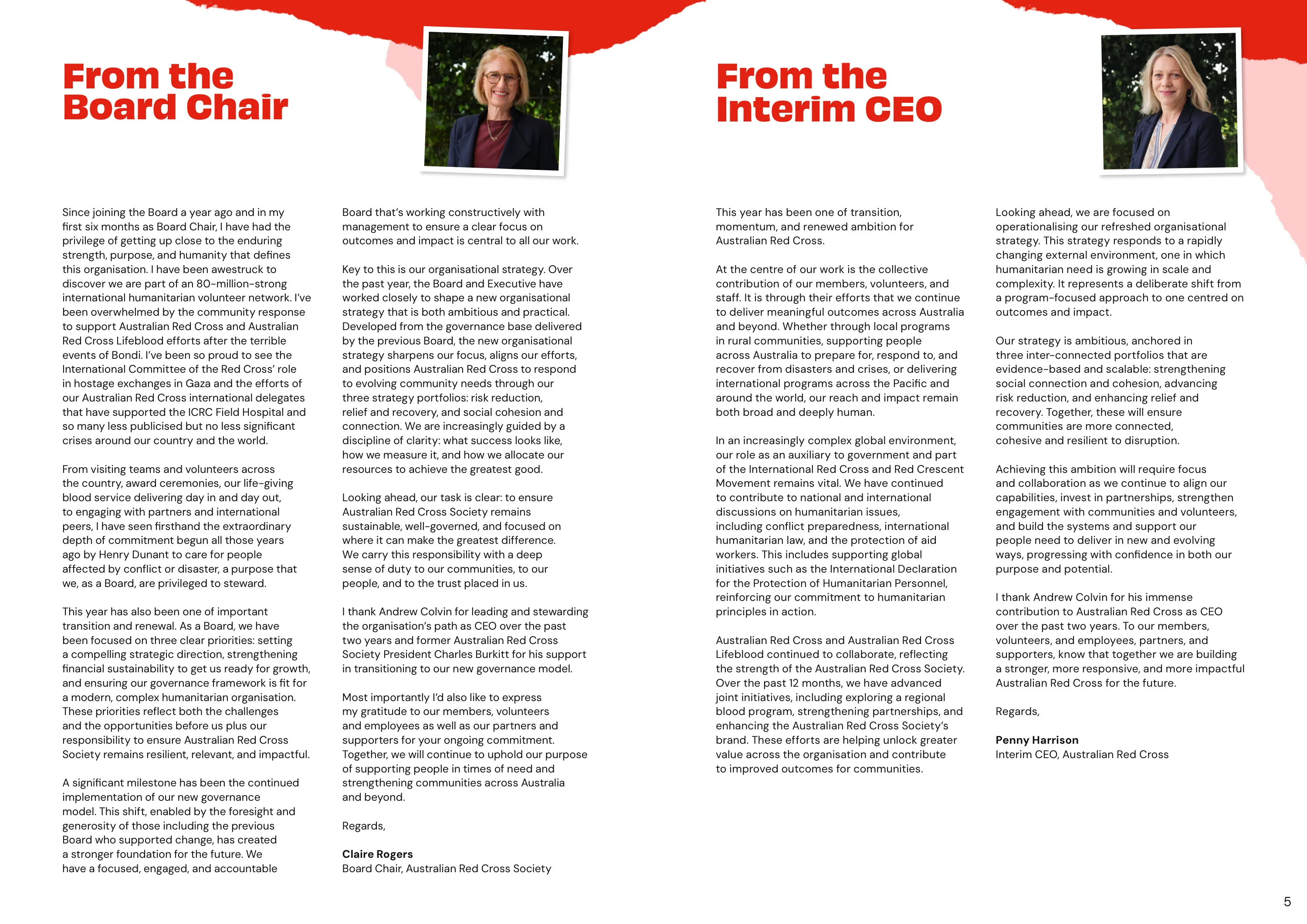
From the Board Chair
Since joining the Board a year ago and in my first six months as Board Chair, I have had the privilege of getting up close to the enduring strength, purpose, and humanity that defines this organisation. I have been awestruck to discover we are part of an 80-million-strong international humanitarian volunteer network. I’ve been overwhelmed by the community response to support Australian Red Cross and Australian Red Cross Lifeblood efforts after the terrible events of Bondi. I’ve been so proud to see the International Committee of the Red Cross’ role in hostage exchanges in Gaza and the efforts of our Australian Red Cross international delegates that have supported the ICRC Field Hospital and so many less publicised but no less significant crises around our country and the world.
From visiting teams and volunteers across the country, award ceremonies, our life-giving blood service delivering day in and day out, to engaging with partners and international peers, I have seen firsthand the extraordinary depth of commitment begun all those years ago by Henry Dunant to care for people affected by conflict or disaster, a purpose that we, as a Board, are privileged to steward.
This year has also been one of important transition and renewal. As a Board, we have been focused on three clear priorities: setting a compelling strategic direction, strengthening financial sustainability to get us ready for growth, and ensuring our governance framework is fit for a modern, complex humanitarian organisation. These priorities reflect both the challenges and the opportunities before us plus our responsibility to ensure Australian Red Cross Society remains resilient, relevant, and impactful.
A significant milestone has been the continued implementation of our new governance model. This shift, enabled by the foresight and generosity of those including the previous Board who supported change, has created a stronger foundation for the future. We have a focused, engaged, and accountable Board that’s working constructively with management to ensure a clear focus on outcomes and impact is central to all our work.
Key to this is our organisational strategy. Over the past year, the Board and Executive have worked closely to shape a new organisational strategy that is both ambitious and practical. Developed from the governance base delivered by the previous Board, the new organisational strategy sharpens our focus, aligns our efforts, and positions Australian Red Cross to respond to evolving community needs through our three strategy portfolios: risk reduction, relief and recovery, and social cohesion and connection. We are increasingly guided by a discipline of clarity: what success looks like, how we measure it, and how we allocate our resources to achieve the greatest good.
Looking ahead, our task is clear: to ensure Australian Red Cross Society remains sustainable, well-governed, and focused on where it can make the greatest difference. We carry this responsibility with a deep sense of duty to our communities, to our people, and to the trust placed in us.
I thank Andrew Colvin for leading and stewarding the organisation’s path as CEO over the past two years and former Australian Red Cross Society President Charles Burkitt for his support in transitioning to our new governance model.
Most importantly I’d also like to express my gratitude to our members, volunteers and employees as well as our partners and supporters for your ongoing commitment. Together, we will continue to uphold our purpose of supporting people in times of need and strengthening communities across Australia and beyond.
Regards,
Claire Rogers
Board Chair, Australian Red Cross Society
From the Interim CEO
This year has been one of transition, momentum, and renewed ambition for Australian Red Cross.
At the centre of our work is the collective contribution of our members, volunteers, and staff. It is through their efforts that we continue to deliver meaningful outcomes across Australia and beyond. Whether through local programs in rural communities, supporting people across Australia to prepare for, respond to, and recover from disasters and crises, or delivering international programs across the Pacific and around the world, our reach and impact remain both broad and deeply human.
In an increasingly complex global environment, our role as an auxiliary to government and part of the International Red Cross and Red Crescent Movement remains vital. We have continued to contribute to national and international discussions on humanitarian issues, including conflict preparedness, international humanitarian law, and the protection of aid workers. This includes supporting global initiatives such as the International Declaration for the Protection of Humanitarian Personnel, reinforcing our commitment to humanitarian principles in action.
Australian Red Cross and Australian Red Cross Lifeblood continued to collaborate, reflecting the strength of the Australian Red Cross Society. Over the past 12 months, we have advanced joint initiatives, including exploring a regional blood program, strengthening partnerships, and enhancing the Australian Red Cross Society’s brand. These efforts are helping unlock greater value across the organisation and contribute to improved outcomes for communities.
Looking ahead, we are focused on operationalising our refreshed organisational strategy. This strategy responds to a rapidly changing external environment, one in which humanitarian need is growing in scale and complexity. It represents a deliberate shift from a program-focused approach to one centred on outcomes and impact.
Our strategy is ambitious, anchored in three inter-connected portfolios that are evidence-based and scalable: strengthening social connection and cohesion, advancing risk reduction, and enhancing relief and recovery. Together, these will ensure communities are more connected, cohesive and resilient to disruption.
Achieving this ambition will require focus and collaboration as we continue to align our capabilities, invest in partnerships, strengthen engagement with communities and volunteers, and build the systems and support our people need to deliver in new and evolving ways, progressing with confidence in both our purpose and potential.
I thank Andrew Colvin for his immense contribution to Australian Red Cross as CEO over the past two years. To our members, volunteers, and employees, partners, and supporters, know that together we are building a stronger, more responsive, and more impactful Australian Red Cross for the future.
Regards,
Penny Harrison
Interim CEO, Australian Red Cross
-
Text of page 6
Purpose, vision, and values
Purpose
Bringing people and communities together in times of need and building on community strengths. We do this by mobilising the power of humanity.
Vision
Trusted as the leading humanitarian organisation, making a genuine difference in the lives of people and communities.
Values
We respect. We aspire. We collaborate. We stand up. We deliver.
Our Fundamental Principles
- Humanity
- Impartiality
- Neutrality
- Independence
- Voluntary Service
- Unity
- Universality
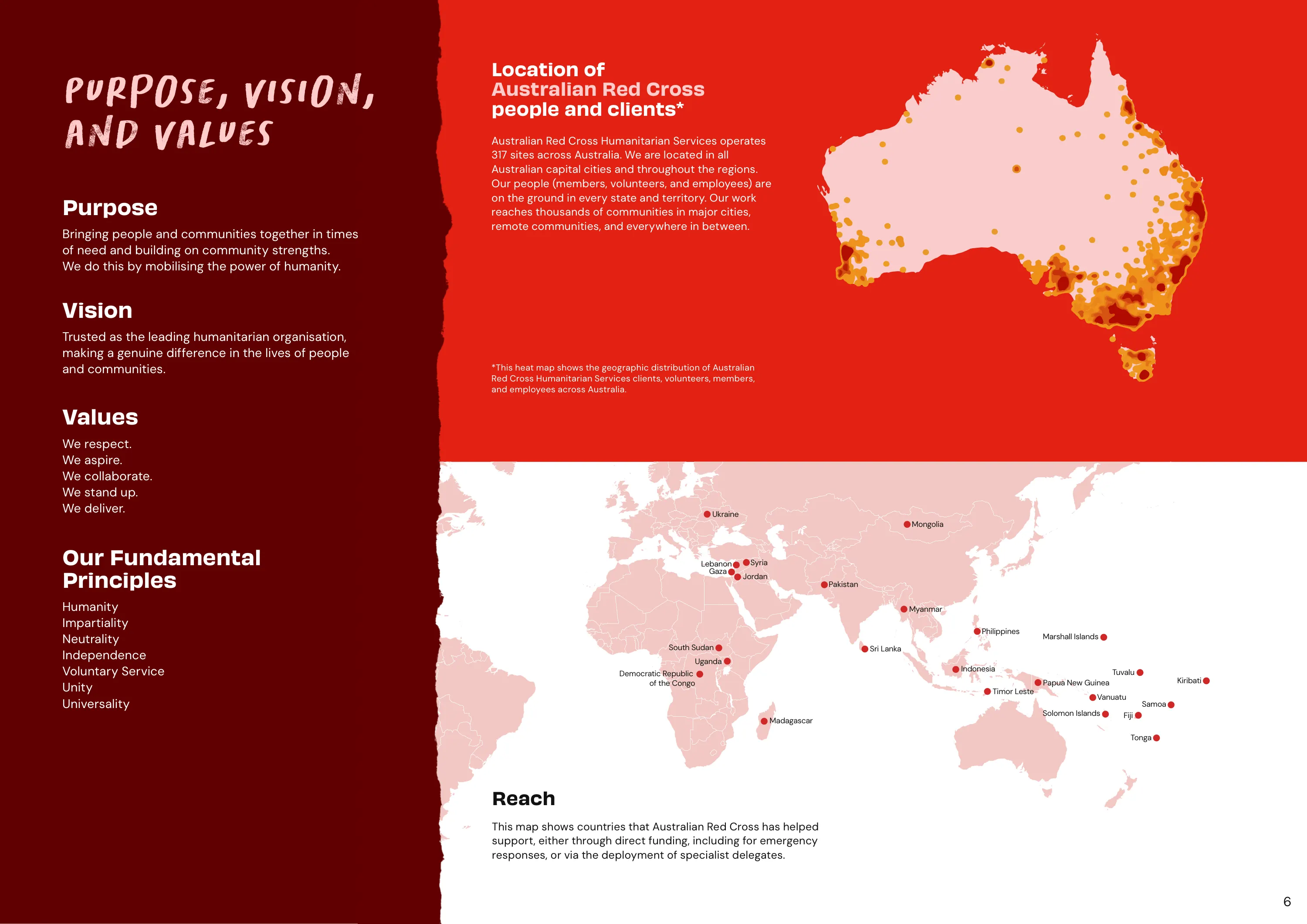
Location of Australian Red Cross people and clients *
Australian Red Cross Humanitarian Services operates 317 sites across Australia. We are located in all Australian capital cities and throughout the regions. Our people (members, volunteers, and employees) are on the ground in every state and territory. Our work reaches thousands of communities in major cities, remote communities, and everywhere in between.
Image description: Heat map of Australia showing where clients, volunteers, members and employees are located. There is activity in every state and territory, and it is most concentrated along the east and south-east coasts, around Adelaide, and in the south-west of Western Australia.
*This heat map shows the geographic distribution of Australian Red Cross Humanitarian Services clients, volunteers, members, and employees across Australia.
Reach
This map shows countries that Australian Red Cross has helped support, either through direct funding, including for emergency responses, or via the deployment of specialist delegates.
Image description: World map marking the countries Australian Red Cross helped support: Ukraine, Lebanon, Gaza, Syria, Jordan, South Sudan, Uganda, Democratic Republic of the Congo, Madagascar, Pakistan, Mongolia, Sri Lanka, Myanmar, Philippines, Indonesia, Timor Leste, Papua New Guinea, Marshall Islands, Solomon Islands, Vanuatu, Fiji, Tuvalu, Kiribati, Samoa and Tonga.
-
Text of page 7
About Australian Red Cross
For 112 years, Australian Red Cross has helped people turn humanity into action. We act locally, connect globally and bring the strength of the world’s largest humanitarian movement into communities across Australia.
You’ll see Australian Red Cross at work in many different places and moments, with our employees, members and volunteers at the heart of it. We have global-to-local expertise in emergencies, migration, International Humanitarian Law and international programs. We have capability in areas including First Aid Mental Health training, community mobilisation, convening and coordination. We have a unique role as an auxiliary to government and public authorities in the humanitarian field.
What connects this work is our shared humanitarian purpose and our Fundamental Principles that set out how we act.
Our commitment to First Nations Centrality seeks to place First Nations knowledge, leadership, values and perspectives at the centre of how we work.
Stronger connections create stronger communities
People today are facing growing disruption, while loss of social connection and isolation is leaving many communities more vulnerable. As these challenges evolve, so must we.
In FY26, we finalised a new organisational strategy designed to respond to the rapidly changing humanitarian landscape and prepare us to achieve greater impact in the future.
The new organisational strategy is anchored in a clear and enduring foundation:
- Purpose: Mobilising the power of humanity
- Vision: Australia’s most trusted, connected humanitarian partner
- Impact ambition: Communities are connected, cohesive, and resilient to disruption
At its heart is a simple idea: stronger connections create stronger communities. When people are connected to one another, and to the knowledge, tools, services and support they need, they’re better able to prepare for challenges, support one another, and recover from disruption.
Because no organisation can solve today’s challenges alone—partnerships are vital. Working alongside communities, governments, researchers, businesses, and humanitarian partners, we can turn shared purpose into meaningful action.
Aligning around what matters most
This strategy is about building on the strengths, expertise, relationships, programs and capabilities that already exist across Australian Red Cross and applying them more intentionally towards shared resilience outcomes.
At the centre of this shift is a recognition that people are the greatest source of resilience in any community. While services, funding and infrastructure all play important roles, it is often people, relationships, knowledge, confidence and collective capability that determine how well communities navigate disruption.
We will continue to deliver support where it is needed, to people and communities who:
- are impacted by crises and disruption
- are vulnerable to exploitation
- experience social isolation or disconnection.
By looking beyond the immediate service being delivered and considering how every interaction can strengthen the foundations of resilience that people and communities draw upon before, during and after disruption, we can create greater impact.
Turning strategy into action
To help us focus on what matters most and maximise our impact, our new organisational strategy brings our collective efforts together across three interconnected Impact Portfolios:
- Social Connection and Cohesion strengthens relationships, participation, sense of being and networks that help people feel connected and communities stay strong through times of uncertainty, enabling communities to act together.
- Risk Reduction helps communities anticipate and understand risks, reduce vulnerability, strengthen preparedness and build their capacity to adapt to changing conditions. Building greater resilience means they will be better able to anticipate and prepare for disruptions.
- Relief and Recovery from Disruption supports communities to navigate disruption, recover, adapt and respond to changing conditions.
Resilient communities are built through collective action and while each portfolio has a distinct role, resilience is created by their combined impact.
By connecting expertise, strengthening collaboration, drawing on diverse perspectives and expanding access to proven approaches, we can increase our impact while remaining responsive to evolving humanitarian needs.
-
Text of page 8
Impact
-
Text of page 9
Emergency services and disasters
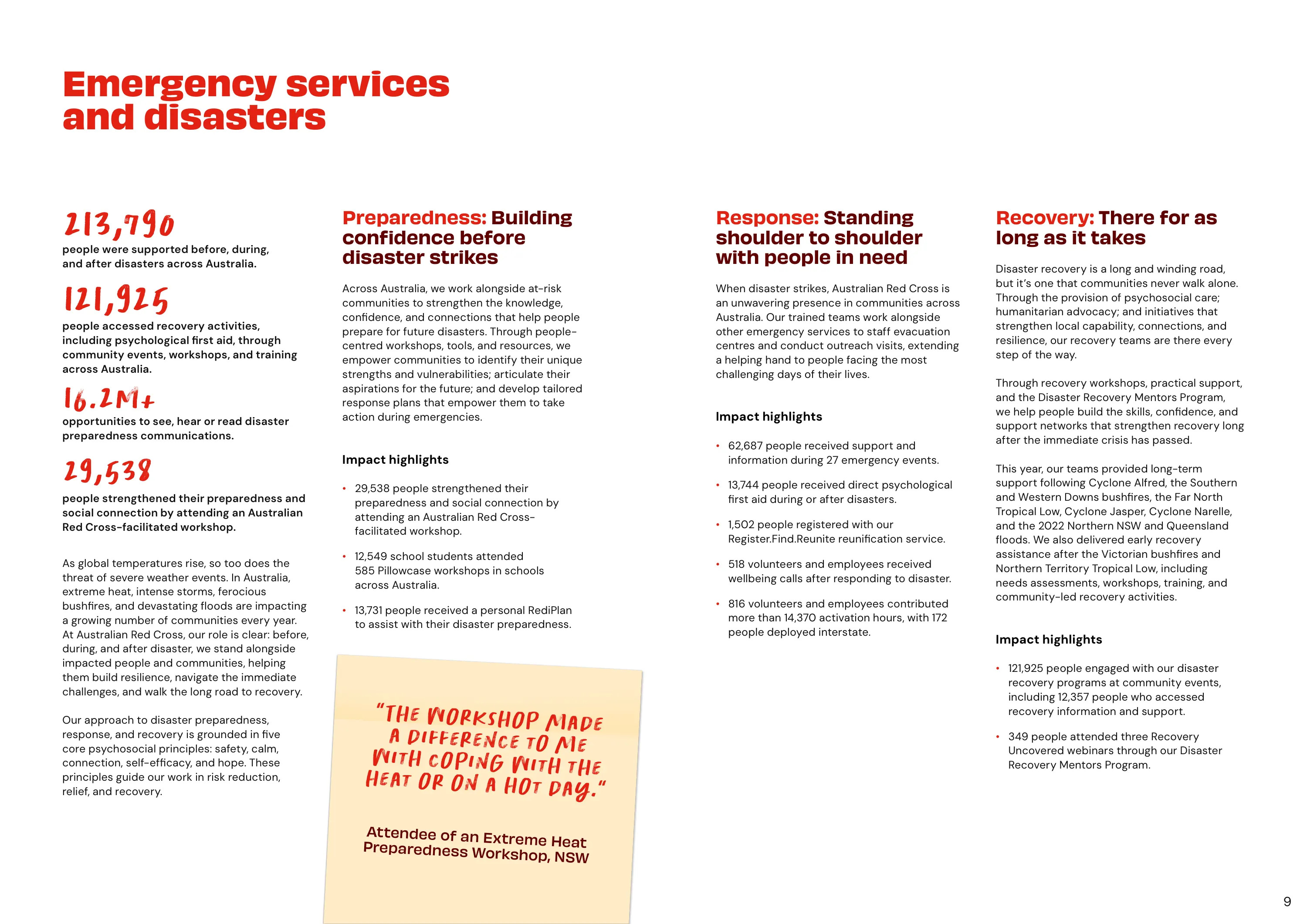
213,790 people were supported before, during, and after disasters across Australia.
121,925 people accessed recovery activities, including psychological first aid, through community events, workshops, and training across Australia.
16.2M+ opportunities to see, hear or read disaster preparedness communications.
29,538 people strengthened their preparedness and social connection by attending an Australian Red Cross-facilitated workshop.
As global temperatures rise, so too does the threat of severe weather events. In Australia, extreme heat, intense storms, ferocious bushfires, and devastating floods are impacting a growing number of communities every year. At Australian Red Cross, our role is clear: before, during, and after disaster, we stand alongside impacted people and communities, helping them build resilience, navigate the immediate challenges, and walk the long road to recovery.
Our approach to disaster preparedness, response, and recovery is grounded in five core psychosocial principles: safety, calm, connection, self-efficacy, and hope. These principles guide our work in risk reduction, relief, and recovery.
Preparedness: Building confidence before disaster strikes
Across Australia, we work alongside at-risk communities to strengthen the knowledge, confidence, and connections that help people prepare for future disasters. Through people-centred workshops, tools, and resources, we empower communities to identify their unique strengths and vulnerabilities; articulate their aspirations for the future; and develop tailored response plans that empower them to take action during emergencies.
Impact highlights
- 29,538 people strengthened their preparedness and social connection by attending an Australian Red Cross-facilitated workshop.
- 12,549 school students attended 585 Pillowcase workshops in schools across Australia.
- 13,731 people received a personal RediPlan to assist with their disaster preparedness.
“The workshop made a difference to me with coping with the heat or on a hot day.”
Attendee of an Extreme Heat Preparedness Workshop, NSW
Response: Standing shoulder to shoulder with people in need
When disaster strikes, Australian Red Cross is an unwavering presence in communities across Australia. Our trained teams work alongside other emergency services to staff evacuation centres and conduct outreach visits, extending a helping hand to people facing the most challenging days of their lives.
Impact highlights
- 62,687 people received support and information during 27 emergency events.
- 13,744 people received direct psychological first aid during or after disasters.
- 1,502 people registered with our Register.Find.Reunite reunification service.
- 518 volunteers and employees received wellbeing calls after responding to disaster.
- 816 volunteers and employees contributed more than 14,370 activation hours, with 172 people deployed interstate.
Recovery: There for as long as it takes
Disaster recovery is a long and winding road, but it’s one that communities never walk alone. Through the provision of psychosocial care; humanitarian advocacy; and initiatives that strengthen local capability, connections, and resilience, our recovery teams are there every step of the way.
Through recovery workshops, practical support, and the Disaster Recovery Mentors Program, we help people build the skills, confidence, and support networks that strengthen recovery long after the immediate crisis has passed.
This year, our teams provided long-term support following Cyclone Alfred, the Southern and Western Downs bushfires, the Far North Tropical Low, Cyclone Jasper, Cyclone Narelle, and the 2022 Northern NSW and Queensland floods. We also delivered early recovery assistance after the Victorian bushfires and Northern Territory Tropical Low, including needs assessments, workshops, training, and community-led recovery activities.
Impact highlights
- 121,925 people engaged with our disaster recovery programs at community events, including 12,357 people who accessed recovery information and support.
- 349 people attended three Recovery Uncovered webinars through our Disaster Recovery Mentors Program.
-
Text of page 10
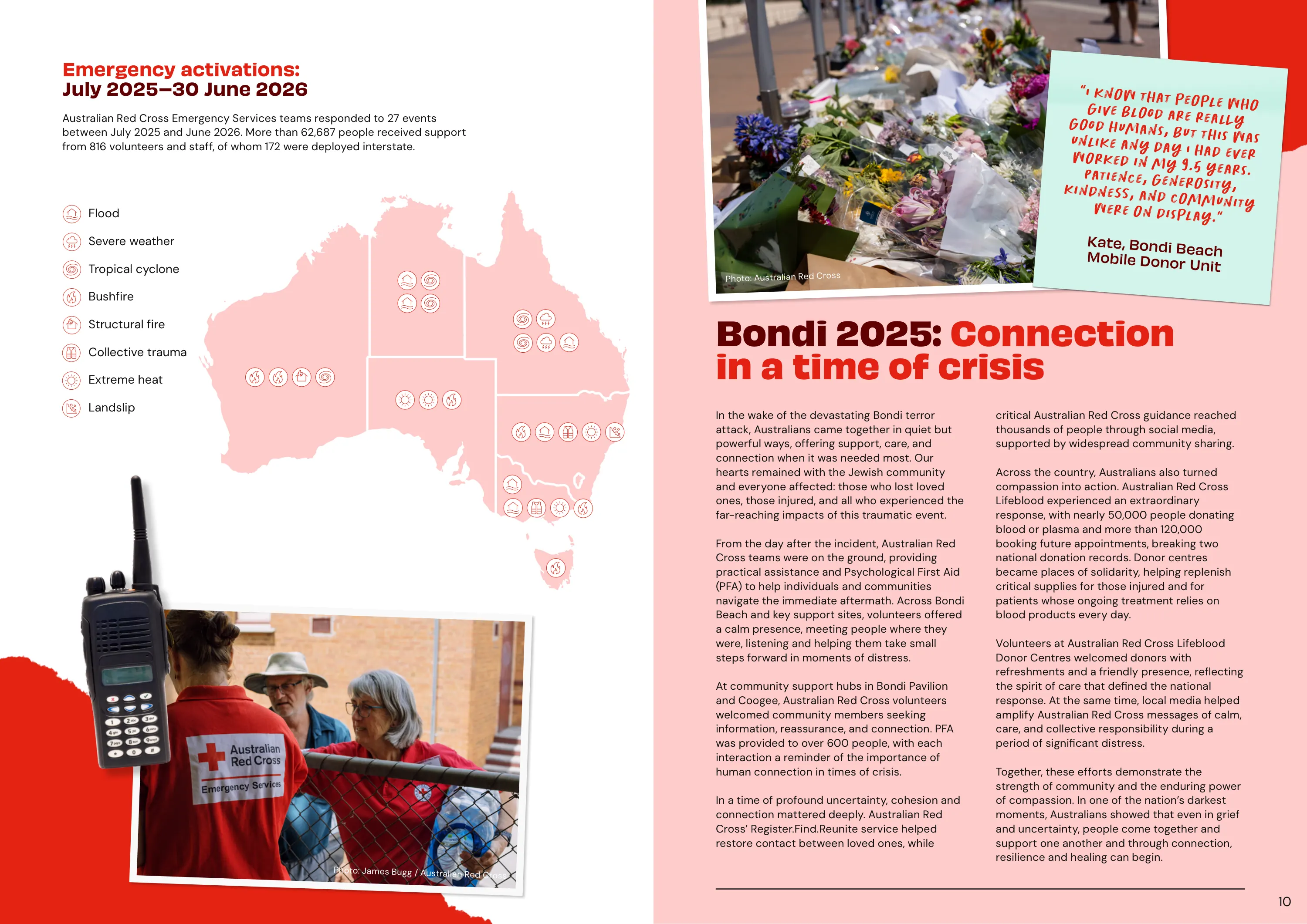
Emergency activations: July 2025–30 June 2026
Australian Red Cross Emergency Services teams responded to 27 events between July 2025 and June 2026. More than 62,687 people received support from 816 volunteers and staff, of whom 172 were deployed interstate.
Image description: Map of Australia with icons in each state and the Northern Territory showing the types of events responded to there. The key lists the event types:
- Flood
- Severe weather
- Tropical cyclone
- Bushfire
- Structural fire
- Collective trauma
- Extreme heat
- Landslip
“I know that people who give blood are really good humans, but this was unlike any day I had ever worked in my 9.5 years. Patience, generosity, kindness, and community were on display.”
Kate, Bondi Beach Mobile Donor Unit
Bondi 2025: Connection in a time of crisis
In the wake of the devastating Bondi terror attack, Australians came together in quiet but powerful ways, offering support, care, and connection when it was needed most. Our hearts remained with the Jewish community and everyone affected: those who lost loved ones, those injured, and all who experienced the far-reaching impacts of this traumatic event.
From the day after the incident, Australian Red Cross teams were on the ground, providing practical assistance and Psychological First Aid (PFA) to help individuals and communities navigate the immediate aftermath. Across Bondi Beach and key support sites, volunteers offered a calm presence, meeting people where they were, listening and helping them take small steps forward in moments of distress.
At community support hubs in Bondi Pavilion and Coogee, Australian Red Cross volunteers welcomed community members seeking information, reassurance, and connection. PFA was provided to over 600 people, with each interaction a reminder of the importance of human connection in times of crisis.
In a time of profound uncertainty, cohesion and connection mattered deeply. Australian Red Cross’ Register.Find.Reunite service helped restore contact between loved ones, while critical Australian Red Cross guidance reached thousands of people through social media, supported by widespread community sharing.
Across the country, Australians also turned compassion into action. Australian Red Cross Lifeblood experienced an extraordinary response, with nearly 50,000 people donating blood or plasma and more than 120,000 booking future appointments, breaking two national donation records. Donor centres became places of solidarity, helping replenish critical supplies for those injured and for patients whose ongoing treatment relies on blood products every day.
Volunteers at Australian Red Cross Lifeblood Donor Centres welcomed donors with refreshments and a friendly presence, reflecting the spirit of care that defined the national response. At the same time, local media helped amplify Australian Red Cross messages of calm, care, and collective responsibility during a period of significant distress.
Together, these efforts demonstrate the strength of community and the enduring power of compassion. In one of the nation’s darkest moments, Australians showed that even in grief and uncertainty, people come together and support one another and through connection, resilience and healing can begin.
-
Text of page 11
Australian Red Cross Lifeblood
8,996 people in Australia joined the stem cell donor registry.
1.2M+ fresh blood products were delivered to hospitals and healthcare providers.
940t of plasma was delivered to CSL Behring for use in life-changing products.
5K+ litres of breast milk were delivered to support some of Australia’s most vulnerable babies.
At Australian Red Cross Lifeblood, our purpose is simple: to deliver life-giving donations for life-changing outcomes. In FY26, the generosity of the Australian community; the dedication of our people and volunteers; and the support of governments, health services, researchers, and industry partners enabled Australian Red Cross Lifeblood to continue providing one of the world’s safest and most reliable supplies of blood, plasma, and other biological products. Together, we ensure that these donations improve health and wellbeing, change lives, and give families precious time with loved ones every day.
Impact highlights
- 607,000+ people provided 1,737,996 individual donations of blood, plasma, and platelets.
- 1,210,205 fresh blood products were delivered to hospitals and healthcare providers for lifesaving medical treatments.
- 940 tonnes of plasma was delivered to CSL Behring for use in life-changing products.
- 82 donor centres are now in operation, with 1 new centre (Cheltenham Donor Centre in Melbourne) opening during the financial year.
- 50,000 donations of blood, plasma, and platelets were made in December 2025, and more than 120,000 future appointments were booked following the Bondi tragedy.
- 5,155 litres (65,442 bottles) of donated breast milk was delivered to support some of Australia’s most vulnerable babies. After expansion to the Northern Territory, donor breast milk distribution is now a national service.
- 8,996 people in Australia joined the stem cell donor registry, offering hope for patients needing a life-saving match.
Giving the gift of humanity
Across the year, more than 607,000 Australians made 1,737,996 donations of blood, plasma, and platelets. These donations helped meet the needs of patients across the country, supported the manufacture of life-changing plasma medicines, and strengthened Australia’s capacity to respond in moments of both everyday need and national crisis. New gender-neutral assessments for people in long-term monogamous relationships made the donation process more inclusive.
For donors, a reason to give
Our enduring campaign, Life is the Reason, continued to connect donors with the lives they help make possible. In March 2026, we launched the campaign’s next evolution. Called Unstoppable, it features the ‘The Unlikely Version’, a reimagining of musical superstar, Sia’s song ‘Unstoppable’ performed by Tina Arena; Ngaiire; and band members Maxwell, Adam, Lara, and Jonathan, all of whom owe their lives to Australian Red Cross Lifeblood’s donors. The campaign deepened emotional connection with Australian Red Cross Lifeblood’s brand and helped inspire more Australians to start donating.
-
Text of page 12
Investing in innovation
Innovation isn’t only about what’s possible today. It’s about creating more options for patients who may face limited treatment choices in the future.
Throughout FY26, Australian Red Cross Lifeblood advanced its lab-grown blood research program, exploring ways to support patients when suitable donated blood is unavailable. Lab-grown red blood cells offering exciting potential for people with rare blood types, younger Australians, and patients requiring frequent transfusions. The program brings together research into cell growth, three-dimensional scaffolds, and red blood cells designed for babies, building capability for future clinical use.
In partnership with Griffith University, Dr Becky Griffiths received a $1.7 million Ideas Grant from the National Health and Medical Research Council. Awarded through a highly competitive program, the funding recognises Australian Red Cross Lifeblood’s contribution to innovation in lab-grown blood and will support work to improve the quality, yield, and affordability of manufactured red cells.
Working with Professor Daniel Kolarich from Griffith University, Australian Red Cross Lifeblood researchers found that adding glycans to two compounds used in cell growth can increase the yield of functional red blood cells by more than 300 per cent. The resulting cells also appeared fitter and more developed.
The funding will help the team understand how glycans influence cell growth and optimise manufacturing conditions. This research strengthens Australian Red Cross Lifeblood’s long-term national capacity to develop high-quality alternatives that complement donor blood and improve access for patients with complex transfusion needs.
Serum eyedrops can be a last-line treatment for people affected by autoimmune disease, transplant complications, or severe dry eye following medical treatment. For some patients, they can mean the difference between daily discomfort and being able to read, drive, and participate fully in life.
In FY26, Australian Red Cross Lifeblood launched Allogeneic Serum Eye Drops (AlloSED). Made from blood donations from male Group AB donors, AlloSED replaces autologous and patient-tailored serum eyedrops. Each donation can support up to three patients for six months, making production more efficient and helping Australian Red Cross Lifeblood respond to growing demand.
Supply is now based on clinical need rather than a patient’s ability to donate their own blood or reach a donor centre, thereby improving equity of access. Through a direct-to-door frozen delivery service, patients can receive treatment wherever they live in Australia.
Developed through years of collaboration across Australian Red Cross Lifeblood and approved by the National Blood Authority, AlloSED demonstrates how donor generosity, clinical expertise, and innovation can come together to improve quality of life for patients nationwide.
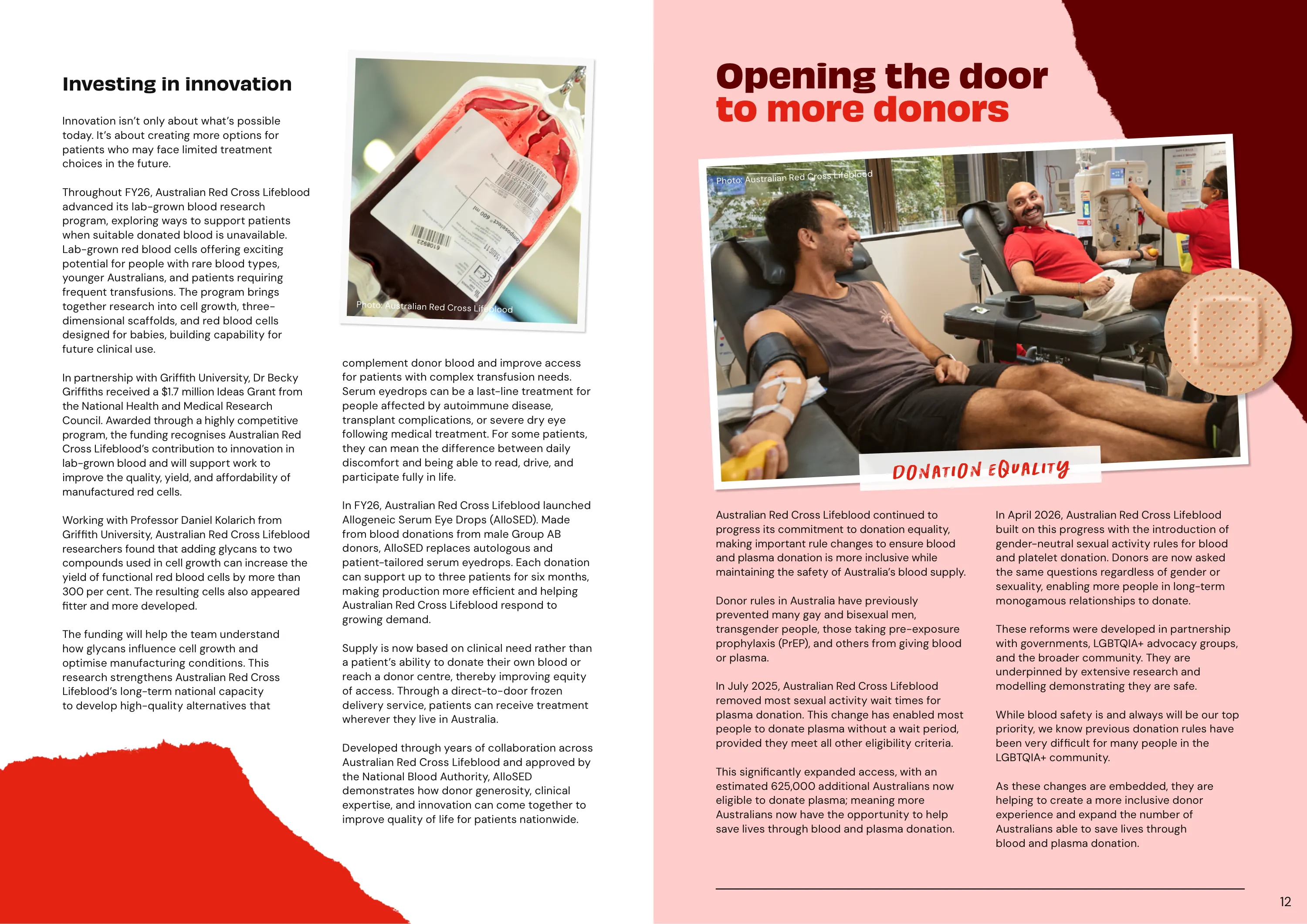
Opening the door to more donors
Australian Red Cross Lifeblood continued to progress its commitment to donation equality, making important rule changes to ensure blood and plasma donation is more inclusive while maintaining the safety of Australia’s blood supply.
Donor rules in Australia have previously prevented many gay and bisexual men, transgender people, those taking pre-exposure prophylaxis (PrEP), and others from giving blood or plasma.
In July 2025, Australian Red Cross Lifeblood removed most sexual activity wait times for plasma donation. This change has enabled most people to donate plasma without a wait period, provided they meet all other eligibility criteria.
This significantly expanded access, with an estimated 625,000 additional Australians now eligible to donate plasma; meaning more Australians now have the opportunity to help save lives through blood and plasma donation.
In April 2026, Australian Red Cross Lifeblood built on this progress with the introduction of gender-neutral sexual activity rules for blood and platelet donation. Donors are now asked the same questions regardless of gender or sexuality, enabling more people in long-term monogamous relationships to donate.
These reforms were developed in partnership with governments, LGBTQIA+ advocacy groups, and the broader community. They are underpinned by extensive research and modelling demonstrating they are safe.
While blood safety is and always will be our top priority, we know previous donation rules have been very difficult for many people in the LGBTQIA+ community.
As these changes are embedded, they are helping to create a more inclusive donor experience and expand the number of Australians able to save lives through blood and plasma donation.
-
Text of page 13
Migration
11,105 people accessed our Work Rights Hub website.
4,624 people participated in In Search of Safety community education sessions.
2,157 refugees from 32 countries who were supported to establish a new home in Australia
35,031 people from 84 countries received direct support, including:
- 3,031 temporary visa holders from 84 countries received a portion of the $4.1 million in financial assistance.
- 226 people who were referred to our migration services by the Australian Federal Police and 151 by our Additional Referral Pathway after experiencing exploitation such as exit trafficking, forced marriage and domestic servitude.
- 745 people who received support via 1,518 Restoring Family Links cases searching for missing people.
Creating pathways to belonging
For people seeking safety in Australia, the journey doesn’t end on arrival. Finding stability, connection and a sense of belonging often takes time. Social programs are key to helping migrants learn about their new environment and build the networks and relationships that will help them feel at home. These programs also prepare the local community to welcome and support newly arrived people and families.
Impact highlights
- 4,908 individuals received support to increase social connection and participation via the Connected Women’s and Connected families Programs (NT & TAS).
- 90% of participants reported increased social and professional connection (NT, NSW & TAS).
- 2,378 clients participated in 243 Health in my Language Program workshops including:
- 47 workshops in Dari/Hazaragi
- 33 workshops in Arabic
- 15 workshops in Spanish
- 13 workshops in Swahili
- 12 workshops in Dinka.
- 4,624 people participated in our In Search of Safety community education sessions (Western Australia and South Australia), including students, teachers, business and higher education professionals, and community groups.
- 377 clients supported from 69 countries accessed the Support for Trafficked People Program, which provides person-centred recovery, safety, and long-term empowerment services for people experiencing exploitation.
Support across the migration journey
The migration process can be long and uncertain, but no one should have to navigate it alone. Our migration programs connect people and families with the support they need to move forward with confidence. From meeting basic needs such as food, shelter, education, and hygiene to helping people navigate resettlement, immigration detention, and family separation, we provide compassionate support and practical advocacy at every stage of the migration journey.
Impact highlights
- 2,157 people from 32 countries were supported throughout their settlement journey within the Humanitarian Settlement Program.
- 99% of refugees program participants felt welcome in Australia.
- 1,075 people secured or maintained their housing, including in 268 properties leased by Australian Red Cross to lower the barriers to entry in the private rental market.
- 445 confidential conversations representing 44% of the detention population were held through our Immigration Detention Monitoring Program, which observes the conditions and treatment of immigration detention in Australia.
- 745 Restoring Family Links cases were managed to search for 1,518 missing people. This global service, delivered by the Red Cross Red Crescent Movement, reconnects loved ones separated by conflict, disasters, and migration.
- A total of 3,031 applications were received during this financial year for Cash and Voucher Assistance, with a total of $4.1 million distributed.
-
Text of page 14
Building connections through employment
Everyone deserves access to safe, dignified, and sustainable work. Our employment-focused migration programs support refugees and migrants in transition to access work and volunteering opportunities that enhance their lives. Through partnerships with businesses, communities, and governments, we create safe and inclusive economic pathways that offer skills development, mentoring, and job-readiness training.
Impact highlights
- 347 clients accessed the Connect, Match, Support resettlement program. 91 found jobs and 51 pursued opportunities for further education (Western Australia & Victoria & Queensland).
- 89% of Connected Women participants reported that the program had a positive impact on their employability, self-employment, and education (Northern Territory & Tasmania).
- 65 people participated in the Kaleidoscope Initiative, a workplace readiness training and mentoring program for migrants (Western Australia).
- 11,105 people accessed the Work Right Hub, an online resource about workers’ rights and staying safe in the workplace.
Improving migration outcomes through research
Better migration outcomes start with a deeper understanding of people›s experiences. That’s why the Red Cross Red Crescent Global Migration Lab conducts research to improve migration policy and humanitarian responses for people experiencing vulnerability. Working with National Societies, the IFRC, the ICRC, and migrants, the Lab delivers evidence-based research that informs advocacy and operational practice worldwide. This year marked the end of Australian Red Cross’s five-year tenure as the Lab’s inaugural host, with leadership transitioning to Swedish Red Cross.
Impact highlights
- 4 reports produced in 3 languages shared the findings of the Missing Migrants project. This collaborative research initiative drew together the ICRC and 17 National Societies across Africa, the Americas, and Europe to examine the risks faced by migrant women and children.
- Growing interest from African National Societies led to a regional project involving 11 countries across East, West, and Central Africa. This project is now providing new insights into migrant experiences along some of the world’s most dangerous migration routes.
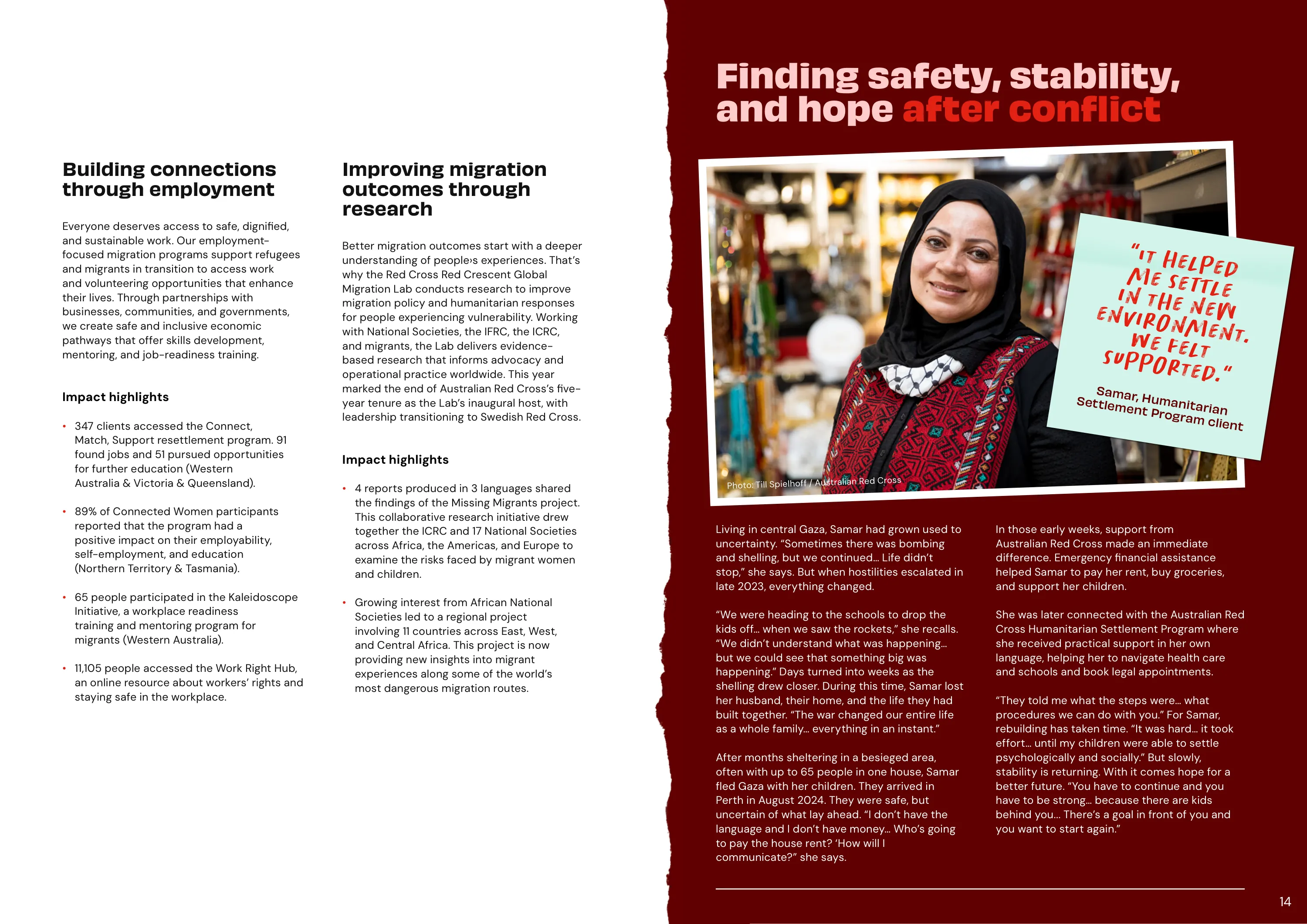
Finding safety, stability, and hope after conflict
“It helped me settle in the new environment. We felt supported.”
Samar, Humanitarian Settlement Program client
Living in central Gaza, Samar had grown used to uncertainty. “Sometimes there was bombing and shelling, but we continued… Life didn’t stop,” she says. But when hostilities escalated in late 2023, everything changed.
“We were heading to the schools to drop the kids off… when we saw the rockets,” she recalls. “We didn’t understand what was happening… but we could see that something big was happening.” Days turned into weeks as the shelling drew closer. During this time, Samar lost her husband, their home, and the life they had built together. “The war changed our entire life as a whole family… everything in an instant.”
After months sheltering in a besieged area, often with up to 65 people in one house, Samar fled Gaza with her children. They arrived in Perth in August 2024. They were safe, but uncertain of what lay ahead. “I don’t have the language and I don’t have money… Who’s going to pay the house rent? ‘How will I communicate?” she says.
In those early weeks, support from Australian Red Cross made an immediate difference. Emergency financial assistance helped Samar to pay her rent, buy groceries, and support her children.
She was later connected with the Australian Red Cross Humanitarian Settlement Program where she received practical support in her own language, helping her to navigate health care and schools and book legal appointments.
“They told me what the steps were… what procedures we can do with you.” For Samar, rebuilding has taken time. “It was hard… it took effort… until my children were able to settle psychologically and socially.” But slowly, stability is returning. With it comes hope for a better future. “You have to continue and you have to be strong… because there are kids behind you... There’s a goal in front of you and you want to start again.”
-
Text of page 15
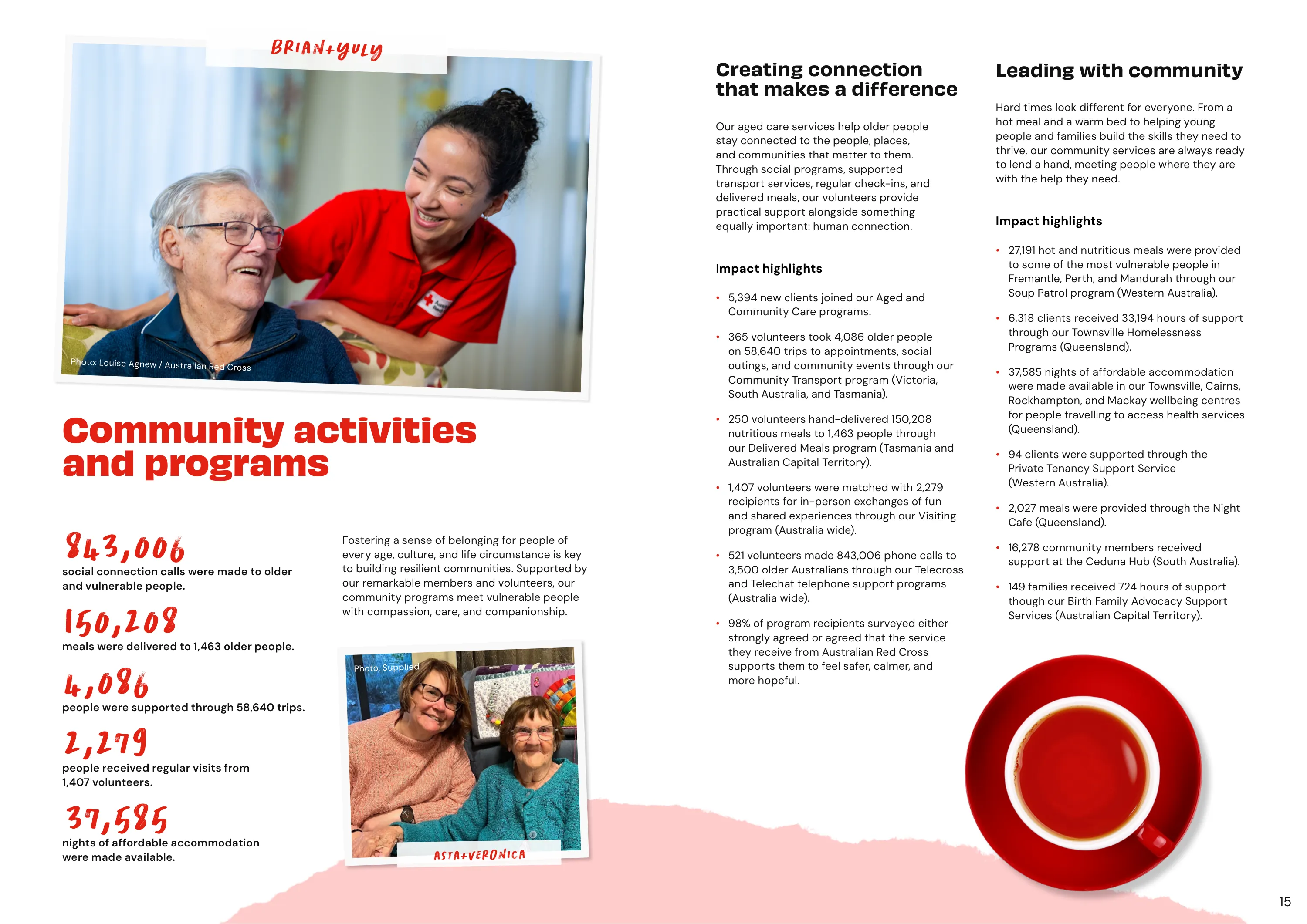
Community activities and programs
843,006 social connection calls were made to older and vulnerable people.
150,208 meals were delivered to 1,463 older people.
4,086 people were supported through 58,640 trips.
2,279 people received regular visits from 1,407 volunteers.
37,585 nights of affordable accommodation were made available.
Fostering a sense of belonging for people of every age, culture, and life circumstance is key to building resilient communities. Supported by our remarkable members and volunteers, our community programs meet vulnerable people with compassion, care, and companionship.
Creating connection that makes a difference
Our aged care services help older people stay connected to the people, places, and communities that matter to them. Through social programs, supported transport services, regular check-ins, and delivered meals, our volunteers provide practical support alongside something equally important: human connection.
Impact highlights
- 5,394 new clients joined our Aged and Community Care programs.
- 365 volunteers took 4,086 older people on 58,640 trips to appointments, social outings, and community events through our Community Transport program (Victoria, South Australia, and Tasmania).
- 250 volunteers hand-delivered 150,208 nutritious meals to 1,463 people through our Delivered Meals program (Tasmania and Australian Capital Territory).
- 1,407 volunteers were matched with 2,279 recipients for in-person exchanges of fun and shared experiences through our Visiting program (Australia wide).
- 521 volunteers made 843,006 phone calls to 3,500 older Australians through our Telecross and Telechat telephone support programs (Australia wide).
- 98% of program recipients surveyed either strongly agreed or agreed that the service they receive from Australian Red Cross supports them to feel safer, calmer, and more hopeful.
Leading with community
Hard times look different for everyone. From a hot meal and a warm bed to helping young people and families build the skills they need to thrive, our community services are always ready to lend a hand, meeting people where they are with the help they need.
Impact highlights
- 27,191 hot and nutritious meals were provided to some of the most vulnerable people in Fremantle, Perth, and Mandurah through our Soup Patrol program (Western Australia).
- 6,318 clients received 33,194 hours of support through our Townsville Homelessness Programs (Queensland).
- 37,585 nights of affordable accommodation were made available in our Townsville, Cairns, Rockhampton, and Mackay wellbeing centres for people travelling to access health services (Queensland).
- 94 clients were supported through the Private Tenancy Support Service (Western Australia).
- 2,027 meals were provided through the Night Cafe (Queensland).
- 16,278 community members received support at the Ceduna Hub (South Australia).
- 149 families received 724 hours of support though our Birth Family Advocacy Support Services (Australian Capital Territory).
-
Text of page 16
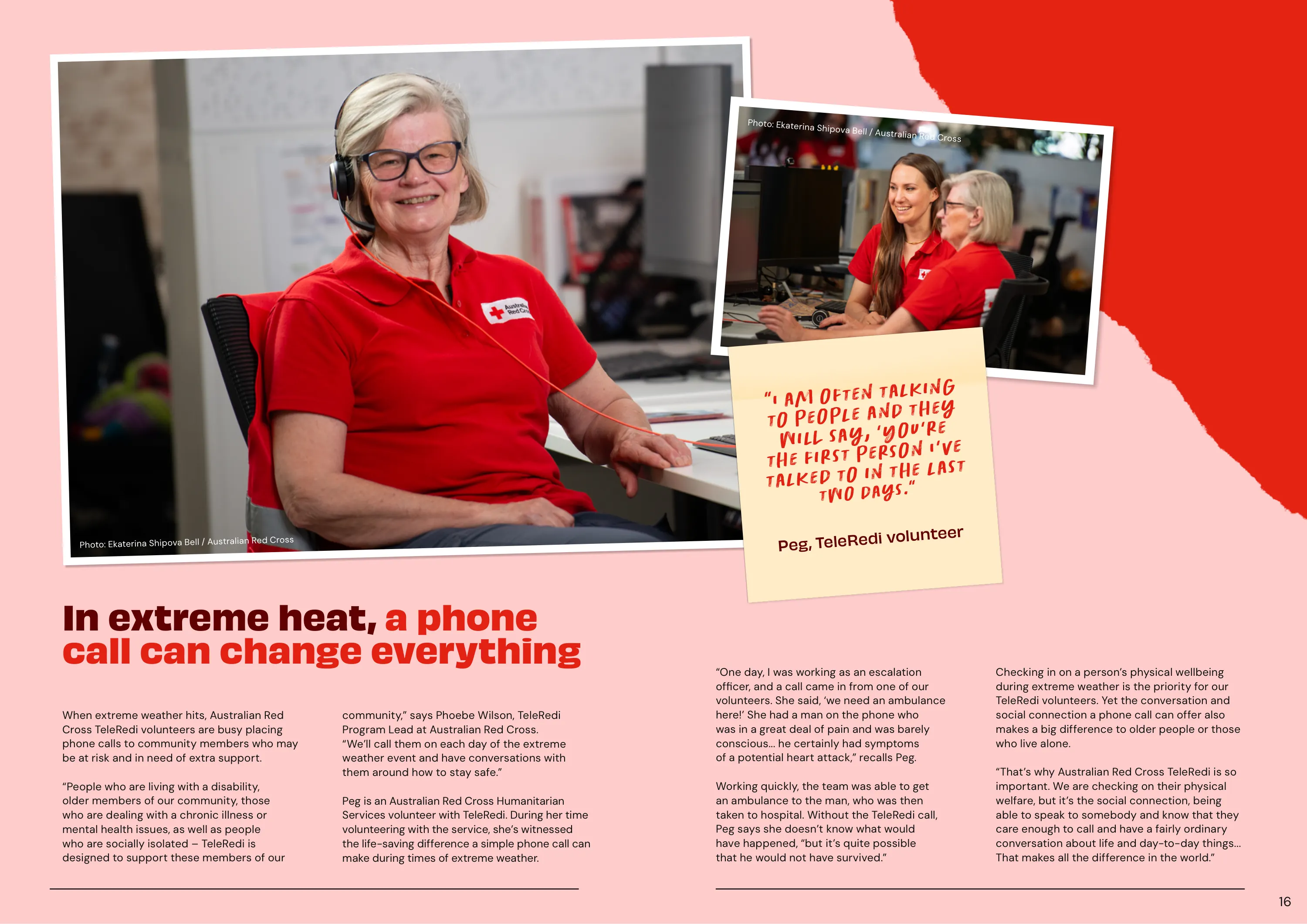
In extreme heat, a phone call can change everything
When extreme weather hits, Australian Red Cross TeleRedi volunteers are busy placing phone calls to community members who may be at risk and in need of extra support.
“People who are living with a disability, older members of our community, those who are dealing with a chronic illness or mental health issues, as well as people who are socially isolated – TeleRedi is designed to support these members of our community,” says Phoebe Wilson, TeleRedi Program Lead at Australian Red Cross. “We’ll call them on each day of the extreme weather event and have conversations with them around how to stay safe.”
Peg is an Australian Red Cross Humanitarian Services volunteer with TeleRedi. During her time volunteering with the service, she’s witnessed the life-saving difference a simple phone call can make during times of extreme weather.
“I am often talking to people and they will say, ‘You’re the first person I’ve talked to in the last two days.”
Peg, TeleRedi volunteer
“One day, I was working as an escalation officer, and a call came in from one of our volunteers. She said, ‘we need an ambulance here!’ She had a man on the phone who was in a great deal of pain and was barely conscious... he certainly had symptoms of a potential heart attack,” recalls Peg.
Working quickly, the team was able to get an ambulance to the man, who was then taken to hospital. Without the TeleRedi call, Peg says she doesn’t know what would have happened, “but it’s quite possible that he would not have survived.”
Checking in on a person’s physical wellbeing during extreme weather is the priority for our TeleRedi volunteers. Yet the conversation and social connection a phone call can offer also makes a big difference to older people or those who live alone.
“That’s why Australian Red Cross TeleRedi is so important. We are checking on their physical welfare, but it’s the social connection, being able to speak to somebody and know that they care enough to call and have a fairly ordinary conversation about life and day-to-day things... That makes all the difference in the world.”
-
Text of page 17
International programs
$9.6m in humanitarian funding was mobilised to support responses to major international disasters and armed conflicts, including in Ukraine, the Middle East, and the Ebola response in the Democratic Republic of the Congo and Uganda.
4.7t of humanitarian aid products were provided to Solomon Islands as part of the Tropical Cyclone Maila response.
44 Australian Red Cross international delegates were deployed to 26 countries.
19 international disaster and crisis response operations received Australian Red Cross support.
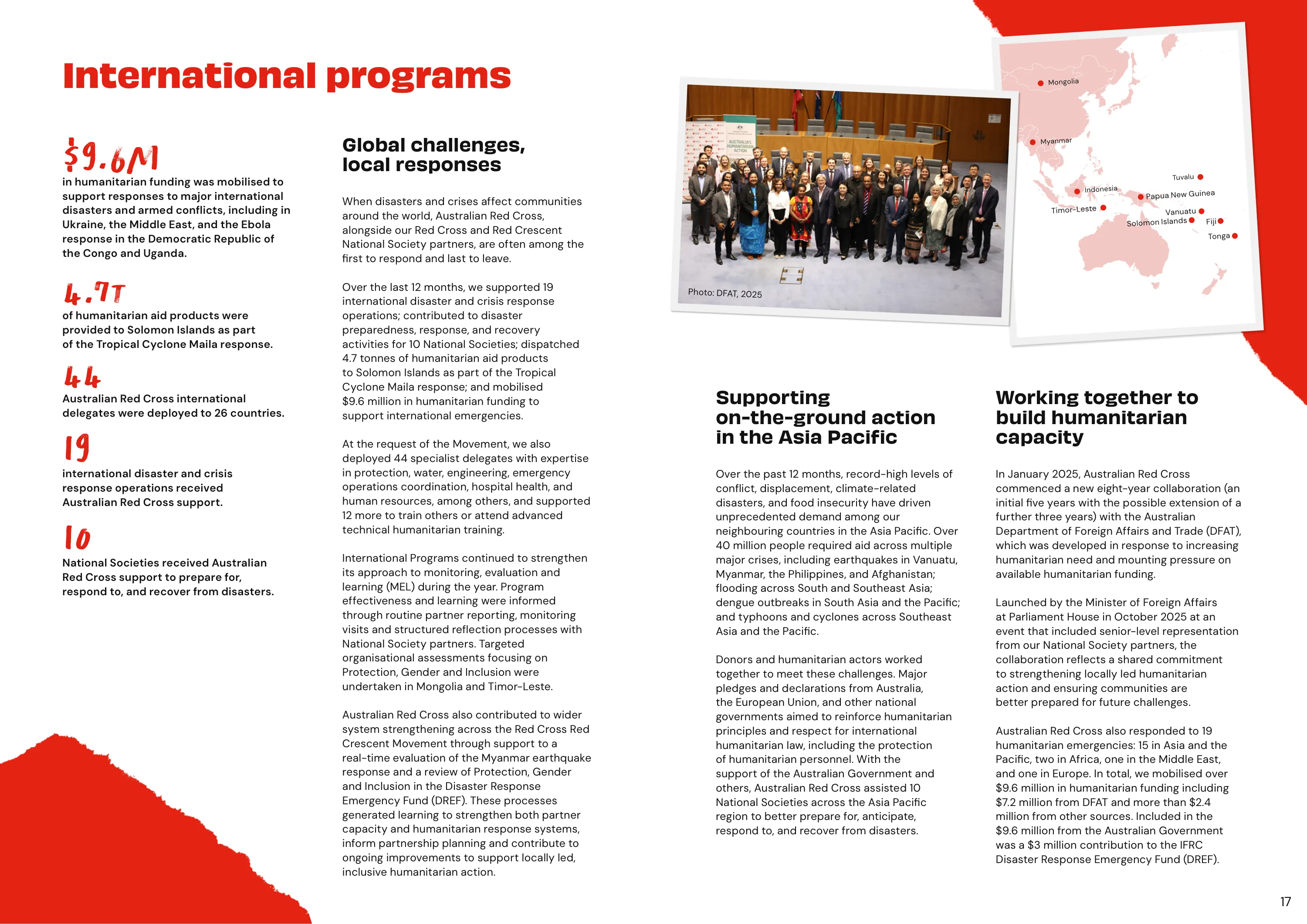
10 National Societies received Australian Red Cross support to prepare for, respond to, and recover from disasters.
Global challenges, local responses
When disasters and crises affect communities around the world, Australian Red Cross, alongside our Red Cross and Red Crescent National Society partners, are often among the first to respond and last to leave.
Over the last 12 months, we supported 19 international disaster and crisis response operations; contributed to disaster preparedness, response, and recovery activities for 10 National Societies; dispatched 4.7 tonnes of humanitarian aid products to Solomon Islands as part of the Tropical Cyclone Maila response; and mobilised $9.6 million in humanitarian funding to support international emergencies.
At the request of the Movement, we also deployed 44 specialist delegates with expertise in protection, water, engineering, emergency operations coordination, hospital health, and human resources, among others, and supported 12 more to train others or attend advanced technical humanitarian training.
International Programs continued to strengthen its approach to monitoring, evaluation and learning (MEL) during the year. Program effectiveness and learning were informed through routine partner reporting, monitoring visits and structured reflection processes with National Society partners. Targeted organisational assessments focusing on Protection, Gender and Inclusion were undertaken in Mongolia and Timor-Leste.
Australian Red Cross also contributed to wider system strengthening across the Red Cross Red Crescent Movement through support to a real-time evaluation of the Myanmar earthquake response and a review of Protection, Gender and Inclusion in the Disaster Response Emergency Fund (DREF). These processes generated learning to strengthen both partner capacity and humanitarian response systems, inform partnership planning and contribute to ongoing improvements to support locally led, inclusive humanitarian action.
Image description: Map of Asia and the Pacific marking the 10 countries whose National Societies Australian Red Cross supported: Mongolia, Myanmar, Indonesia, Timor-Leste, Papua New Guinea, Solomon Islands, Vanuatu, Fiji, Tuvalu and Tonga.
Supporting on-the-ground action in the Asia Pacific
Over the past 12 months, record-high levels of conflict, displacement, climate-related disasters, and food insecurity have driven unprecedented demand among our neighbouring countries in the Asia Pacific. Over 40 million people required aid across multiple major crises, including earthquakes in Vanuatu, Myanmar, the Philippines, and Afghanistan; flooding across South and Southeast Asia; dengue outbreaks in South Asia and the Pacific; and typhoons and cyclones across Southeast Asia and the Pacific.
Donors and humanitarian actors worked together to meet these challenges. Major pledges and declarations from Australia, the European Union, and other national governments aimed to reinforce humanitarian principles and respect for international humanitarian law, including the protection of humanitarian personnel. With the support of the Australian Government and others, Australian Red Cross assisted 10 National Societies across the Asia Pacific region to better prepare for, anticipate, respond to, and recover from disasters.
Working together to build humanitarian capacity
In January 2025, Australian Red Cross commenced a new eight-year collaboration (an initial five years with the possible extension of a further three years) with the Australian Department of Foreign Affairs and Trade (DFAT), which was developed in response to increasing humanitarian need and mounting pressure on available humanitarian funding.
Launched by the Minister of Foreign Affairs at Parliament House in October 2025 at an event that included senior-level representation from our National Society partners, the collaboration reflects a shared commitment to strengthening locally led humanitarian action and ensuring communities are better prepared for future challenges.
Australian Red Cross also responded to 19 humanitarian emergencies: 15 in Asia and the Pacific, two in Africa, one in the Middle East, and one in Europe. In total, we mobilised over $9.6 million in humanitarian funding including $7.2 million from DFAT and more than $2.4 million from other sources. Included in the $9.6 million from the Australian Government was a $3 million contribution to the IFRC Disaster Response Emergency Fund (DREF).
-
Text of page 18
When water becomes hope
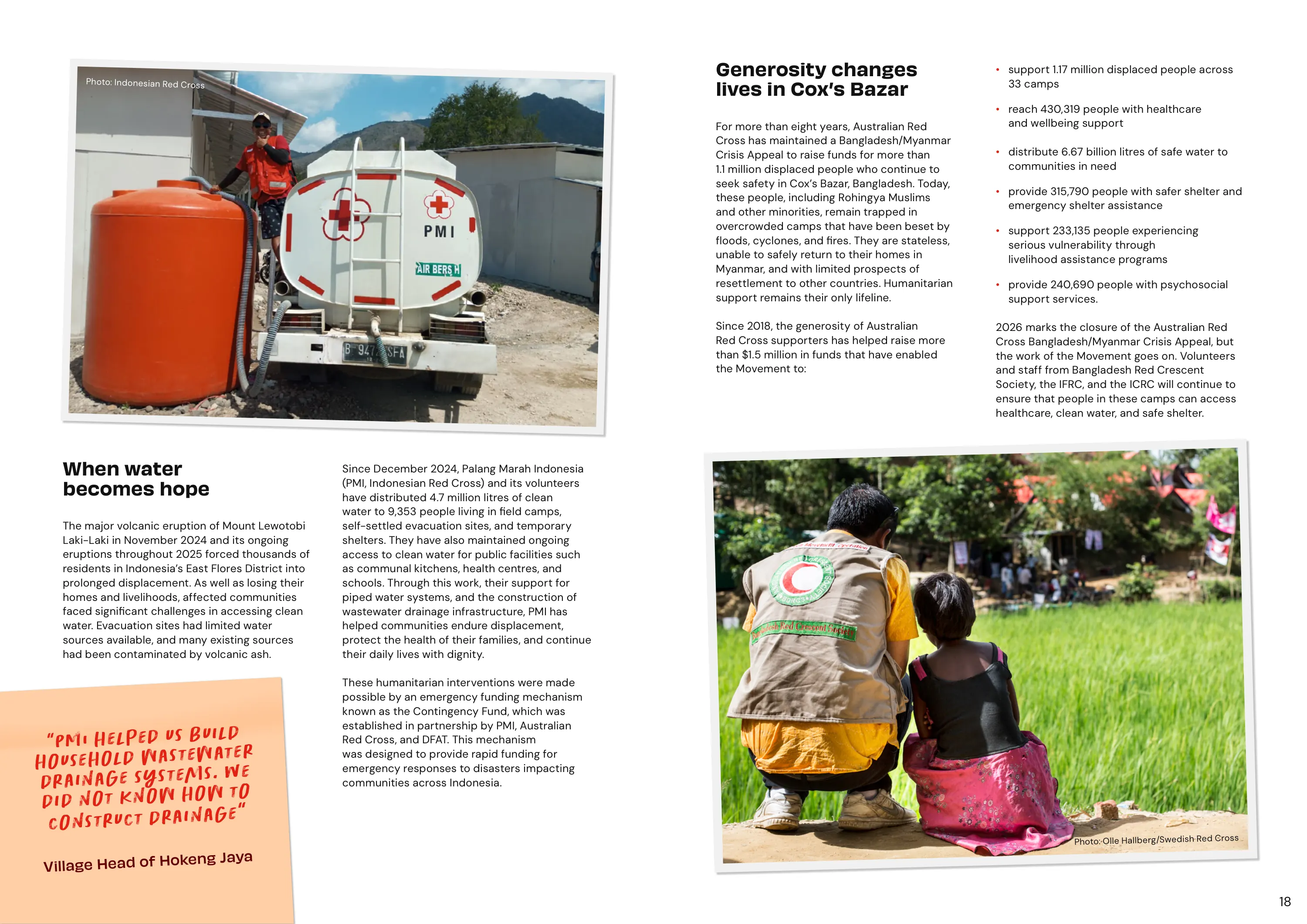
The major volcanic eruption of Mount Lewotobi Laki-Laki in November 2024 and its ongoing eruptions throughout 2025 forced thousands of residents in Indonesia’s East Flores District into prolonged displacement. As well as losing their homes and livelihoods, affected communities faced significant challenges in accessing clean water. Evacuation sites had limited water sources available, and many existing sources had been contaminated by volcanic ash.
“PMI helped us build household wastewater drainage systems. We did not know how to construct drainage”
Village Head of Hokeng Jaya
Since December 2024, Palang Marah Indonesia (PMI, Indonesian Red Cross) and its volunteers have distributed 4.7 million litres of clean water to 9,353 people living in field camps, self-settled evacuation sites, and temporary shelters. They have also maintained ongoing access to clean water for public facilities such as communal kitchens, health centres, and schools. Through this work, their support for piped water systems, and the construction of wastewater drainage infrastructure, PMI has helped communities endure displacement, protect the health of their families, and continue their daily lives with dignity.
These humanitarian interventions were made possible by an emergency funding mechanism known as the Contingency Fund, which was established in partnership by PMI, Australian Red Cross, and DFAT. This mechanism was designed to provide rapid funding for emergency responses to disasters impacting communities across Indonesia.
Generosity changes lives in Cox’s Bazar
For more than eight years, Australian Red Cross has maintained a Bangladesh/Myanmar Crisis Appeal to raise funds for more than 1.1 million displaced people who continue to seek safety in Cox’s Bazar, Bangladesh. Today, these people, including Rohingya Muslims and other minorities, remain trapped in overcrowded camps that have been beset by floods, cyclones, and fires. They are stateless, unable to safely return to their homes in Myanmar, and with limited prospects of resettlement to other countries. Humanitarian support remains their only lifeline.
Since 2018, the generosity of Australian Red Cross supporters has helped raise more than $1.5 million in funds that have enabled the Movement to:
- support 1.17 million displaced people across 33 camps
- reach 430,319 people with healthcare and wellbeing support
- distribute 6.67 billion litres of safe water to communities in need
- provide 315,790 people with safer shelter and emergency shelter assistance
- support 233,135 people experiencing serious vulnerability through livelihood assistance programs
- provide 240,690 people with psychosocial support services.
2026 marks the closure of the Australian Red Cross Bangladesh/Myanmar Crisis Appeal, but the work of the Movement goes on. Volunteers and staff from Bangladesh Red Crescent Society, the IFRC, and the ICRC will continue to ensure that people in these camps can access healthcare, clean water, and safe shelter.
-
Text of page 19
Supporting dengue responses in the Pacific
In 2025, the highest recorded levels of dengue fever in years strained hospital services, blood supplies, and public health resources in many Pacific Island countries. Through the Australian Red Cross Asia Pacific Response Flexible Fund, National Societies in three countries reached more than 5,400 people with rapid, locally led responses:
- In Samoa, the Red Cross launched its first Cash and Voucher Assistance (CVA) program, supporting over 1,500 people. During dengue outbreaks, cash assistance can help households meet additional expenses, such as transport to health facilities, medical care, and mosquito prevention, and prioritise their individual needs. A CVA technical specialist was also deployed to help Samoa Red Cross implement the CVA program, building capacity for future cash responses.
- In Kiribati, Red Cross teams reached over 2,000 people by distributing 1,200 mosquito nets, mobilising young people through a community clean-up initiative, and delivering public health awareness sessions to reduce dengue transmission risks.
- In Tuvalu, Red Cross staff and volunteers distributed mosquito nets and conducted community awareness sessions, reaching more than 1,900 people. Staff also received Protection, Gender and Inclusion training that strengthened their capacity to deliver a safe, accessible, and inclusive dengue response, ensuring that prevention information reached people who might otherwise have faced barriers to access.
Across all three countries, flexible funding enabled timely, locally led responses while building the foundations for more effective future emergency preparedness and response.
Supporting our Movement partners in the Middle East
The ongoing conflict in the Middle East continued to drive immense humanitarian need this year. Australian Red Cross maintained our longstanding support of the ICRC in the Occupied Palestinian Territory through the provision of funding and specialist medical delegates.
In Gaza, these contributions helped sustain the Red Cross Field Hospital in Rafah where teams treat hundreds of patients each day. They work shoulder to shoulder with local health professionals to provide emergency care, maternal and paediatric services, and critical mental health support in one of the world’s most complex operating contexts. Since 1 July, we have deployed seven delegates into the Middle East Crisis, six into the Rafah field hospital, and one to support the response to the escalation of conflict in Iran.
Beyond Gaza, we continued to stand in solidarity with Movement partners, including the Iranian Red Crescent Society, Magen David Adom in Israel, and the Lebanese Red Cross, who responded to the most recent escalations across the region. Our Middle East Crisis Appeal enabled us to deploy a Human Resources in Emergencies Officer to the IFRC Operation in Jordan to support the recruitment, onboarding, and wellbeing of national and international surge staff.
Two Australian Red Cross nursing delegates, Anne Maree Furner and Jean-Philippe (JP) Miller, were awarded the prestigious Florence Nightingale Medal. Considered the highest international award for nurses, the medal recognises exceptional courage, devotion, and service by a nurse in situations of armed conflict, disaster, and profound human need. Between them, Anne-Maree and JP have completed 23 Red Cross international deployments to locations including Palestine, Myanmar, Nigeria, South Sudan, and Syria.
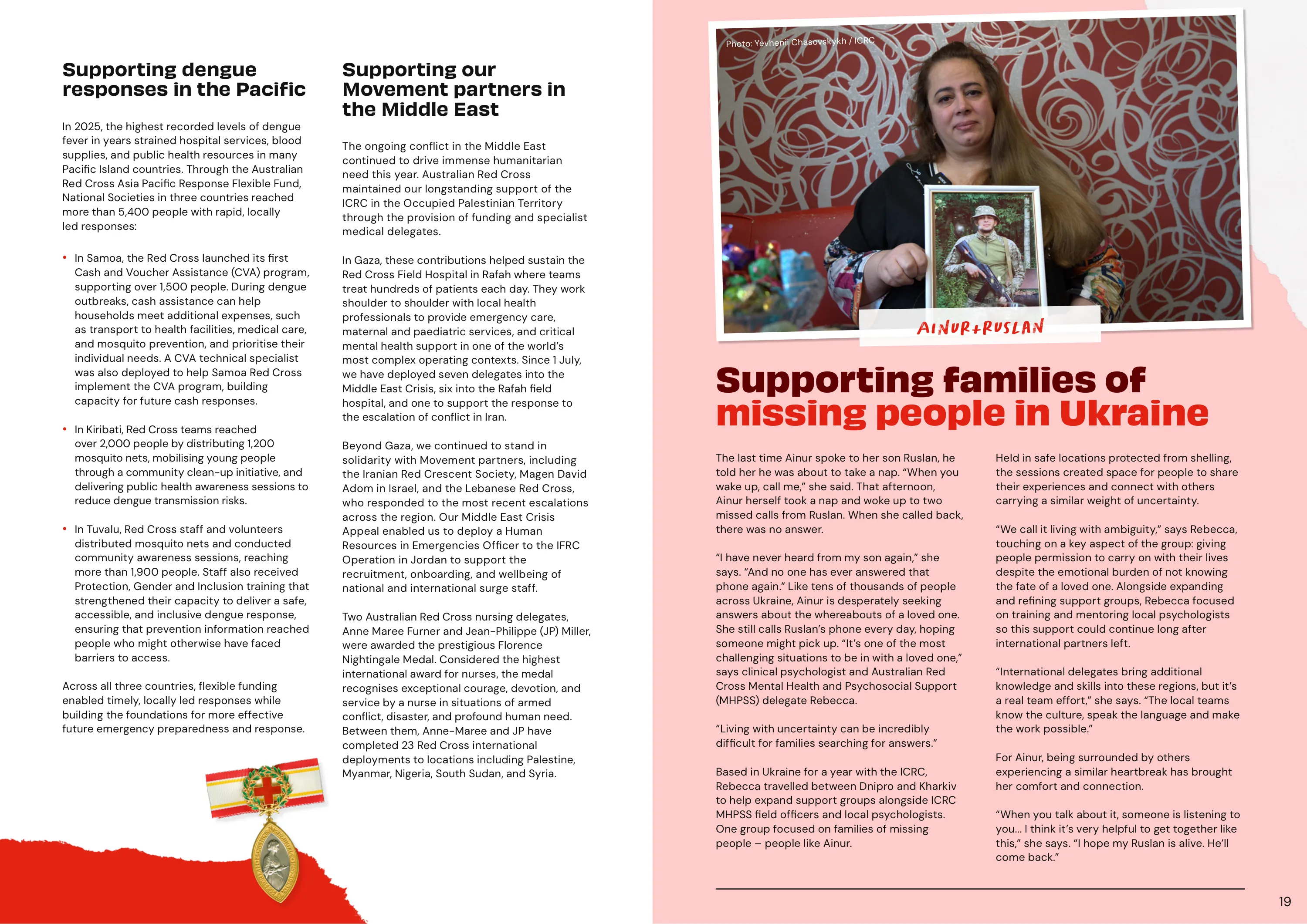
Supporting families of missing people in Ukraine
The last time Ainur spoke to her son Ruslan, he told her he was about to take a nap. “When you wake up, call me,” she said. That afternoon, Ainur herself took a nap and woke up to two missed calls from Ruslan. When she called back, there was no answer.
“I have never heard from my son again,” she says. “And no one has ever answered that phone again.” Like tens of thousands of people across Ukraine, Ainur is desperately seeking answers about the whereabouts of a loved one. She still calls Ruslan’s phone every day, hoping someone might pick up. “It’s one of the most challenging situations to be in with a loved one,” says clinical psychologist and Australian Red Cross Mental Health and Psychosocial Support (MHPSS) delegate Rebecca.
“Living with uncertainty can be incredibly difficult for families searching for answers.”
Based in Ukraine for a year with the ICRC, Rebecca travelled between Dnipro and Kharkiv to help expand support groups alongside ICRC MHPSS field officers and local psychologists. One group focused on families of missing people – people like Ainur.
Held in safe locations protected from shelling, the sessions created space for people to share their experiences and connect with others carrying a similar weight of uncertainty.
“We call it living with ambiguity,” says Rebecca, touching on a key aspect of the group: giving people permission to carry on with their lives despite the emotional burden of not knowing the fate of a loved one. Alongside expanding and refining support groups, Rebecca focused on training and mentoring local psychologists so this support could continue long after international partners left.
“International delegates bring additional knowledge and skills into these regions, but it’s a real team effort,” she says. “The local teams know the culture, speak the language and make the work possible.”
For Ainur, being surrounded by others experiencing a similar heartbreak has brought her comfort and connection.
“When you talk about it, someone is listening to you... I think it’s very helpful to get together like this,” she says. “I hope my Ruslan is alive. He’ll come back.”
-
Text of page 20
International Humanitarian Law
Australia might be far from global conflict zones, but Australian Red Cross plays an important role in promoting awareness of and respect for international humanitarian law (IHL). Also known as the laws of war, IHL seeks to limit the impact of armed conflict by protecting those who are not, or are no longer, taking part in the hostilities, and restricting the ways in which wars may be fought. Our IHL experts collaborate with local actors who have a footprint in armed conflict, including those in the business, government, military, and humanitarian sectors, to help them understand IHL and its relevance to their work.
Championing responsible business practice
Operating in proximity to armed conflict requires organisations to understand and commit to upholding the principles of IHL. One of our key areas of focus is working with Australian private sector companies who operate in these environments, creating opportunities to explore their IHL risks and responsibilities.
Impact highlights
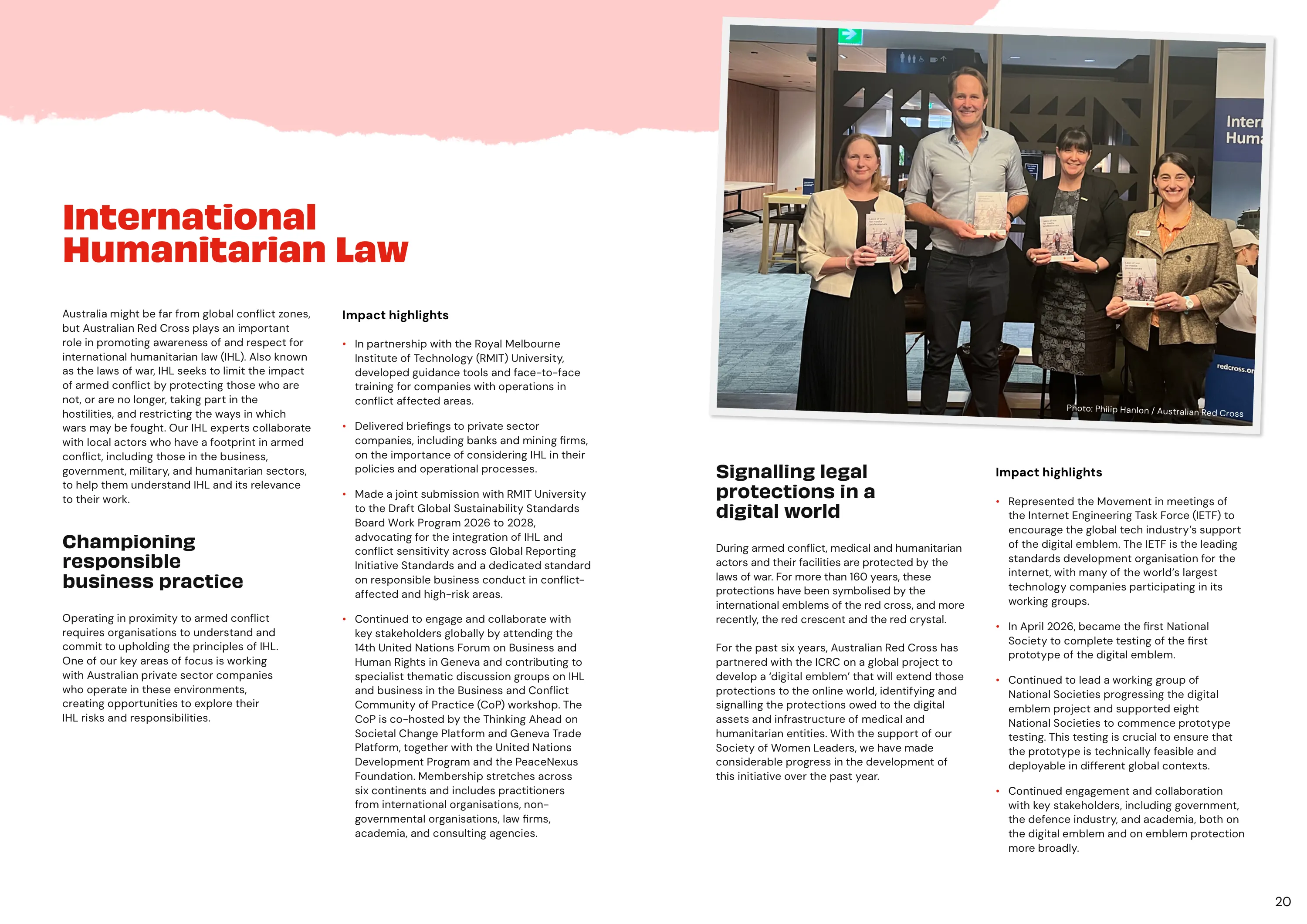
- In partnership with the Royal Melbourne Institute of Technology (RMIT) University, developed guidance tools and face-to-face training for companies with operations in conflict affected areas.
- Delivered briefings to private sector companies, including banks and mining firms, on the importance of considering IHL in their policies and operational processes.
- Made a joint submission with RMIT University to the Draft Global Sustainability Standards Board Work Program 2026 to 2028, advocating for the integration of IHL and conflict sensitivity across Global Reporting Initiative Standards and a dedicated standard on responsible business conduct in conflict-affected and high-risk areas.
- Continued to engage and collaborate with key stakeholders globally by attending the 14th United Nations Forum on Business and Human Rights in Geneva and contributing to specialist thematic discussion groups on IHL and business in the Business and Conflict Community of Practice (CoP) workshop. The CoP is co-hosted by the Thinking Ahead on Societal Change Platform and Geneva Trade Platform, together with the United Nations Development Program and the PeaceNexus Foundation. Membership stretches across six continents and includes practitioners from international organisations, non-governmental organisations, law firms, academia, and consulting agencies.
Signalling legal protections in a digital world
During armed conflict, medical and humanitarian actors and their facilities are protected by the laws of war. For more than 160 years, these protections have been symbolised by the international emblems of the red cross, and more recently, the red crescent and the red crystal.
For the past six years, Australian Red Cross has partnered with the ICRC on a global project to develop a ‘digital emblem’ that will extend those protections to the online world, identifying and signalling the protections owed to the digital assets and infrastructure of medical and humanitarian entities. With the support of our Society of Women Leaders, we have made considerable progress in the development of this initiative over the past year.
Impact highlights
- Represented the Movement in meetings of the Internet Engineering Task Force (IETF) to encourage the global tech industry’s support of the digital emblem. The IETF is the leading standards development organisation for the internet, with many of the world’s largest technology companies participating in its working groups.
- In April 2026, became the first National Society to complete testing of the first prototype of the digital emblem.
- Continued to lead a working group of National Societies progressing the digital emblem project and supported eight National Societies to commence prototype testing. This testing is crucial to ensure that the prototype is technically feasible and deployable in different global contexts.
- Continued engagement and collaboration with key stakeholders, including government, the defence industry, and academia, both on the digital emblem and on emblem protection more broadly.
-
Text of page 21
Speaking up for the laws of war
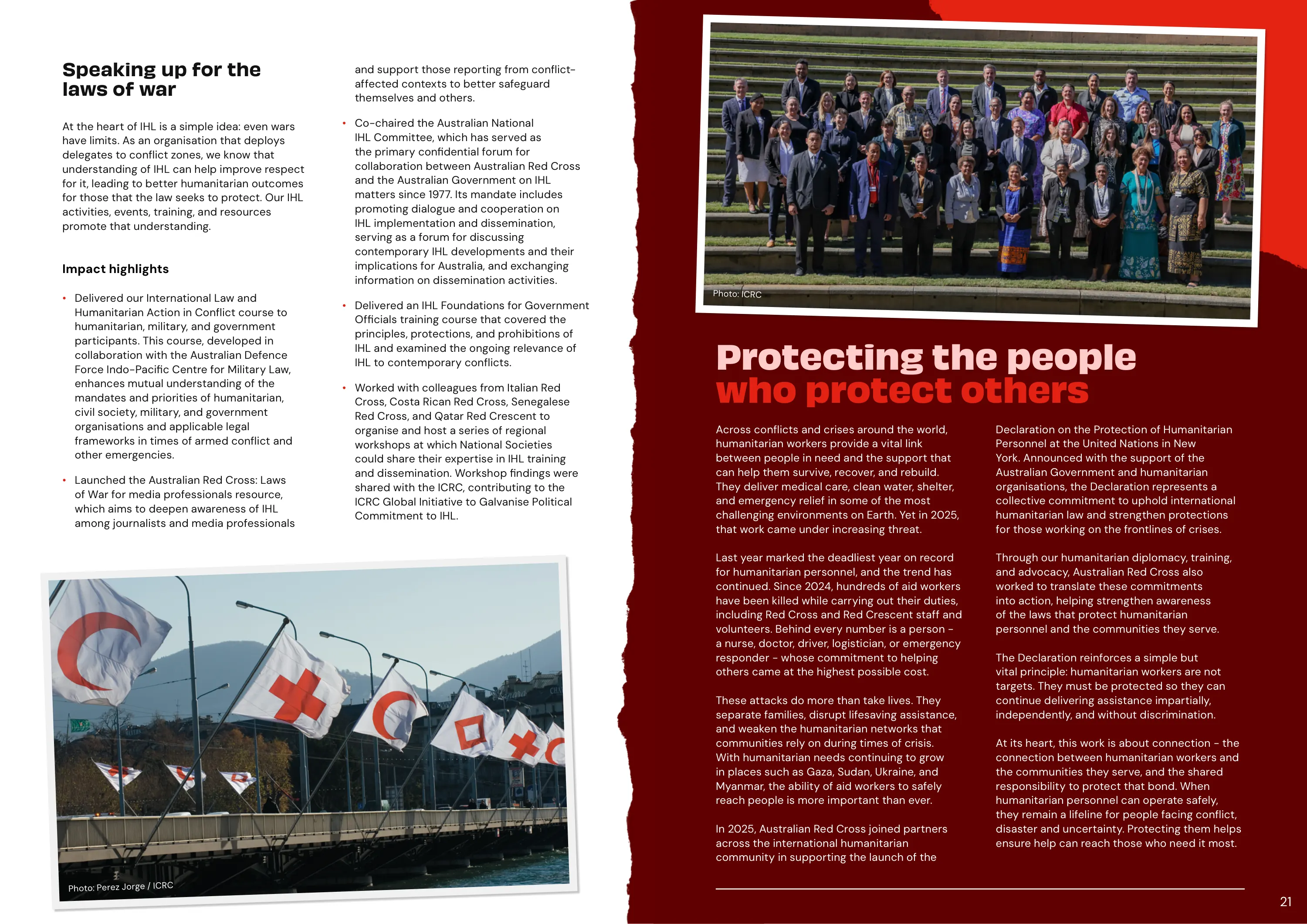
At the heart of IHL is a simple idea: even wars have limits. As an organisation that deploys delegates to conflict zones, we know that understanding of IHL can help improve respect for it, leading to better humanitarian outcomes for those that the law seeks to protect. Our IHL activities, events, training, and resources promote that understanding.
Impact highlights
- Delivered our International Law and Humanitarian Action in Conflict course to humanitarian, military, and government participants. This course, developed in collaboration with the Australian Defence Force Indo-Pacific Centre for Military Law, enhances mutual understanding of the mandates and priorities of humanitarian, civil society, military, and government organisations and applicable legal frameworks in times of armed conflict and other emergencies.
- Launched the Australian Red Cross: Laws of War for media professionals resource, which aims to deepen awareness of IHL among journalists and media professionals and support those reporting from conflict-affected contexts to better safeguard themselves and others.
- Co-chaired the Australian National IHL Committee, which has served as the primary confidential forum for collaboration between Australian Red Cross and the Australian Government on IHL matters since 1977. Its mandate includes promoting dialogue and cooperation on IHL implementation and dissemination, serving as a forum for discussing contemporary IHL developments and their implications for Australia, and exchanging information on dissemination activities.
- Delivered an IHL Foundations for Government Officials training course that covered the principles, protections, and prohibitions of IHL and examined the ongoing relevance of IHL to contemporary conflicts.
- Worked with colleagues from Italian Red Cross, Costa Rican Red Cross, Senegalese Red Cross, and Qatar Red Crescent to organise and host a series of regional workshops at which National Societies could share their expertise in IHL training and dissemination. Workshop findings were shared with the ICRC, contributing to the ICRC Global Initiative to Galvanise Political Commitment to IHL.
Protecting the people who protect others
Across conflicts and crises around the world, humanitarian workers provide a vital link between people in need and the support that can help them survive, recover, and rebuild. They deliver medical care, clean water, shelter, and emergency relief in some of the most challenging environments on Earth. Yet in 2025, that work came under increasing threat.
Last year marked the deadliest year on record for humanitarian personnel, and the trend has continued. Since 2024, hundreds of aid workers have been killed while carrying out their duties, including Red Cross and Red Crescent staff and volunteers. Behind every number is a person - a nurse, doctor, driver, logistician, or emergency responder - whose commitment to helping others came at the highest possible cost.
These attacks do more than take lives. They separate families, disrupt lifesaving assistance, and weaken the humanitarian networks that communities rely on during times of crisis. With humanitarian needs continuing to grow in places such as Gaza, Sudan, Ukraine, and Myanmar, the ability of aid workers to safely reach people is more important than ever.
In 2025, Australian Red Cross joined partners across the international humanitarian community in supporting the launch of the Declaration on the Protection of Humanitarian Personnel at the United Nations in New York. Announced with the support of the Australian Government and humanitarian organisations, the Declaration represents a collective commitment to uphold international humanitarian law and strengthen protections for those working on the frontlines of crises.
Through our humanitarian diplomacy, training, and advocacy, Australian Red Cross also worked to translate these commitments into action, helping strengthen awareness of the laws that protect humanitarian personnel and the communities they serve.
The Declaration reinforces a simple but vital principle: humanitarian workers are not targets. They must be protected so they can continue delivering assistance impartially, independently, and without discrimination.
At its heart, this work is about connection - the connection between humanitarian workers and the communities they serve, and the shared responsibility to protect that bond. When humanitarian personnel can operate safely, they remain a lifeline for people facing conflict, disaster and uncertainty. Protecting them helps ensure help can reach those who need it most.
-
Text of page 22
Humanitarian diplomacy
Influencing practice, policy, and law
As part of the world’s largest humanitarian network, and building on our auxiliary role to governments, Australian Red Cross brings an impartial, evidence-based perspective to the work of humanitarian diplomacy. We connect governments and communities, keeping humanitarian principles and community needs at the centre of decision making.
In FY26, we worked alongside communities, governments, non-government organisations, and corporate partners to influence law, policy, and practice. Through these partnerships we shaped humanitarian and social policy outcomes across Australia and the Asia Pacific and supported people and communities facing crisis.
Partnering with governments
We worked alongside Commonwealth, state and territory, and local governments, sharing community insights and strategic advice to shape legislative, policy, and practice outcomes.
In January 2025, we commenced a new eight-year strategic partnership with the Department of Foreign Affairs and Trade that supports stronger disaster preparedness, early action, and locally led response across Asia and the Pacific. We also continued our engagement across Commonwealth Departments and Agencies to strengthen government partnerships across emergency services, migration and settlement, aged care, and social cohesion.
Our strong relationships with Parliamentary champions across Australia helped to increase awareness of humanitarian issues, community resilience, and preparedness. At the Commonwealth level, Parliamentary Friends of Australian Red Cross hosted events marking the 35th anniversary of Trauma Teddy® and Extreme Heat Awareness Day, helping Parliamentarians and their staff better understand practical preparedness and Australia’s deadliest natural hazard.
At the state and territory level, we held Parliamentary events across Australia, including a Trauma Teddy® anniversary event in Queensland Parliament and an EmergencyRedi workshop in the South Australian Parliament. We also supported Parliamentary recognition of the 60th anniversary of the Fundamental Principles of the International Red Cross and Red Crescent Movement, with Members of Parliament introducing motions in the South Australian, New South Wales, and Commonwealth Parliaments.
Our contributions to Parliamentary processes, policy forums and processes, and decision making included submissions and engagement on a range of humanitarian issues, such as:
- conflict preparedness, including the role of Australia’s international development program in preventing conflict, a collaboration with the Australian Civil and Military Centre
- strengthening emergency management and disaster resilience systems to ensure communities are safer, better prepared, and supported throughout the disaster cycle. This work has encompassed fostering relationships across the emergency management sector; drawing on operational insights to inform system reform; and hosting symposiums, webinars and events, including the Housing and Homelessness in Disasters National Symposium and Report and the Disasters and the Law National Symposium and Report
- migration support and settlement, including helping to inform Australia’s Humanitarian Settlement Program and state and territory multicultural strategies and plans
- disaster resilience and the humanitarian impacts of a changing climate, including Ministerial and departmental briefings on extreme heat preparedness, workshops, and events as well as ongoing collaboration with the National Emergency Management Agency and state and territory departments on climate risk assessment, resilience, and recovery policy
- community resilience, including resilience workshops supporting the South Australian community during the algal bloom
- counter-terrorism legislation safeguards, including submissions in response to proposed changes to the definition of a terrorist act and the State Sponsors of Terrorism Bill
- strengthening modern slavery legislation.
Through these efforts, Australian Red Cross brings trusted expertise, neutrality, and community reach, helping shape policies that support dignity, resilience, and humane outcomes for people and communities.
Connecting local action to global impact
In a year characterised by global conflict, displacement, and disasters, Australian Red Cross drew on our global reach, expertise, and role as part of the broader Red Cross and Red Crescent Movement to influence humanitarian law and policy. Working across Australia, the Asia Pacific, and globally, we focused on:
- strengthening and upholding international humanitarian law
- protecting humanitarian personnel
- advancing disaster law
- principled migration policy
- preparedness for conflict and disaster
- social cohesion.
We advanced humanitarian policy and practice by leading and contributing to national, regional, and international advisory bodies, taskforces, and communities of practice, as well as to CEO and executive dialogues with government, NGO, and private sector leaders.
We supported the Australian Government’s international leadership on the protection of humanitarian personnel by contributing humanitarian and legal expertise to the development and promotion of the Declaration for the Protection of Humanitarian Personnel, and by working with governments and Movement partners to translate its commitments into practical action. We also contributed technical expertise and advocacy to the Global Initiative on International Humanitarian Law and supported international efforts to develop the proposed Treaty on the Protection of Persons in the Event of Disasters.
-
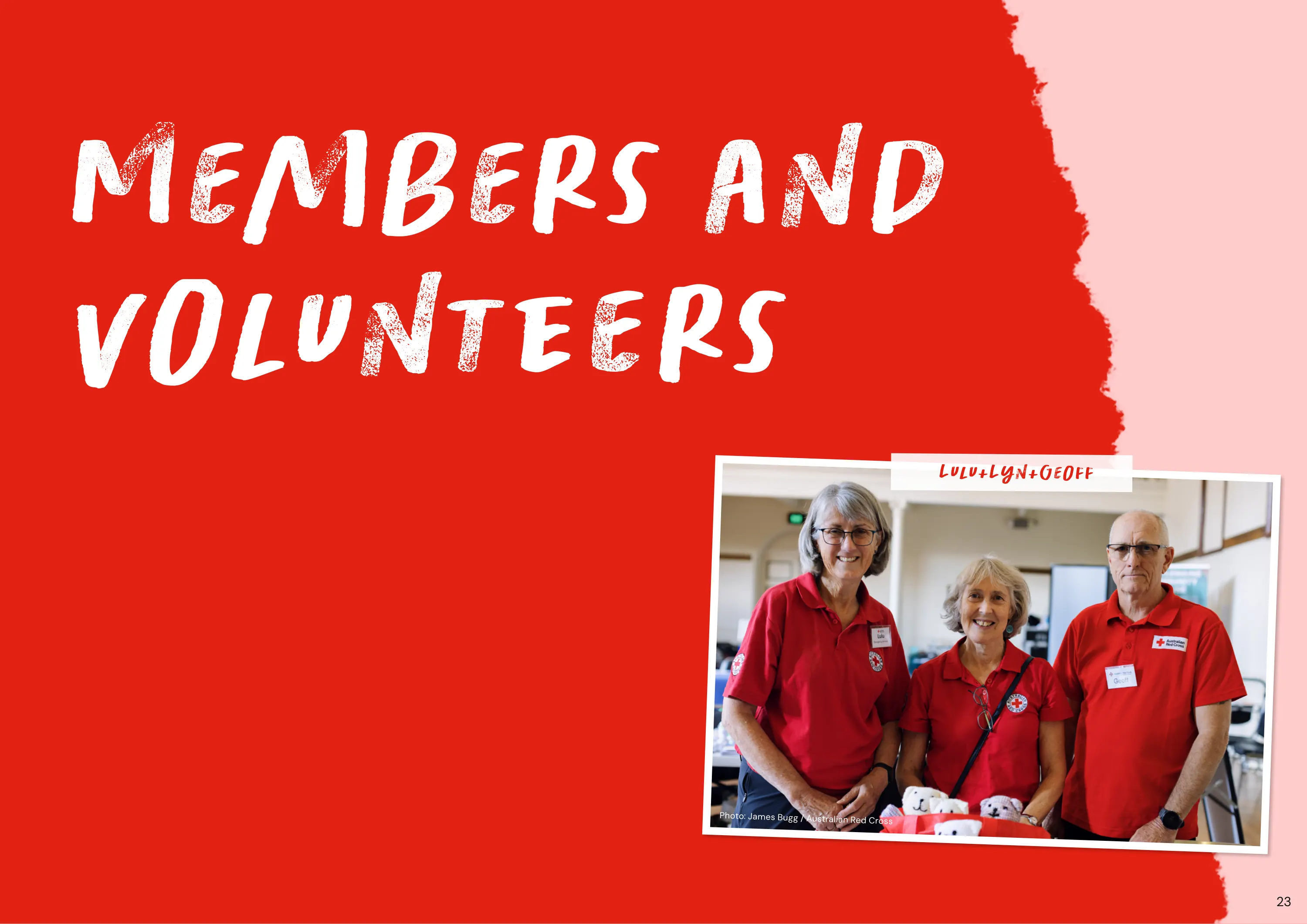
Text of page 23
Members and volunteers
-
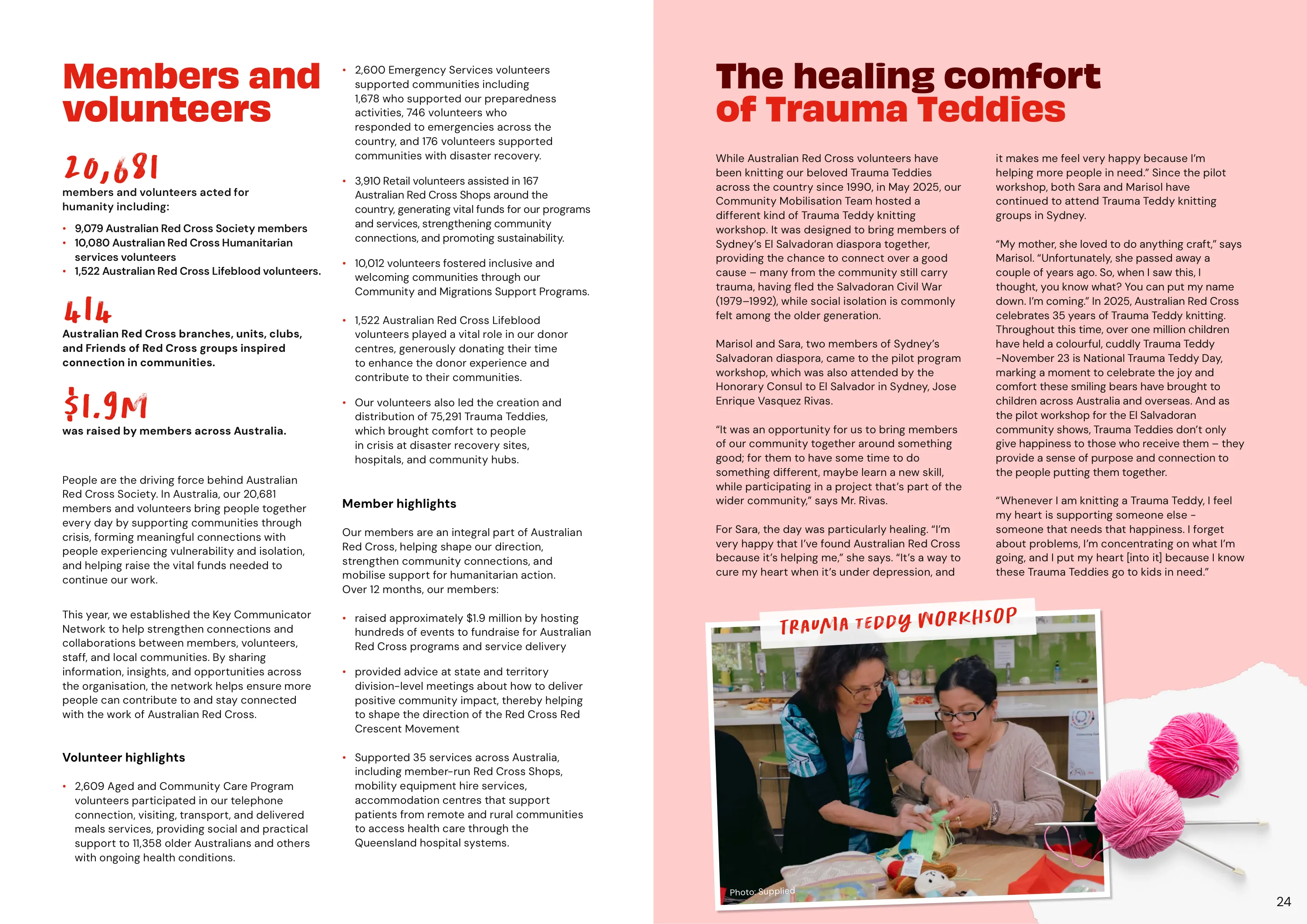
Text of page 24
Members and volunteers
20,681 members and volunteers acted for humanity including:
- 9,079 Australian Red Cross Society members
- 10,080 Australian Red Cross Humanitarian services volunteers
- 1,522 Australian Red Cross Lifeblood volunteers.
414 Australian Red Cross branches, units, clubs, and Friends of Red Cross groups inspired connection in communities.
$1.9M was raised by members across Australia.
People are the driving force behind Australian Red Cross Society. In Australia, our 20,681 members and volunteers bring people together every day by supporting communities through crisis, forming meaningful connections with people experiencing vulnerability and isolation, and helping raise the vital funds needed to continue our work.
This year, we established the Key Communicator Network to help strengthen connections and collaborations between members, volunteers, staff, and local communities. By sharing information, insights, and opportunities across the organisation, the network helps ensure more people can contribute to and stay connected with the work of Australian Red Cross.
Volunteer highlights
- 2,609 Aged and Community Care Program volunteers participated in our telephone connection, visiting, transport, and delivered meals services, providing social and practical support to 11,358 older Australians and others with ongoing health conditions.
- 2,600 Emergency Services volunteers supported communities including 1,678 who supported our preparedness activities, 746 volunteers who responded to emergencies across the country, and 176 volunteers supported communities with disaster recovery.
- 3,910 Retail volunteers assisted in 167 Australian Red Cross Shops around the country, generating vital funds for our programs and services, strengthening community connections, and promoting sustainability.
- 10,012 volunteers fostered inclusive and welcoming communities through our Community and Migrations Support Programs.
- 1,522 Australian Red Cross Lifeblood volunteers played a vital role in our donor centres, generously donating their time to enhance the donor experience and contribute to their communities.
- Our volunteers also led the creation and distribution of 75,291 Trauma Teddies, which brought comfort to people in crisis at disaster recovery sites, hospitals, and community hubs.
Member highlights
Our members are an integral part of Australian Red Cross, helping shape our direction, strengthen community connections, and mobilise support for humanitarian action. Over 12 months, our members:
- raised approximately $1.9 million by hosting hundreds of events to fundraise for Australian Red Cross programs and service delivery
- provided advice at state and territory division-level meetings about how to deliver positive community impact, thereby helping to shape the direction of the Red Cross Red Crescent Movement
- Supported 35 services across Australia, including member-run Red Cross Shops, mobility equipment hire services, accommodation centres that support patients from remote and rural communities to access health care through the Queensland hospital systems.
The healing comfort of Trauma Teddies
While Australian Red Cross volunteers have been knitting our beloved Trauma Teddies across the country since 1990, in May 2025, our Community Mobilisation Team hosted a different kind of Trauma Teddy knitting workshop. It was designed to bring members of Sydney’s El Salvadoran diaspora together, providing the chance to connect over a good cause – many from the community still carry trauma, having fled the Salvadoran Civil War (1979–1992), while social isolation is commonly felt among the older generation.
Marisol and Sara, two members of Sydney’s Salvadoran diaspora, came to the pilot program workshop, which was also attended by the Honorary Consul to El Salvador in Sydney, Jose Enrique Vasquez Rivas.
“It was an opportunity for us to bring members of our community together around something good; for them to have some time to do something different, maybe learn a new skill, while participating in a project that’s part of the wider community,” says Mr. Rivas.
For Sara, the day was particularly healing. “I’m very happy that I’ve found Australian Red Cross because it’s helping me,” she says. “It’s a way to cure my heart when it’s under depression, and it makes me feel very happy because I’m helping more people in need.” Since the pilot workshop, both Sara and Marisol have continued to attend Trauma Teddy knitting groups in Sydney.
“My mother, she loved to do anything craft,” says Marisol. “Unfortunately, she passed away a couple of years ago. So, when I saw this, I thought, you know what? You can put my name down. I’m coming.” In 2025, Australian Red Cross celebrates 35 years of Trauma Teddy knitting. Throughout this time, over one million children have held a colourful, cuddly Trauma Teddy -November 23 is National Trauma Teddy Day, marking a moment to celebrate the joy and comfort these smiling bears have brought to children across Australia and overseas. And as the pilot workshop for the El Salvadoran community shows, Trauma Teddies don’t only give happiness to those who receive them – they provide a sense of purpose and connection to the people putting them together.
“Whenever I am knitting a Trauma Teddy, I feel my heart is supporting someone else - someone that needs that happiness. I forget about problems, I’m concentrating on what I’m going, and I put my heart [into it] because I know these Trauma Teddies go to kids in need.”
-
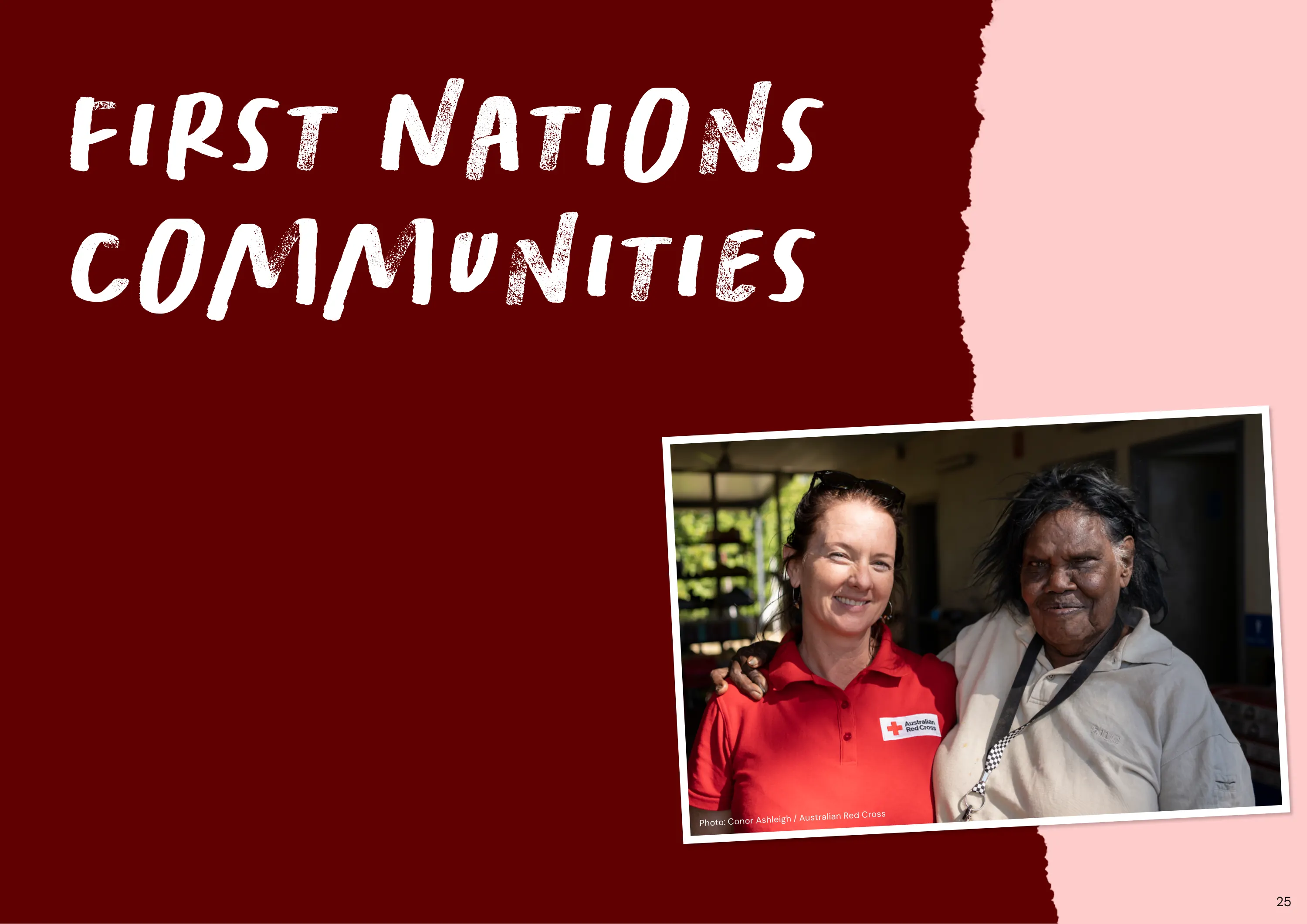
Text of page 25
First Nations Communities
-
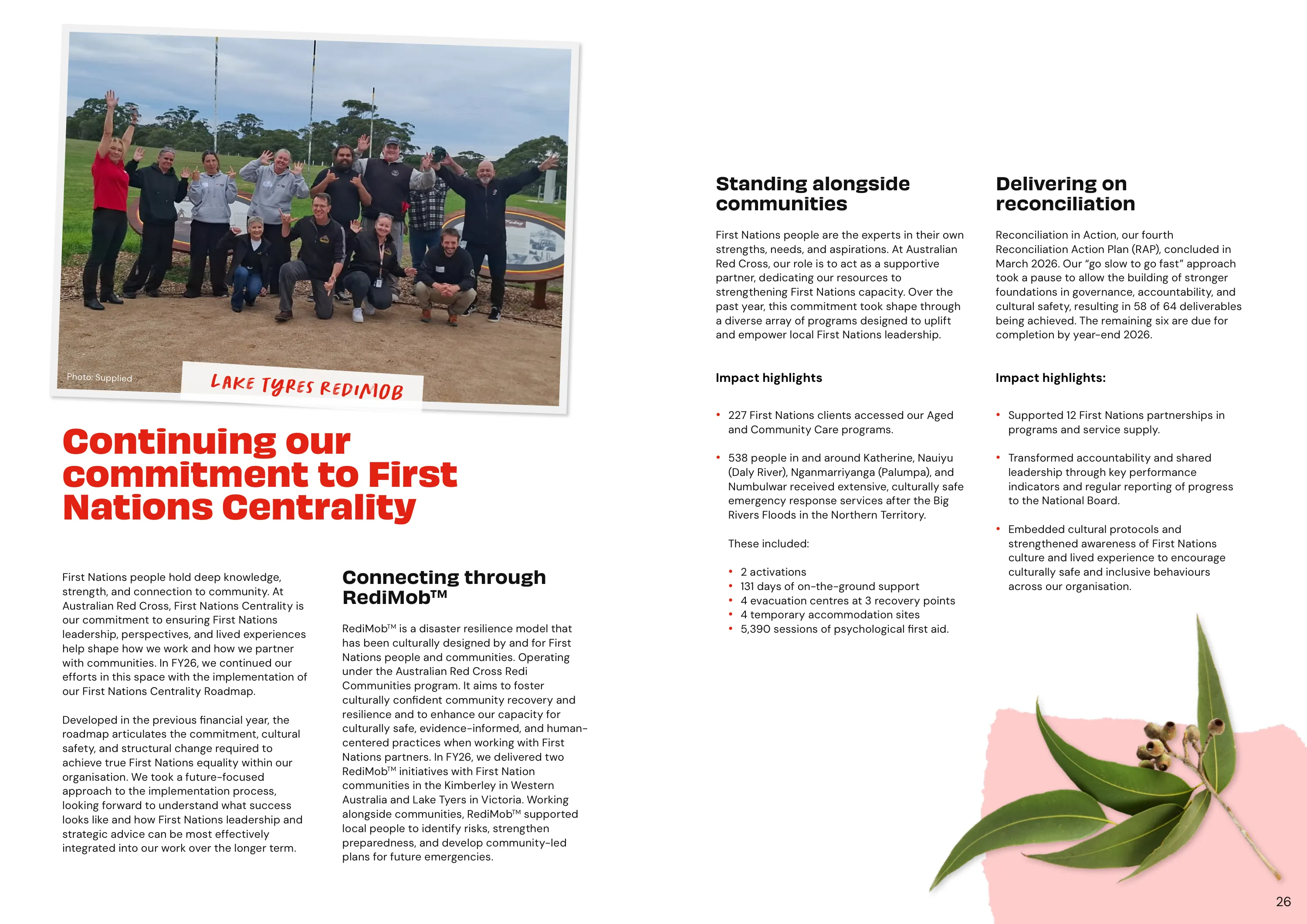
Text of page 26
Continuing our commitment to First Nations Centrality
First Nations people hold deep knowledge, strength, and connection to community. At Australian Red Cross, First Nations Centrality is our commitment to ensuring First Nations leadership, perspectives, and lived experiences help shape how we work and how we partner with communities. In FY26, we continued our efforts in this space with the implementation of our First Nations Centrality Roadmap.
Developed in the previous financial year, the roadmap articulates the commitment, cultural safety, and structural change required to achieve true First Nations equality within our organisation. We took a future-focused approach to the implementation process, looking forward to understand what success looks like and how First Nations leadership and strategic advice can be most effectively integrated into our work over the longer term.
Connecting through RediMob™
RediMob™ is a disaster resilience model that has been culturally designed by and for First Nations people and communities. Operating under the Australian Red Cross Redi Communities program. It aims to foster culturally confident community recovery and resilience and to enhance our capacity for culturally safe, evidence-informed, and human-centered practices when working with First Nations partners. In FY26, we delivered two RediMob™ initiatives with First Nation communities in the Kimberley in Western Australia and Lake Tyers in Victoria. Working alongside communities, RediMob™ supported local people to identify risks, strengthen preparedness, and develop community-led plans for future emergencies.
Standing alongside communities
First Nations people are the experts in their own strengths, needs, and aspirations. At Australian Red Cross, our role is to act as a supportive partner, dedicating our resources to strengthening First Nations capacity. Over the past year, this commitment took shape through a diverse array of programs designed to uplift and empower local First Nations leadership.
Impact highlights
- 227 First Nations clients accessed our Aged and Community Care programs.
- 538 people in and around Katherine, Nauiyu (Daly River), Nganmarriyanga (Palumpa), and Numbulwar received extensive, culturally safe emergency response services after the Big Rivers Floods in the Northern Territory. These included:
- 2 activations
- 131 days of on-the-ground support
- 4 evacuation centres at 3 recovery points
- 4 temporary accommodation sites
- 5,390 sessions of psychological first aid.
Delivering on reconciliation
Reconciliation in Action, our fourth Reconciliation Action Plan (RAP), concluded in March 2026. Our “go slow to go fast” approach took a pause to allow the building of stronger foundations in governance, accountability, and cultural safety, resulting in 58 of 64 deliverables being achieved. The remaining six are due for completion by year-end 2026.
Impact highlights:
- Supported 12 First Nations partnerships in programs and service supply.
- Transformed accountability and shared leadership through key performance indicators and regular reporting of progress to the National Board.
- Embedded cultural protocols and strengthened awareness of First Nations culture and lived experience to encourage culturally safe and inclusive behaviours across our organisation.
-
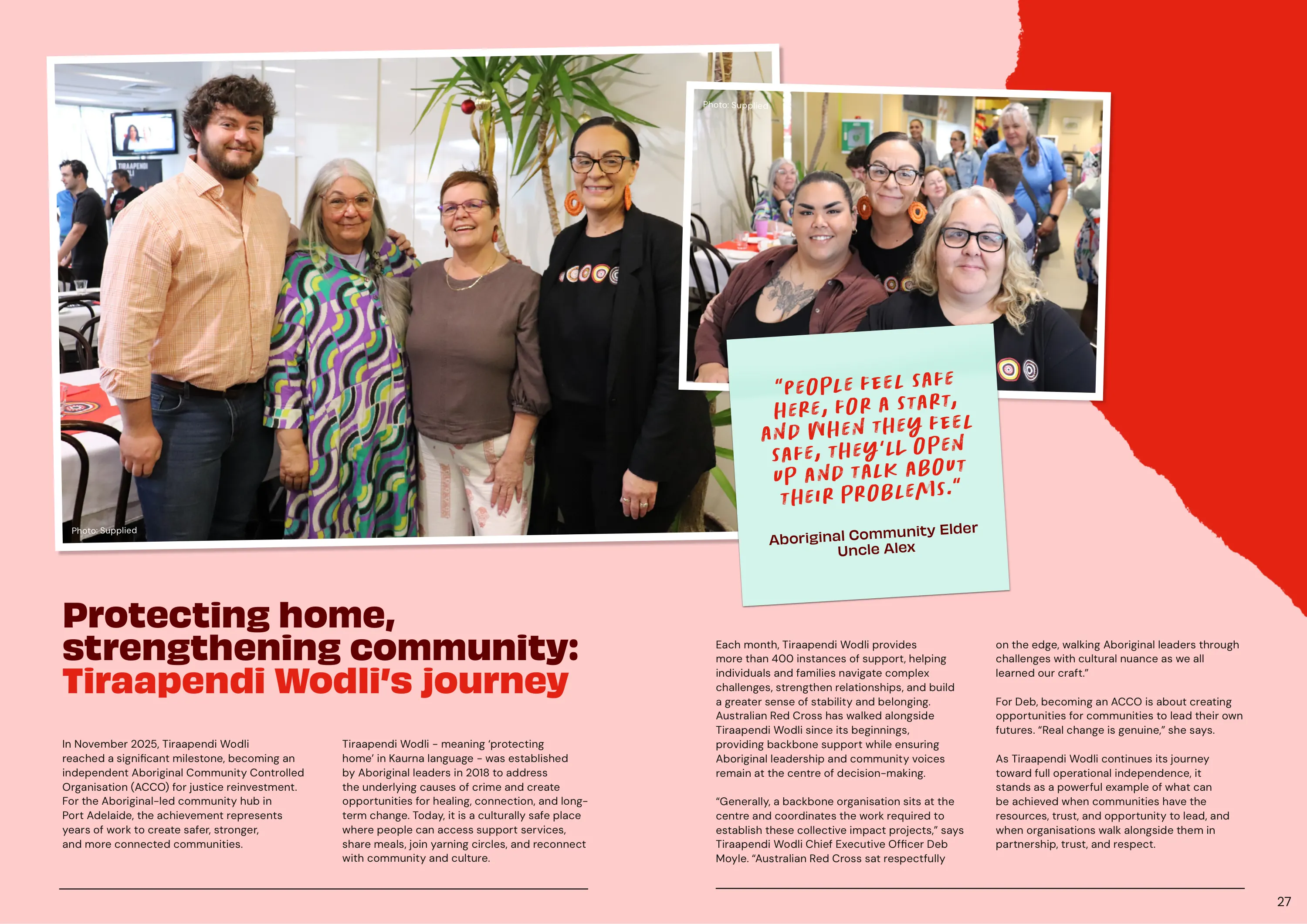
Text of page 27
Protecting home, strengthening community: Tiraapendi Wodli’s journey
In November 2025, Tiraapendi Wodli reached a significant milestone, becoming an independent Aboriginal Community Controlled Organisation (ACCO) for justice reinvestment. For the Aboriginal-led community hub in Port Adelaide, the achievement represents years of work to create safer, stronger, and more connected communities.
Tiraapendi Wodli - meaning ‘protecting home’ in Kaurna language - was established by Aboriginal leaders in 2018 to address the underlying causes of crime and create opportunities for healing, connection, and long-term change. Today, it is a culturally safe place where people can access support services, share meals, join yarning circles, and reconnect with community and culture.
“People feel safe here, for a start, and when they feel safe, they’ll open up and talk about their problems.”
Aboriginal Community Elder
Uncle Alex
Each month, Tiraapendi Wodli provides more than 400 instances of support, helping individuals and families navigate complex challenges, strengthen relationships, and build a greater sense of stability and belonging. Australian Red Cross has walked alongside Tiraapendi Wodli since its beginnings, providing backbone support while ensuring Aboriginal leadership and community voices remain at the centre of decision-making.
“Generally, a backbone organisation sits at the centre and coordinates the work required to establish these collective impact projects,” says Tiraapendi Wodli Chief Executive Officer Deb Moyle. “Australian Red Cross sat respectfully on the edge, walking Aboriginal leaders through challenges with cultural nuance as we all learned our craft.”
For Deb, becoming an ACCO is about creating opportunities for communities to lead their own futures. “Real change is genuine,” she says.
As Tiraapendi Wodli continues its journey toward full operational independence, it stands as a powerful example of what can be achieved when communities have the resources, trust, and opportunity to lead, and when organisations walk alongside them in partnership, trust, and respect.
-
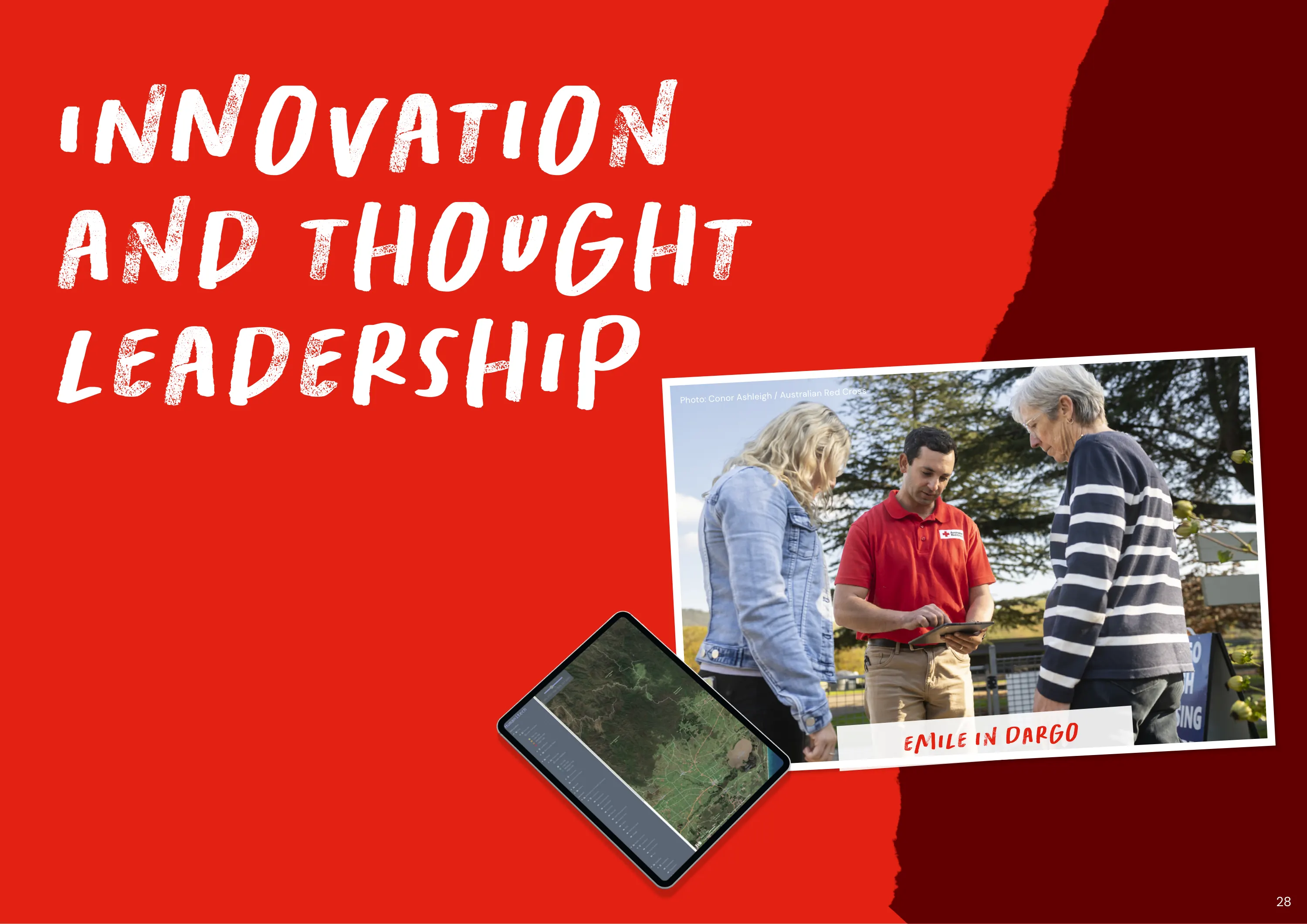
Text of page 28
Innovation and thought leadership
-
Text of page 29
Humanitech: Connecting technology and climate resilience to help communities thrive
Rising temperatures, unpredictable weather, and the growing threat of extreme events are placing growing pressure on communities and the systems designed to support them. While technology can help communities to meet the challenges of disaster head on, many solutions fail to reach those who need them most.
Humanitech is an Australian Red Cross initiative that brings together communities, innovators, and partners to explore how technology can help solve real-world humanitarian challenges. It supports the development and scaling of innovation through cross-sector partnerships that test solutions in real-world contexts. Our work advocates for approaches that are inclusive, community-led, and grounded in both lived experience and humanitarian principles.
Expanding the QBE AcceliCITY Humanitarian Challenge
A central pillar of this work is the QBE AcceliCITY Humanitarian Challenge, which our Humanitech team delivers in partnership with QBE Foundation, Leading Cities, and the Global Disaster Preparedness Center. In FY26, Humanitech tripled the program’s cohort, with 30 teams progressing through a six-month innovation pathway. This substantial expansion extended pilot opportunities beyond Australia into the Asia-Pacific region. Two global innovators, Bridgefy and Atma Connect, were selected as the 2026 Challenge winners. Each will pilot their solutions with communities, supported by funding and implementation partnerships with Australian Red Cross, Palang Merah Indonesia, and the Global Disaster Preparedness Center. These pilots reflect a growing emphasis on locally led, scalable approaches to climate resilience, enabling solutions to be shaped by community priorities while creating pathways towards broader regional adoption.
Turning local solutions into lasting impact
Beyond this year’s Challenge, Humanitech continued piloting WEO, the 2024 Challenge-winning solution, with the remote community of Dargo in Victoria. WEO combines satellite imagery, artificial intelligence, and local knowledge to help communities understand and respond to climate risks.
The pilot achieved strong community participation, with more than 80 of Dargo’s approximately 105 residents contributing to platform design and testing. Activities included two co-design workshops involving 45 participants, training for 16 local product champions, and digital literacy workshops for 30 residents.
As a result of the pilot, nine community resilience actions were implemented in Dargo, and advocacy supported by Australian Red Cross contributed to the Victoria State Emergency Service prioritising flood impact mapping for the town. Capability gains were recorded across knowledge, security, and wellbeing measures. Community connection remained strong. Feedback from participants highlighted increased awareness of local climate risks, improved preparedness, and greater confidence to take action.
By combining community knowledge with emerging technologies, the pilot demonstrated how locally led innovation can strengthen preparedness, build trust, and support more resilient communities.
Partnerships for purpose
Increasing impact, expanding reach
QBE Foundation funding also enables Humanitech to apply technology innovation across Australian Red Cross programs, expanding the reach and effectiveness of initiatives that support communities experiencing vulnerability to build their climate resilience.
Through this partnership, Humanitech brings together humanitarian, community, and technology expertise to help communities harness innovation and shape solutions that meet local needs. This includes strengthening Australian Red Cross programs; building capability across technology partners; and co-designing, piloting, and scaling approaches that improve preparedness, response, and recovery outcomes.
Enabling more inclusive emergency communication
In partnership with Kara Technologies, Humanitech supported the translation of Australian Red Cross emergency preparedness information into Australian Sign Language (Auslan) using AI-driven avatar technology. The initiative explored how trusted preparedness information can be delivered in more accessible and culturally appropriate ways for Deaf Australians. By reducing language barriers and incorporating feedback from the Deaf community throughout development, the project establishes a foundation for more inclusive and scalable emergency communication.
Re-greening communities
On Nywaigi Country in Far North Queensland, Australian Red Cross Humanitech and recovery teams contributed to an AirSeed revegetation project following Cyclone Jasper. Delivered in partnership with Traditional Owners and local organisations, the project combined technology and traditional ecological knowledge to restore flood-affected land and strengthen long-term resilience.
AirSeed supplied 2,290 native plants across 11 species selected by Traditional Owners, contributing to healthier waterways, improved biodiversity, and landscape recovery. Rather than relying on conventional planting methods, AirSeed uses biodegradable planting pods designed to protect seedlings during establishment and improve survival in challenging conditions. The technology can be adapted to different landscapes and soil types, helping support revegetation efforts in areas affected by flooding and environmental degradation. Beyond environmental restoration, the project also supported community recovery and connection.
These initiatives demonstrate how QBE Foundation funding is enabling Humanitech to apply innovation in practical, community-led ways: strengthening recovery, improving preparedness, and building more resilient and connected communities.
“It’s a great thing what you’re all doing... I think it’s beautiful. I think it’s great for Ingham, Mungalla and the Country that we stand on here today too.”
Community member
-
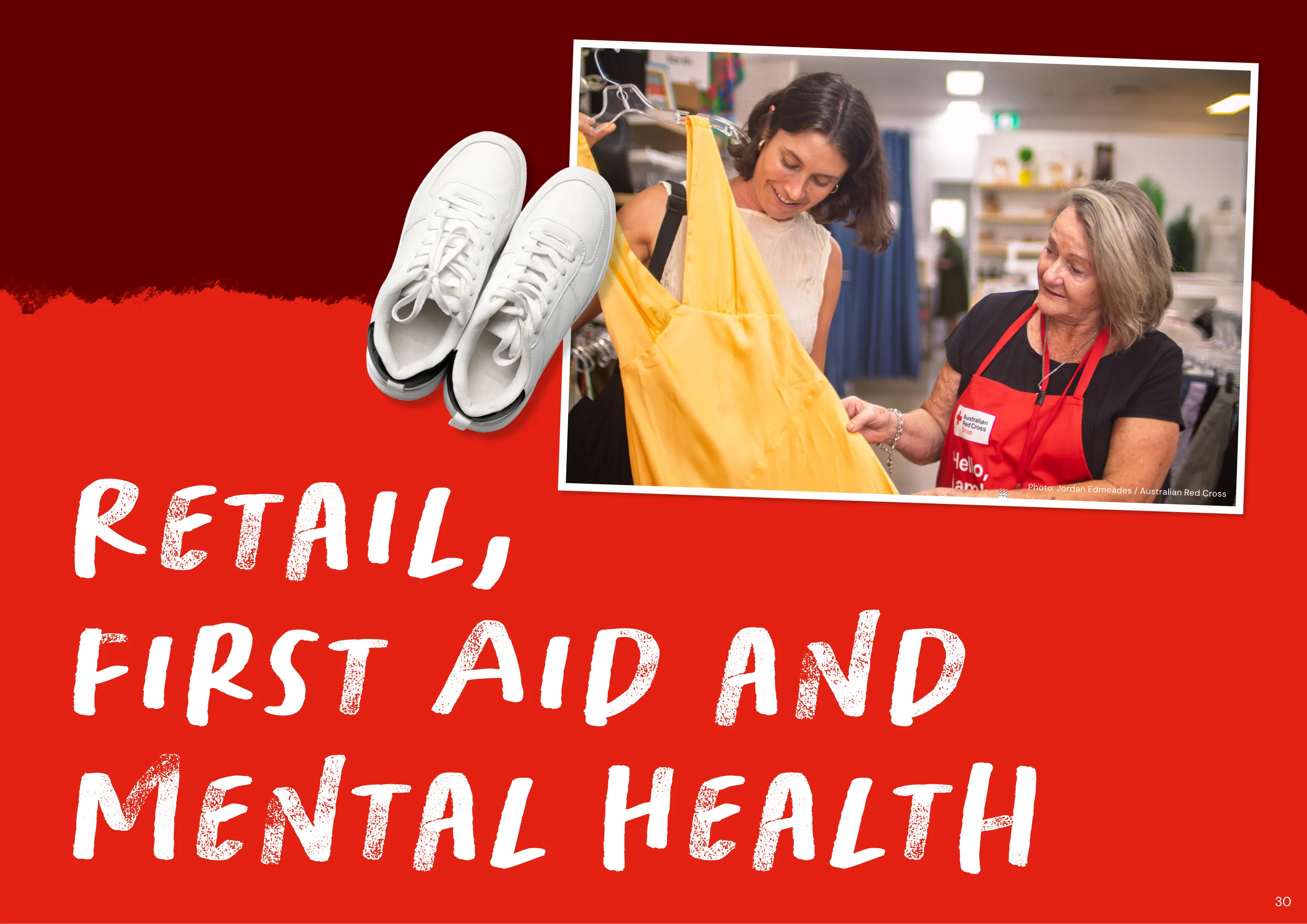
Text of page 30
Retail, First Aid and Mental Health
-
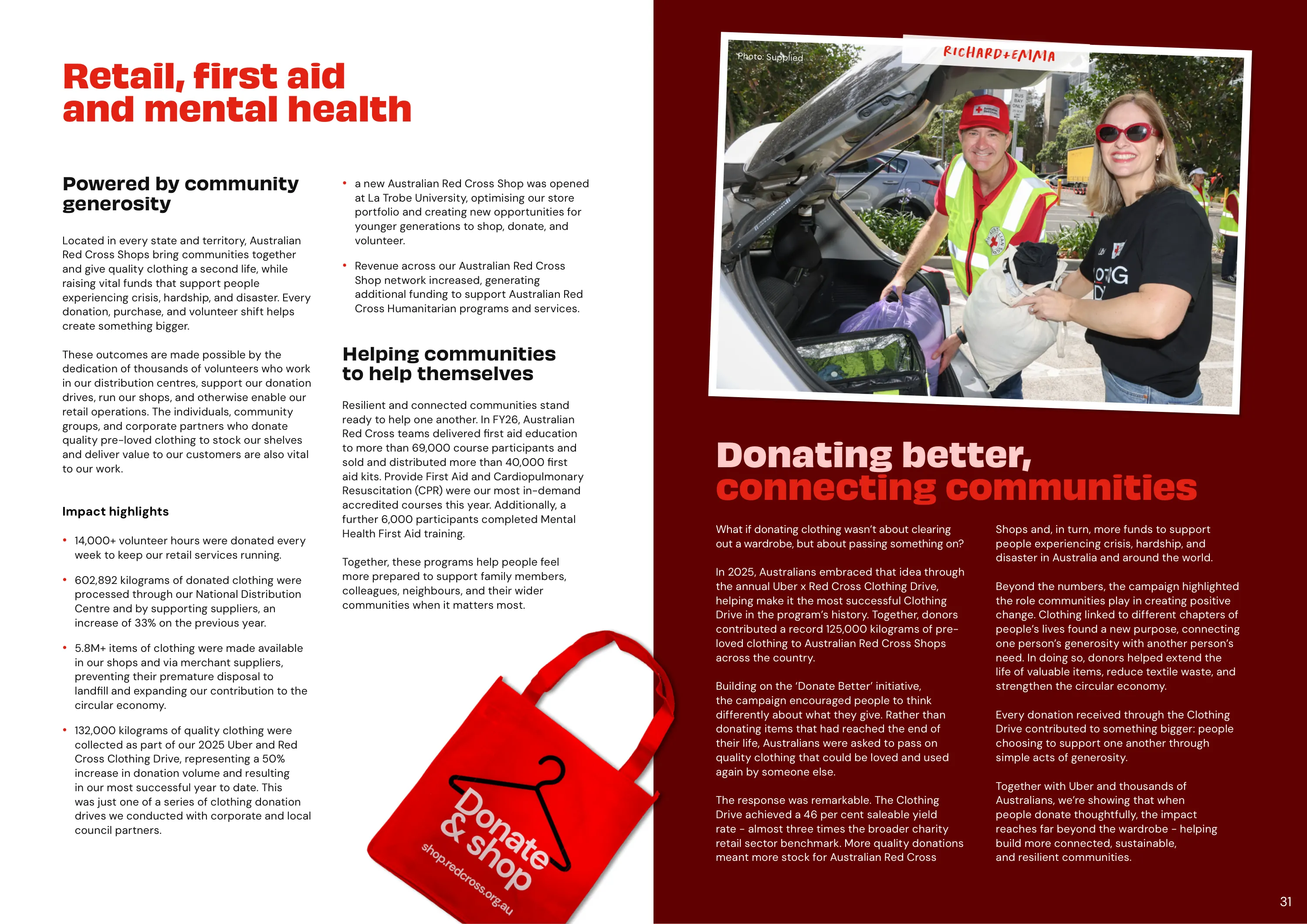
Text of page 31
Retail, first aid and mental health
Powered by community generosity
Located in every state and territory, Australian Red Cross Shops bring communities together and give quality clothing a second life, while raising vital funds that support people experiencing crisis, hardship, and disaster. Every donation, purchase, and volunteer shift helps create something bigger.
These outcomes are made possible by the dedication of thousands of volunteers who work in our distribution centres, support our donation drives, run our shops, and otherwise enable our retail operations. The individuals, community groups, and corporate partners who donate quality pre-loved clothing to stock our shelves and deliver value to our customers are also vital to our work.
Impact highlights
- 14,000+ volunteer hours were donated every week to keep our retail services running.
- 602,892 kilograms of donated clothing were processed through our National Distribution Centre and by supporting suppliers, an increase of 33% on the previous year.
- 5.8M+ items of clothing were made available in our shops and via merchant suppliers, preventing their premature disposal to landfill and expanding our contribution to the circular economy.
- 132,000 kilograms of quality clothing were collected as part of our 2025 Uber and Red Cross Clothing Drive, representing a 50% increase in donation volume and resulting in our most successful year to date. This was just one of a series of clothing donation drives we conducted with corporate and local council partners.
- a new Australian Red Cross Shop was opened at La Trobe University, optimising our store portfolio and creating new opportunities for younger generations to shop, donate, and volunteer.
- Revenue across our Australian Red Cross Shop network increased, generating additional funding to support Australian Red Cross Humanitarian programs and services.
Helping communities to help themselves
Resilient and connected communities stand ready to help one another. In FY26, Australian Red Cross teams delivered first aid education to more than 69,000 course participants and sold and distributed more than 40,000 first aid kits. Provide First Aid and Cardiopulmonary Resuscitation (CPR) were our most in-demand accredited courses this year. Additionally, a further 6,000 participants completed Mental Health First Aid training.
Together, these programs help people feel more prepared to support family members, colleagues, neighbours, and their wider communities when it matters most.
Donating better, connecting communities
What if donating clothing wasn’t about clearing out a wardrobe, but about passing something on?
In 2025, Australians embraced that idea through the annual Uber x Red Cross Clothing Drive, helping make it the most successful Clothing Drive in the program’s history. Together, donors contributed a record 125,000 kilograms of pre-loved clothing to Australian Red Cross Shops across the country.
Building on the ‘Donate Better’ initiative, the campaign encouraged people to think differently about what they give. Rather than donating items that had reached the end of their life, Australians were asked to pass on quality clothing that could be loved and used again by someone else.
The response was remarkable. The Clothing Drive achieved a 46 per cent saleable yield rate - almost three times the broader charity retail sector benchmark. More quality donations meant more stock for Australian Red Cross Shops and, in turn, more funds to support people experiencing crisis, hardship, and disaster in Australia and around the world.
Beyond the numbers, the campaign highlighted the role communities play in creating positive change. Clothing linked to different chapters of people’s lives found a new purpose, connecting one person’s generosity with another person’s need. In doing so, donors helped extend the life of valuable items, reduce textile waste, and strengthen the circular economy.
Every donation received through the Clothing Drive contributed to something bigger: people choosing to support one another through simple acts of generosity.
Together with Uber and thousands of Australians, we’re showing that when people donate thoughtfully, the impact reaches far beyond the wardrobe - helping build more connected, sustainable, and resilient communities.
-
Text of page 32
Partners and donors
-
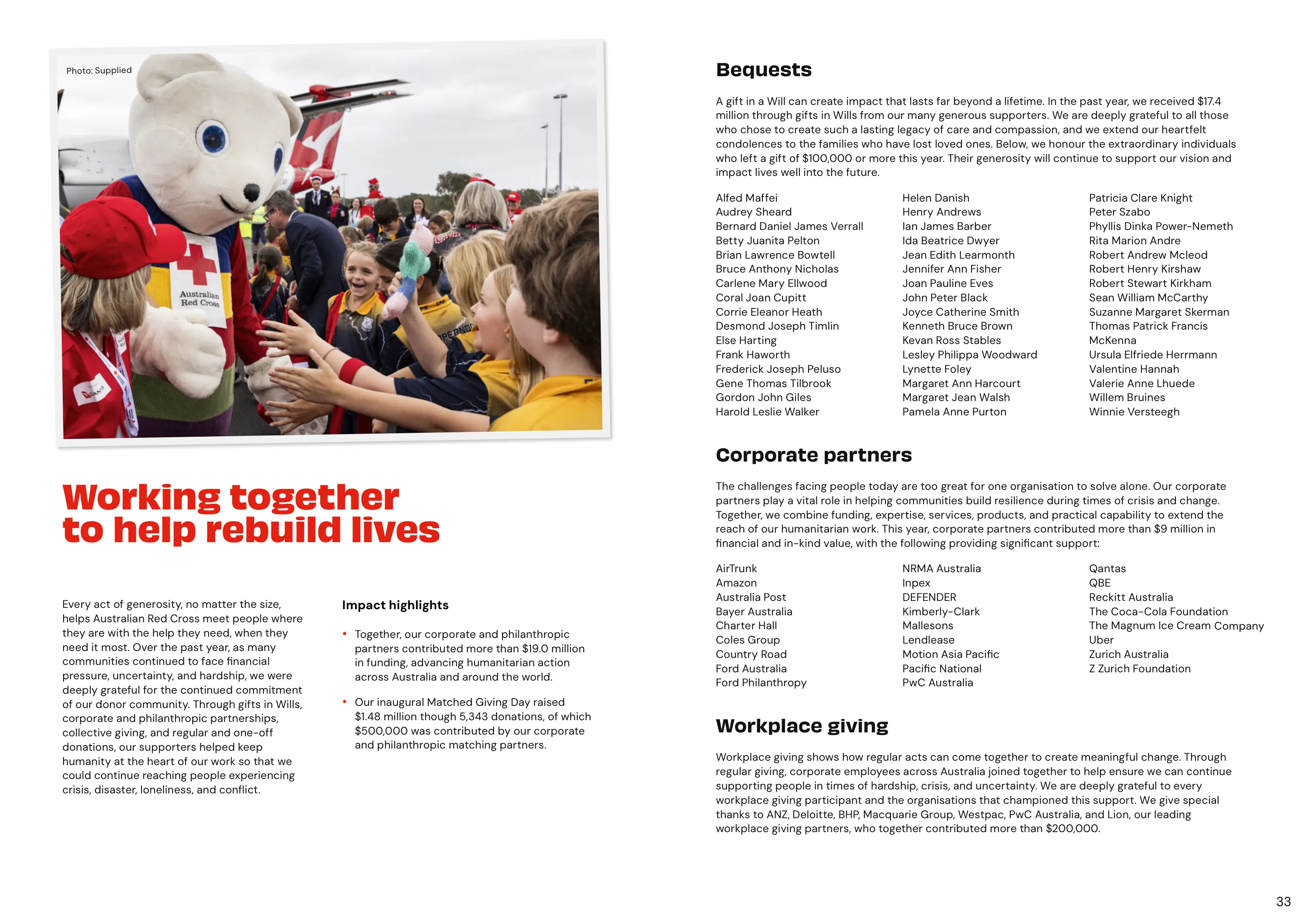
Text of page 33
Working together to help rebuild lives
Every act of generosity, no matter the size, helps Australian Red Cross meet people where they are with the help they need, when they need it most. Over the past year, as many communities continued to face financial pressure, uncertainty, and hardship, we were deeply grateful for the continued commitment of our donor community. Through gifts in Wills, corporate and philanthropic partnerships, collective giving, and regular and one-off donations, our supporters helped keep humanity at the heart of our work so that we could continue reaching people experiencing crisis, disaster, loneliness, and conflict.
Impact highlights
- Together, our corporate and philanthropic partners contributed more than $19.0 million in funding, advancing humanitarian action across Australia and around the world.
- Our inaugural Matched Giving Day raised $1.48 million though 5,343 donations, of which $500,000 was contributed by our corporate and philanthropic matching partners.
Bequests
A gift in a Will can create impact that lasts far beyond a lifetime. In the past year, we received $17.4 million through gifts in Wills from our many generous supporters. We are deeply grateful to all those who chose to create such a lasting legacy of care and compassion, and we extend our heartfelt condolences to the families who have lost loved ones. Below, we honour the extraordinary individuals who left a gift of $100,000 or more this year. Their generosity will continue to support our vision and impact lives well into the future.
- Alfed Maffei
- Audrey Sheard
- Bernard Daniel James Verrall
- Betty Juanita Pelton
- Brian Lawrence Bowtell
- Bruce Anthony Nicholas
- Carlene Mary Ellwood
- Coral Joan Cupitt
- Corrie Eleanor Heath
- Desmond Joseph Timlin
- Else Harting
- Frank Haworth
- Frederick Joseph Peluso
- Gene Thomas Tilbrook
- Gordon John Giles
- Harold Leslie Walker
- Helen Danish
- Henry Andrews
- Ian James Barber
- Ida Beatrice Dwyer
- Jean Edith Learmonth
- Jennifer Ann Fisher
- Joan Pauline Eves
- John Peter Black
- Joyce Catherine Smith
- Kenneth Bruce Brown
- Kevan Ross Stables
- Lesley Philippa Woodward
- Lynette Foley
- Margaret Ann Harcourt
- Margaret Jean Walsh
- Pamela Anne Purton
- Patricia Clare Knight
- Peter Szabo
- Phyllis Dinka Power-Nemeth
- Rita Marion Andre
- Robert Andrew Mcleod
- Robert Henry Kirshaw
- Robert Stewart Kirkham
- Sean William McCarthy
- Suzanne Margaret Skerman
- Thomas Patrick Francis McKenna
- Ursula Elfriede Herrmann
- Valentine Hannah
- Valerie Anne Lhuede
- Willem Bruines
- Winnie Versteegh
Corporate partners
The challenges facing people today are too great for one organisation to solve alone. Our corporate partners play a vital role in helping communities build resilience during times of crisis and change. Together, we combine funding, expertise, services, products, and practical capability to extend the reach of our humanitarian work. This year, corporate partners contributed more than $9 million in financial and in-kind value, with the following providing significant support:
- AirTrunk
- Amazon
- Australia Post
- Bayer Australia
- Charter Hall
- Coles Group
- Country Road
- Ford Australia
- Ford Philanthropy
- NRMA Australia
- Inpex
- DEFENDER
- Kimberly-Clark
- Mallesons
- Lendlease
- Motion Asia Pacific
- Pacific National
- PwC Australia
- Qantas
- QBE
- Reckitt Australia
- The Coca-Cola Foundation
- The Magnum Ice Cream Company
- Uber
- Zurich Australia
- Z Zurich Foundation
Workplace giving
Workplace giving shows how regular acts can come together to create meaningful change. Through regular giving, corporate employees across Australia joined together to help ensure we can continue supporting people in times of hardship, crisis, and uncertainty. We are deeply grateful to every workplace giving participant and the organisations that championed this support. We give special thanks to ANZ, Deloitte, BHP, Macquarie Group, Westpac, PwC Australia, and Lion, our leading workplace giving partners, who together contributed more than $200,000.
-
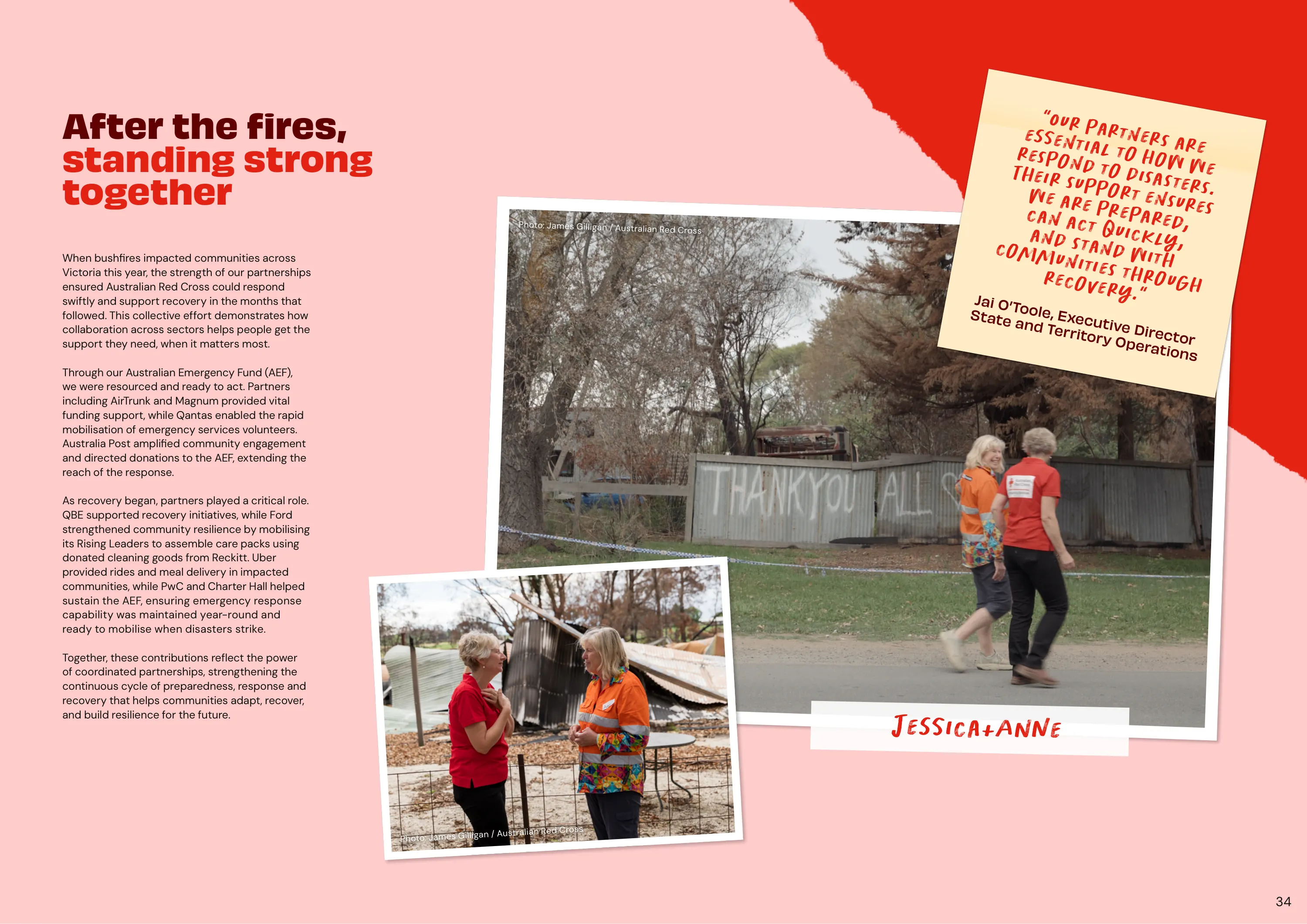
Text of page 34
After the fires, standing strong together
When bushfires impacted communities across Victoria this year, the strength of our partnerships ensured Australian Red Cross could respond swiftly and support recovery in the months that followed. This collective effort demonstrates how collaboration across sectors helps people get the support they need, when it matters most.
Through our Australian Emergency Fund (AEF), we were resourced and ready to act. Partners including AirTrunk and Magnum provided vital funding support, while Qantas enabled the rapid mobilisation of emergency services volunteers. Australia Post amplified community engagement and directed donations to the AEF, extending the reach of the response.
As recovery began, partners played a critical role. QBE supported recovery initiatives, while Ford strengthened community resilience by mobilising its Rising Leaders to assemble care packs using donated cleaning goods from Reckitt. Uber provided rides and meal delivery in impacted communities, while PwC and Charter Hall helped sustain the AEF, ensuring emergency response capability was maintained year-round and ready to mobilise when disasters strike.
Together, these contributions reflect the power of coordinated partnerships, strengthening the continuous cycle of preparedness, response and recovery that helps communities adapt, recover, and build resilience for the future.
“Our partners are essential to how we respond to disasters. Their support ensures we are prepared, can act quickly, and stand with communities through recovery.”
Jai O’Toole, Executive Director State and Territory Operations
-
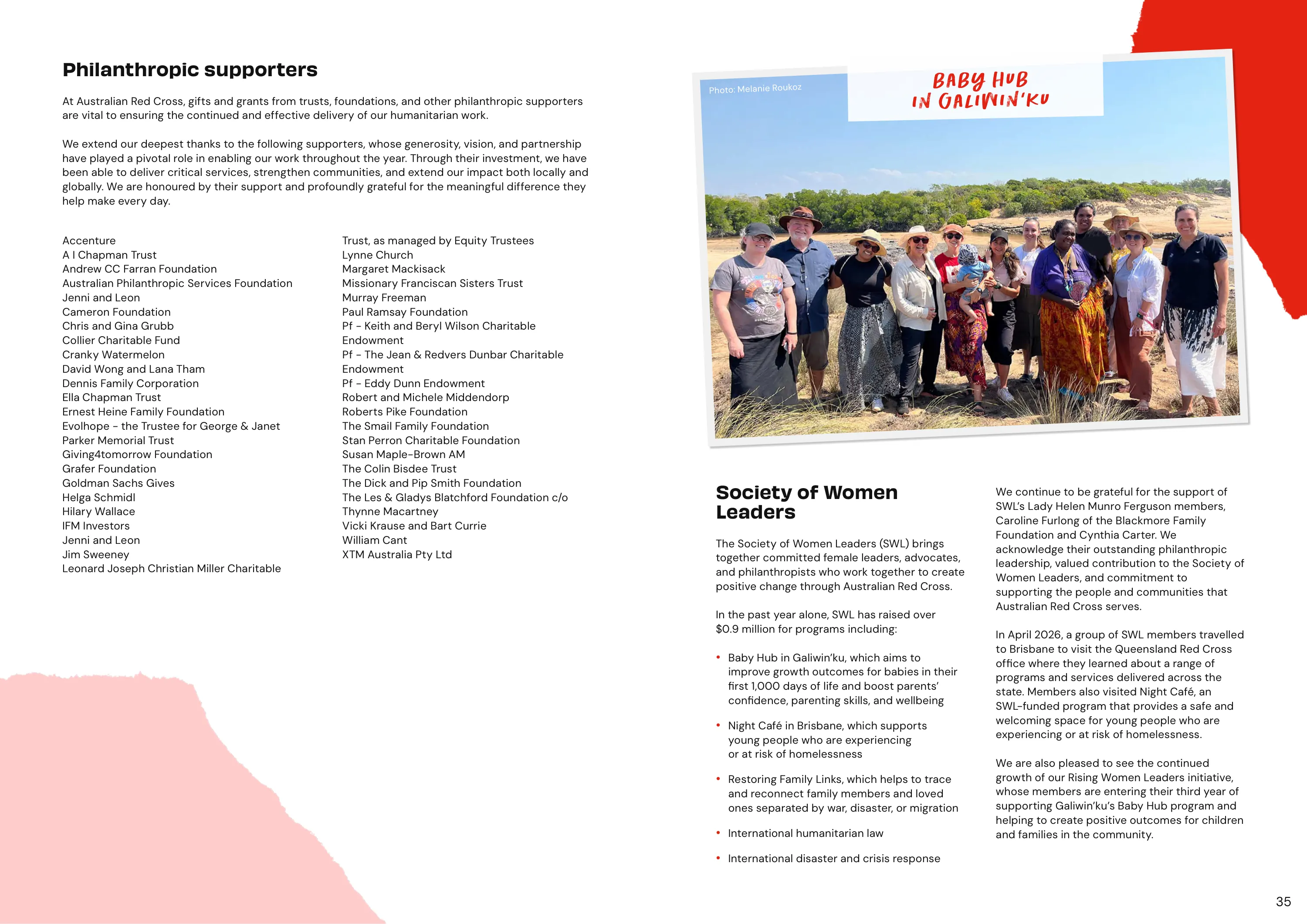
Text of page 35
Philanthropic supporters
At Australian Red Cross, gifts and grants from trusts, foundations, and other philanthropic supporters are vital to ensuring the continued and effective delivery of our humanitarian work.
We extend our deepest thanks to the following supporters, whose generosity, vision, and partnership have played a pivotal role in enabling our work throughout the year. Through their investment, we have been able to deliver critical services, strengthen communities, and extend our impact both locally and globally. We are honoured by their support and profoundly grateful for the meaningful difference they help make every day.
- Accenture
- A I Chapman Trust
- Andrew CC Farran Foundation
- Australian Philanthropic Services Foundation
- Jenni and Leon
- Cameron Foundation
- Chris and Gina Grubb
- Collier Charitable Fund
- Cranky Watermelon
- David Wong and Lana Tham
- Dennis Family Corporation
- Ella Chapman Trust
- Ernest Heine Family Foundation
- Evolhope - the Trustee for George & Janet Parker Memorial Trust
- Giving4tomorrow Foundation
- Grafer Foundation
- Goldman Sachs Gives
- Helga Schmidl
- Hilary Wallace
- IFM Investors
- Jenni and Leon
- Jim Sweeney
- Leonard Joseph Christian Miller Charitable Trust, as managed by Equity Trustees
- Lynne Church
- Margaret Mackisack
- Missionary Franciscan Sisters Trust
- Murray Freeman
- Paul Ramsay Foundation
- Pf - Keith and Beryl Wilson Charitable Endowment
- Pf - The Jean & Redvers Dunbar Charitable Endowment
- Pf - Eddy Dunn Endowment
- Robert and Michele Middendorp
- Roberts Pike Foundation
- The Smail Family Foundation
- Stan Perron Charitable Foundation
- Susan Maple-Brown AM
- The Colin Bisdee Trust
- The Dick and Pip Smith Foundation
- The Les & Gladys Blatchford Foundation c/o Thynne Macartney
- Vicki Krause and Bart Currie
- William Cant
- XTM Australia Pty Ltd
Society of Women Leaders
The Society of Women Leaders (SWL) brings together committed female leaders, advocates, and philanthropists who work together to create positive change through Australian Red Cross.
In the past year alone, SWL has raised over $0.9 million for programs including:
- Baby Hub in Galiwin’ku, which aims to improve growth outcomes for babies in their first 1,000 days of life and boost parents’ confidence, parenting skills, and wellbeing
- Night Café in Brisbane, which supports young people who are experiencing or at risk of homelessness
- Restoring Family Links, which helps to trace and reconnect family members and loved ones separated by war, disaster, or migration
- International humanitarian law
- International disaster and crisis response
We continue to be grateful for the support of SWL’s Lady Helen Munro Ferguson members, Caroline Furlong of the Blackmore Family Foundation and Cynthia Carter. We acknowledge their outstanding philanthropic leadership, valued contribution to the Society of Women Leaders, and commitment to supporting the people and communities that Australian Red Cross serves.
In April 2026, a group of SWL members travelled to Brisbane to visit the Queensland Red Cross office where they learned about a range of programs and services delivered across the state. Members also visited Night Café, an SWL-funded program that provides a safe and welcoming space for young people who are experiencing or at risk of homelessness.
We are also pleased to see the continued growth of our Rising Women Leaders initiative, whose members are entering their third year of supporting Galiwin’ku’s Baby Hub program and helping to create positive outcomes for children and families in the community.
-
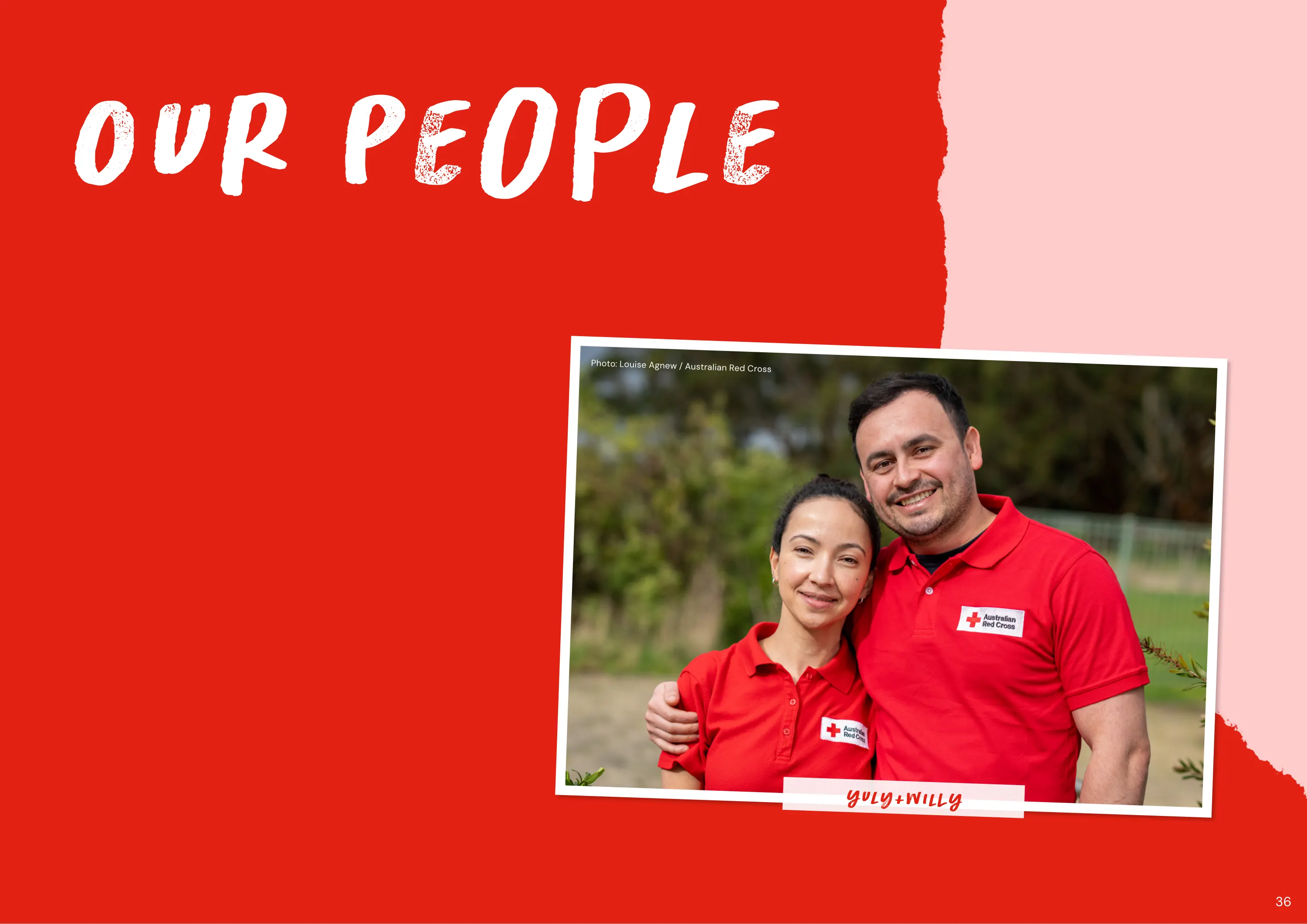
Text of page 36
Our People
-
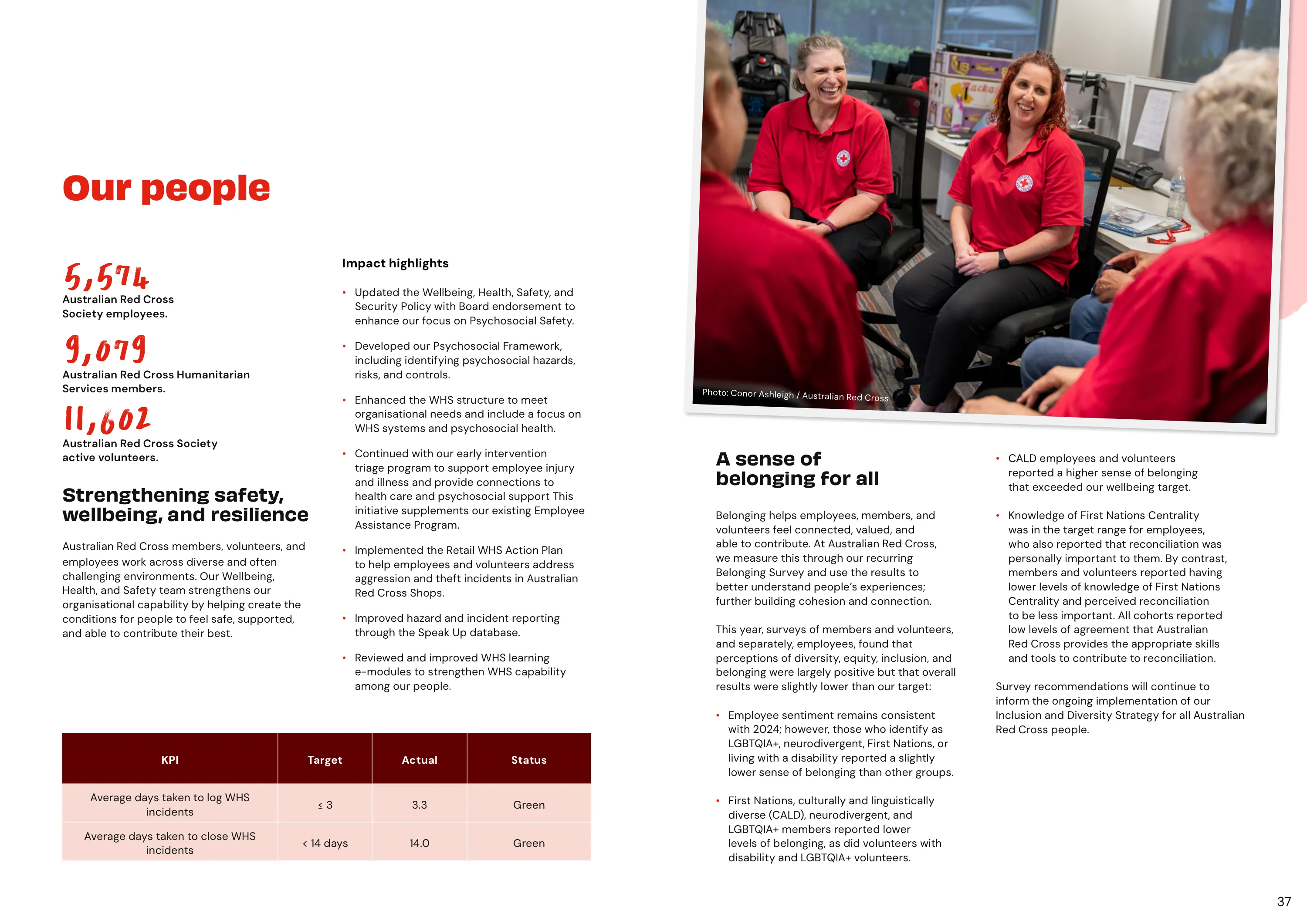
Text of page 37
Our people
5,574 Australian Red Cross Society employees.
9,079 Australian Red Cross Humanitarian Services members.
11,602 Australian Red Cross Society active volunteers.
Strengthening safety, wellbeing, and resilience
Australian Red Cross members, volunteers, and employees work across diverse and often challenging environments. Our Wellbeing, Health, and Safety team strengthens our organisational capability by helping create the conditions for people to feel safe, supported, and able to contribute their best.
Image description: A table of two WHS key performance indicators (KPI) showing the target, actual result and status for each. It is set out below as a list.
- Average days taken to log WHS incidents: Target ≤ 3; Actual 3.3; Status Green.
- Average days taken to close WHS incidents: Target < 14 days; Actual 14.0; Status Green.
Impact highlights
- Updated the Wellbeing, Health, Safety, and Security Policy with Board endorsement to enhance our focus on Psychosocial Safety.
- Developed our Psychosocial Framework, including identifying psychosocial hazards, risks, and controls.
- Enhanced the WHS structure to meet organisational needs and include a focus on WHS systems and psychosocial health.
- Continued with our early intervention triage program to support employee injury and illness and provide connections to health care and psychosocial support This initiative supplements our existing Employee Assistance Program.
- Implemented the Retail WHS Action Plan to help employees and volunteers address aggression and theft incidents in Australian Red Cross Shops.
- Improved hazard and incident reporting through the Speak Up database.
- Reviewed and improved WHS learning e-modules to strengthen WHS capability among our people.
A sense of belonging for all
Belonging helps employees, members, and volunteers feel connected, valued, and able to contribute. At Australian Red Cross, we measure this through our recurring Belonging Survey and use the results to better understand people’s experiences; further building cohesion and connection.
This year, surveys of members and volunteers, and separately, employees, found that perceptions of diversity, equity, inclusion, and belonging were largely positive but that overall results were slightly lower than our target:
- Employee sentiment remains consistent with 2024; however, those who identify as LGBTQIA+, neurodivergent, First Nations, or living with a disability reported a slightly lower sense of belonging than other groups.
- First Nations, culturally and linguistically diverse (CALD), neurodivergent, and LGBTQIA+ members reported lower levels of belonging, as did volunteers with disability and LGBTQIA+ volunteers.
- CALD employees and volunteers reported a higher sense of belonging that exceeded our wellbeing target.
- Knowledge of First Nations Centrality was in the target range for employees, who also reported that reconciliation was personally important to them. By contrast, members and volunteers reported having lower levels of knowledge of First Nations Centrality and perceived reconciliation to be less important. All cohorts reported low levels of agreement that Australian Red Cross provides the appropriate skills and tools to contribute to reconciliation.
Survey recommendations will continue to inform the ongoing implementation of our Inclusion and Diversity Strategy for all Australian Red Cross people.
-
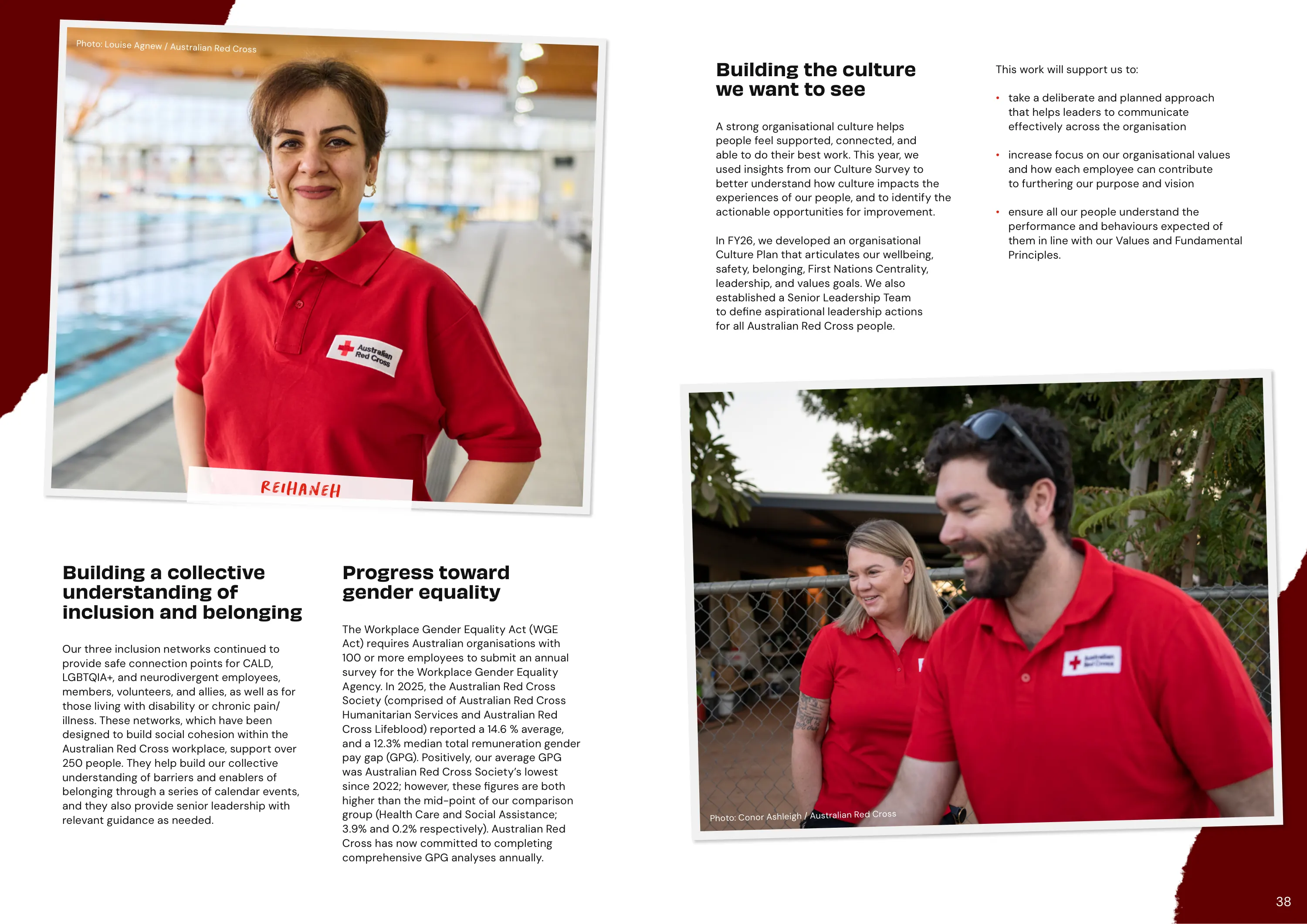
Text of page 38
Building a collective understanding of inclusion and belonging
Our three inclusion networks continued to provide safe connection points for CALD, LGBTQIA+, and neurodivergent employees, members, volunteers, and allies, as well as for those living with disability or chronic pain/ illness. These networks, which have been designed to build social cohesion within the Australian Red Cross workplace, support over 250 people. They help build our collective understanding of barriers and enablers of belonging through a series of calendar events, and they also provide senior leadership with relevant guidance as needed.
Progress toward gender equality
The Workplace Gender Equality Act (WGE Act) requires Australian organisations with 100 or more employees to submit an annual survey for the Workplace Gender Equality Agency. In 2025, the Australian Red Cross Society (comprised of Australian Red Cross Humanitarian Services and Australian Red Cross Lifeblood) reported a 14.6 % average, and a 12.3% median total remuneration gender pay gap (GPG). Positively, our average GPG was Australian Red Cross Society’s lowest since 2022; however, these figures are both higher than the mid-point of our comparison group (Health Care and Social Assistance; 3.9% and 0.2% respectively). Australian Red Cross has now committed to completing comprehensive GPG analyses annually.
Building the culture we want to see
A strong organisational culture helps people feel supported, connected, and able to do their best work. This year, we used insights from our Culture Survey to better understand how culture impacts the experiences of our people, and to identify the actionable opportunities for improvement.
In FY26, we developed an organisational Culture Plan that articulates our wellbeing, safety, belonging, First Nations Centrality, leadership, and values goals. We also established a Senior Leadership Team to define aspirational leadership actions for all Australian Red Cross people.
This work will support us to:
- take a deliberate and planned approach that helps leaders to communicate effectively across the organisation
- increase focus on our organisational values and how each employee can contribute to furthering our purpose and vision
- ensure all our people understand the performance and behaviours expected of them in line with our Values and Fundamental Principles.
-
Text of page 39
Governance and risk
-
Text of page 40
Governance
Patron
Her Excellency The Honourable Sam Mostyn AC, Governor-General of Australia, is Patron of Australian Red Cross Society. More details about our Patron can be found at redcross.org.au/governance.
National Council
The National Council is the peak representative body for Members of Australian Red Cross. It holds specific powers under the Rules, including electing the President and appointing the Board Members (except the Australian Red Cross Lifeblood Chair, who is appointed by the Board).
Our President, Kate Jenkins AO, was elected by the National Council and is a pivotal ambassador for Australian Red Cross. Her role (which is separate to the role of the Board Chair) includes public speaking engagements and other ceremonial duties, chairing the National Council, and acting as our ambassador and relationship builder.
Kate Jenkins AO BA (Hons), LLB (Hons), GAICD President
Kate Jenkins was appointed as President in July 2025.
Kate is currently Chair of the Australian Sports Commission and the Creative Workplaces Council. Previously, she was the Australian Sex Discrimination Commissioner, the Victorian Equal Opportunity and Human Rights Commissioner, an Employment Law Partner at Herbert Smith Freehills, the Chair of Play by the Rules, and a non-executive director of Berry Street Victoria, Carlton Football Club, and the Heide Museum of Modern Art.
Board
The Board is responsible for governing Australian Red Cross Society and ensuring that it carries out its objects under the Rules. The Board holds all the powers of the Australian Red Cross Society that are not required by the Royal Charter or Rules to be exercised by the National Council.
At 30 June 2026, the Board had two formal Board Committees: the Finance, Risk, and Audit Committee and the Governance, People, Remuneration, and Culture Committee.
Details of attendance at 2025/26 Board and Board Committee meetings are set out on page 44 of this Annual Report.
Board Members
Claire Rogers MBA, BA, FAICD
Board Chair and Board Member
Claire Rogers was appointed as a Board Member in July 2025 and as Board Chair in December 2025.
She is a member of the Finance, Risk, and Audit Committee; Governance, People, Remuneration, and Culture Committee; and the Australian Red Cross Lifeblood Board.
Claire is currently a non-executive director of Victorian Funds Management Corporation, Spiire Limited, auDA Limited, and Melbourne Business School. She is also Group Chair, CEO Mastermind and Managing Partner, Advisory Services at Mentorlist, and co-founder and director of Dutyof.care Solutions Pty Ltd trading as Oho.
Previously, Claire was Chief Executive of World Vision Australia; held senior leadership roles with ANZ; and was a non-executive director of Payton Capital Ltd, Methodist Ladies College (Kew), Australian Council for International Development, and Ridley College (Melbourne).
Annette Ruhotas AM BEng(Civil) Hons., BEd(Science) Dist., MAICD
Deputy Board Chair and Board Member
Annette Ruhotas Morgan AM was appointed as a Board Member in December 2023 and as Deputy Board Chair in July 2025.
She is a member of the Governance, People, Remuneration, and Culture Committee and the Australian Red Cross Lifeblood Board and Chair of the National Awards Panel and Lady Lawley Cottage Management Committee.
Annette’s current roles include non-executive director for Kimbriki Environmental Enterprises Pty Ltd and The Reconnect Project Limited; a Board member for the NSW Board of Medical Board of Australia; a Council member for the Medical Council of NSW, the Therapeutic Goods Administration Advisory Committee on Chemicals Scheduling; and an independent expert for the NSW Department of Planning.
Previously, Annette was Chair of Playgroup NSW Inc.; a non-executive director of One Door Mental Health Limited and Playgroup Australia Limited; and General Manager, Social Sustainability & the Lendlease Foundation for Lendlease Corporation.
-
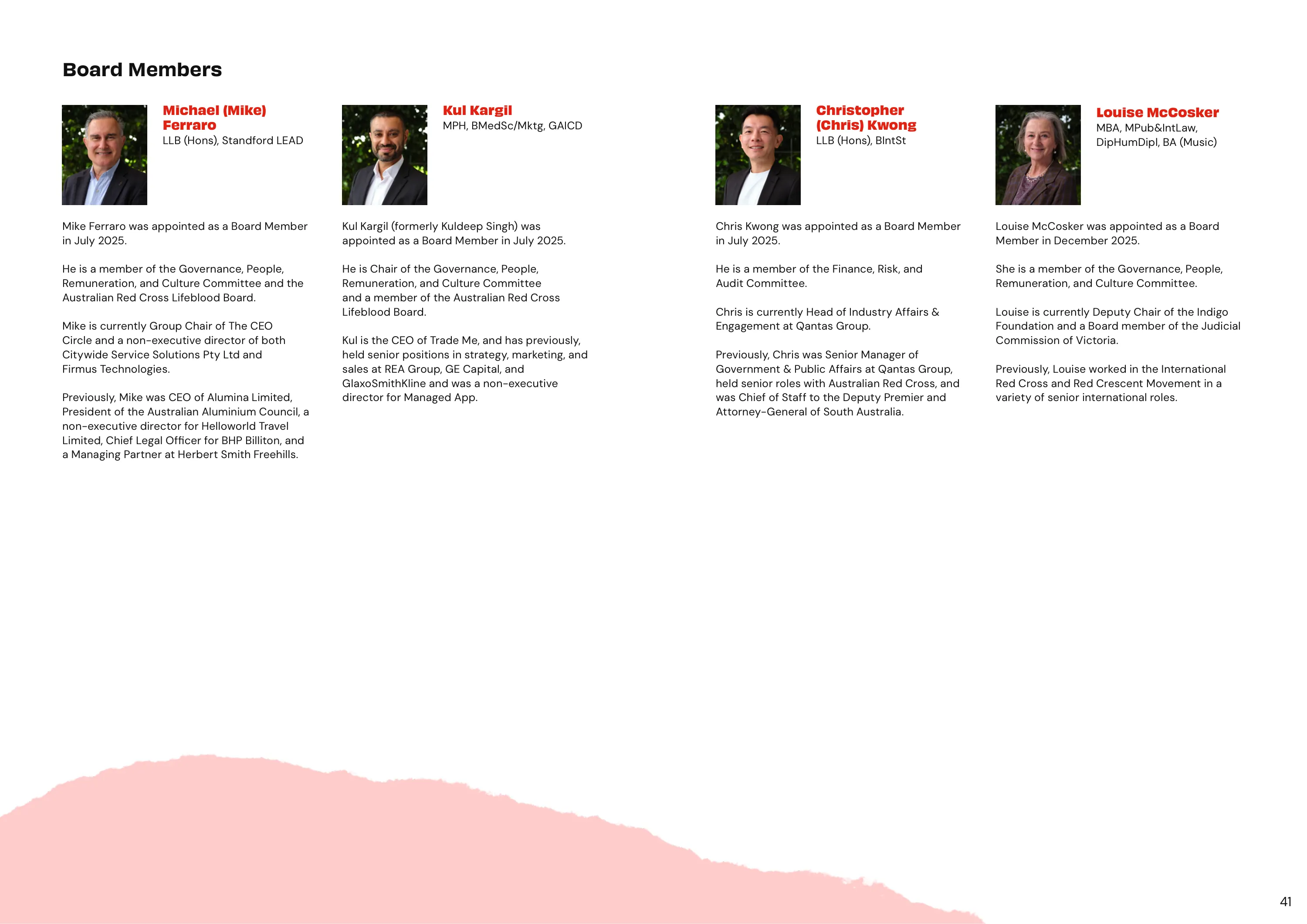
Text of page 41
Board Members
Michael (Mike) Ferraro LLB (Hons), Standford LEAD
Mike Ferraro was appointed as a Board Member in July 2025.
He is a member of the Governance, People, Remuneration, and Culture Committee and the Australian Red Cross Lifeblood Board.
Mike is currently Group Chair of The CEO Circle and a non-executive director of both Citywide Service Solutions Pty Ltd and Firmus Technologies.
Previously, Mike was CEO of Alumina Limited, President of the Australian Aluminium Council, a non-executive director for Helloworld Travel Limited, Chief Legal Officer for BHP Billiton, and a Managing Partner at Herbert Smith Freehills.
Kul Kargil MPH, BMedSc/Mktg, GAICD
Kul Kargil (formerly Kuldeep Singh) was appointed as a Board Member in July 2025.
He is Chair of the Governance, People, Remuneration, and Culture Committee and a member of the Australian Red Cross Lifeblood Board.
Kul is the CEO of Trade Me, and has previously, held senior positions in strategy, marketing, and sales at REA Group, GE Capital, and GlaxoSmithKline and was a non-executive director for Managed App.
Christopher (Chris) Kwong LLB (Hons), BIntSt
Chris Kwong was appointed as a Board Member in July 2025.
He is a member of the Finance, Risk, and Audit Committee.
Chris is currently Head of Industry Affairs & Engagement at Qantas Group.
Previously, Chris was Senior Manager of Government & Public Affairs at Qantas Group, held senior roles with Australian Red Cross, and was Chief of Staff to the Deputy Premier and Attorney-General of South Australia.
Louise McCosker MBA, MPub&IntLaw, DipHumDipl, BA (Music)
Louise McCosker was appointed as a Board Member in December 2025.
She is a member of the Governance, People, Remuneration, and Culture Committee.
Louise is currently Deputy Chair of the Indigo Foundation and a Board member of the Judicial Commission of Victoria.
Previously, Louise worked in the International Red Cross and Red Crescent Movement in a variety of senior international roles.
-
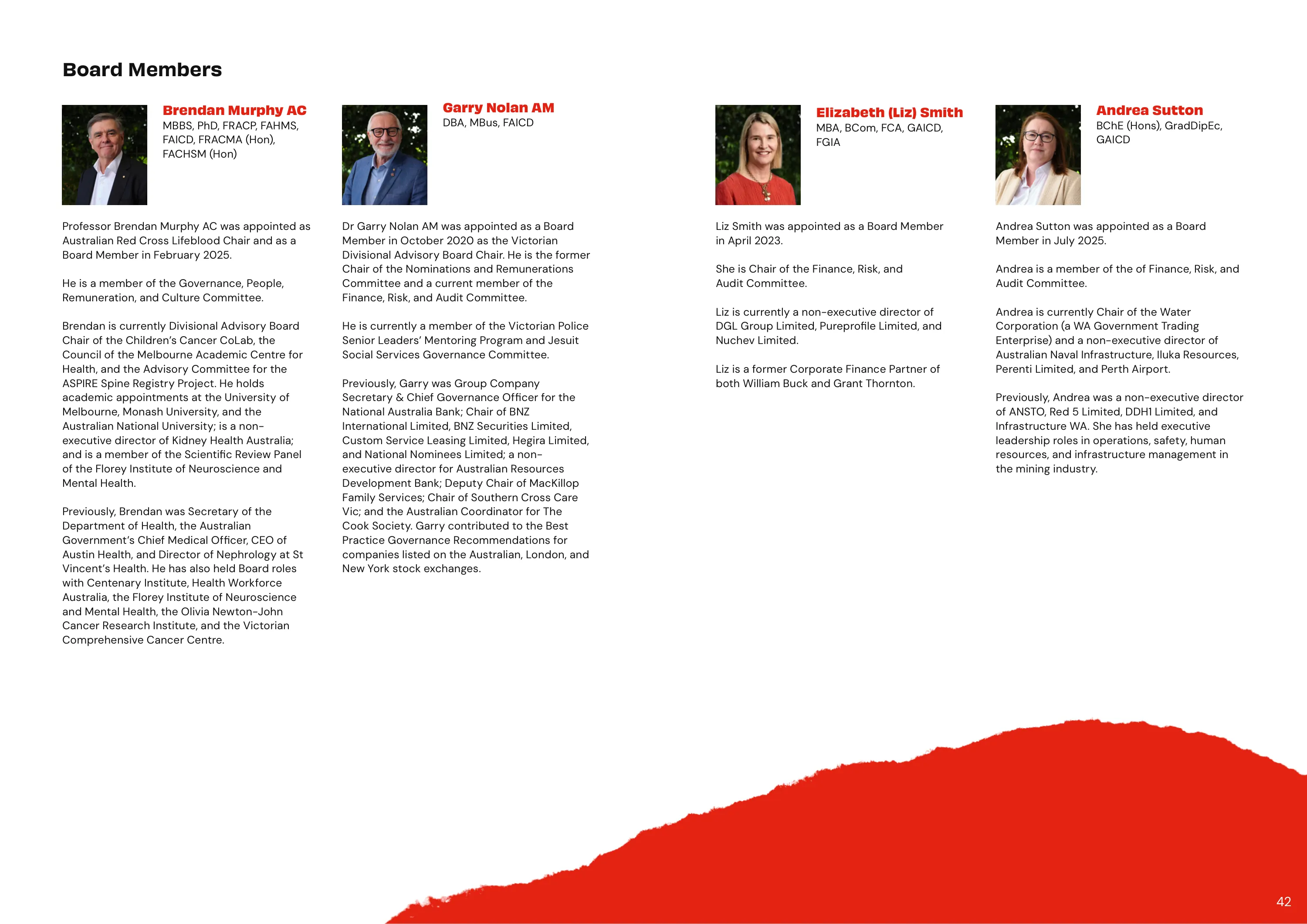
Text of page 42
Board Members
Brendan Murphy AC MBBS, PhD, FRACP, FAHMS, FAICD, FRACMA (Hon), FACHSM (Hon)
Professor Brendan Murphy AC was appointed as Australian Red Cross Lifeblood Chair and as a Board Member in February 2025.
He is a member of the Governance, People, Remuneration, and Culture Committee.
Brendan is currently Divisional Advisory Board Chair of the Children’s Cancer CoLab, the Council of the Melbourne Academic Centre for Health, and the Advisory Committee for the ASPIRE Spine Registry Project. He holds academic appointments at the University of Melbourne, Monash University, and the Australian National University; is a non-executive director of Kidney Health Australia; and is a member of the Scientific Review Panel of the Florey Institute of Neuroscience and Mental Health.
Previously, Brendan was Secretary of the Department of Health, the Australian Government’s Chief Medical Officer, CEO of Austin Health, and Director of Nephrology at St Vincent’s Health. He has also held Board roles with Centenary Institute, Health Workforce Australia, the Florey Institute of Neuroscience and Mental Health, the Olivia Newton-John Cancer Research Institute, and the Victorian Comprehensive Cancer Centre.
Garry Nolan AM DBA, MBus, FAICD
Dr Garry Nolan AM was appointed as a Board Member in October 2020 as the Victorian Divisional Advisory Board Chair. He is the former Chair of the Nominations and Remunerations Committee and a current member of the Finance, Risk, and Audit Committee.
He is currently a member of the Victorian Police Senior Leaders’ Mentoring Program and Jesuit Social Services Governance Committee.
Previously, Garry was Group Company Secretary & Chief Governance Officer for the National Australia Bank; Chair of BNZ International Limited, BNZ Securities Limited, Custom Service Leasing Limited, Hegira Limited, and National Nominees Limited; a non-executive director for Australian Resources Development Bank; Deputy Chair of MacKillop Family Services; Chair of Southern Cross Care Vic; and the Australian Coordinator for The Cook Society. Garry contributed to the Best Practice Governance Recommendations for companies listed on the Australian, London, and New York stock exchanges.
Elizabeth (Liz) Smith MBA, BCom, FCA, GAICD, FGIA
Liz Smith was appointed as a Board Member in April 2023.
She is Chair of the Finance, Risk, and Audit Committee.
Liz is currently a non-executive director of DGL Group Limited, Pureprofile Limited, and Nuchev Limited.
Liz is a former Corporate Finance Partner of both William Buck and Grant Thornton.
Andrea Sutton BChE (Hons), GradDipEc, GAICD
Andrea Sutton was appointed as a Board Member in July 2025.
Andrea is a member of the of Finance, Risk, and Audit Committee.
Andrea is currently Chair of the Water Corporation (a WA Government Trading Enterprise) and a non-executive director of Australian Naval Infrastructure, Iluka Resources, Perenti Limited, and Perth Airport.
Previously, Andrea was a non-executive director of ANSTO, Red 5 Limited, DDH1 Limited, and Infrastructure WA. She has held executive leadership roles in operations, safety, human resources, and infrastructure management in the mining industry.
-
Text of page 43
Charles Burkitt GAICD
(Retired Dec 2025)
Charles Burkitt was appointed as a Board Member in October 2014, elected as Deputy President in November 2019, elected as President in December 2023, and appointed as Board Chair in July 2025. Charles retired from the Board in December 2025.
At the time of his retirement, Charles was a member of the Audit and Risk Committee, Finance Committee, Nominations and Remuneration Committee, and Australian Red Cross Lifeblood Board.
Society Secretary
The Society Secretary holds office on the terms and conditions and with the powers and duties as determined by the Board.
Jennifer Currie LLM (IP), BCom, LLB (Hons), GDipACG, Oxford Executive Leadership Programme, GAICD, FGIA
Jennifer Currie was appointed as Society Secretary in June 2021.
Previously, Jennifer was the Company Secretary for Equity Trustees Limited; Chief Legal Officer & Company Secretary for Syrah Resources Limited; General Counsel & Company Secretary for Capital Health Limited; General Counsel & Company Secretary for the Baker Heart & Diabetes Institute; and a non-executive director of Ceridian Australia, Summer Infant Australia and the Intensive Care Foundation of Australia and New Zealand.
CEO
The CEO (Secretary-General) is responsible for the day-to-day management of Australian Red Cross Society with all powers, discretions, and delegations authorised, from time to time, by the Board.
Penny Harrison MA, BA (Hons)
Interim CEO
Penny Harrison was appointed as Interim CEO in July 2025.
Penny is currently a member of the International Advisory Board for the Australian Research Council Centre of Excellence for Automated Decision-Making and Society.
Previously, Penny has held senior roles at Australian Red Cross, including Deputy CEO, Chief of Staff, Director – Volunteering, and Director – Victoria.
Andrew Colvin AO APM MPA, BA(Pol), BA
CEO (Retired June 2026)
Andrew Colvin was appointed as CEO in July 2024 and retired as CEO in June 2026.
Andrew is a member of the Champions of Change Founding Group.
Previously, Andrew was a partner at Deloitte, National Coordinator of the National Bushfire Recovery Agency, and Commissioner of the Australian Federal Police.
Australian Red Cross Lifeblood Board
The Board appoints a separate body (called the Australian Red Cross Lifeblood Board) with delegations authorised from time to time by the Board, to oversee Australian Red Cross Lifeblood (which is an operating division of Australian Red Cross Society). Members of the Australian Red Cross Lifeblood Board and its Committees are remunerated in connection with those positions.
Details about Australian Red Cross Lifeblood’s current Board Members can be found at redcross.org.au/governance/lifeblood.
Australian Red Cross Lifeblood CEO
Stephen Cornelissen AM BN, MHA, Grad Cert Leadership and Catholic Culture, PGDipSI (Oxford), FAICD
CEO
Stephen Cornelissen AM is Chief Executive Officer of Australian Red Cross Lifeblood and an experienced healthcare leader whose career spans hospitals, aged care, community organisations and government across metropolitan and regional Australia and New Zealand. Stephen is committed to improving public health outcomes, strengthening organisational performance and building mission-led cultures of learning, accountability and continuous improvement. In 2016, the CEO Magazine Awards named him Chief Executive Officer of the Year and Health Service Executive of the Year.
A Fellow of the Australian Institute of Company Directors, Stephen has also held several non-executive director roles.
-
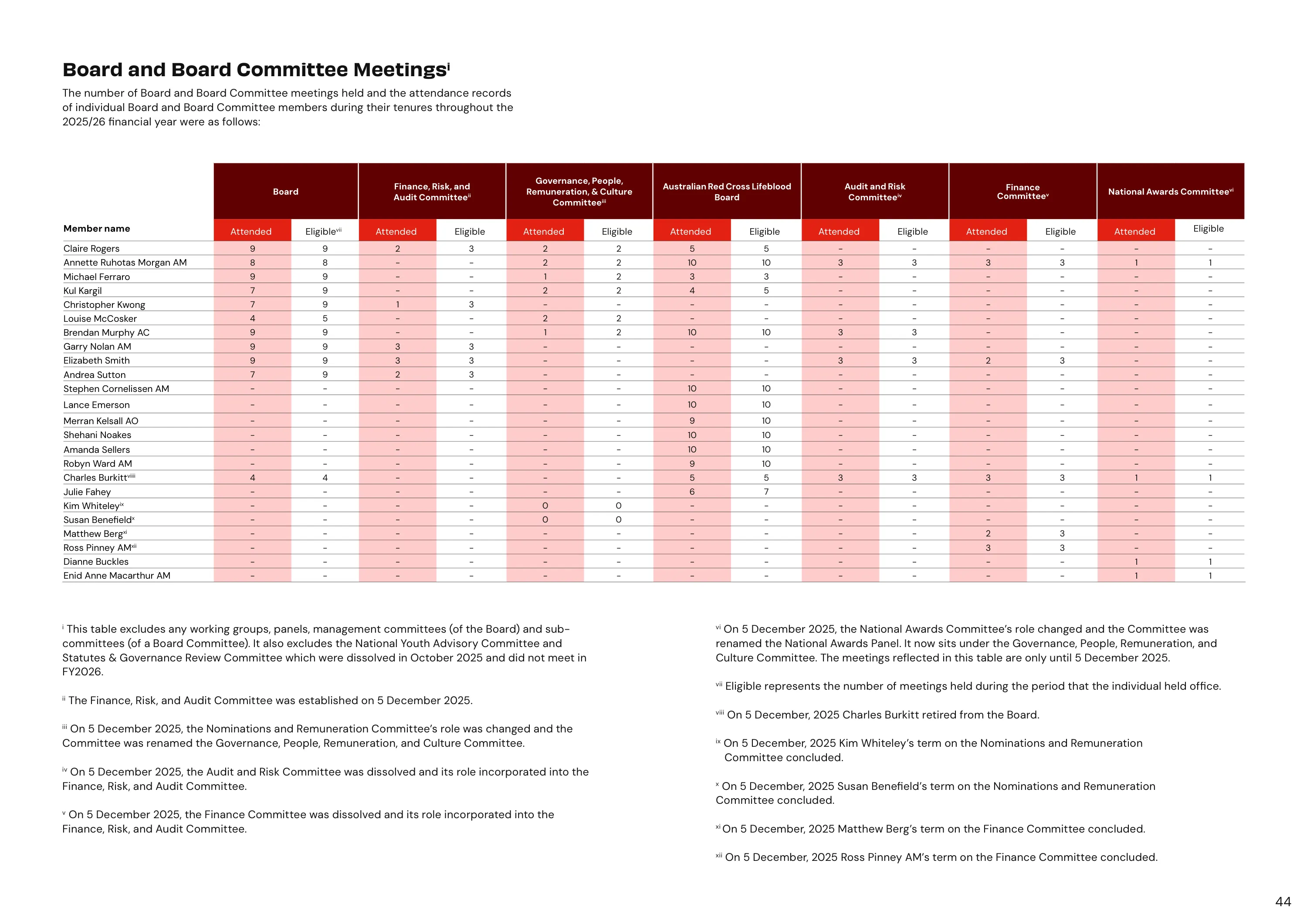
Text of page 44
Board and Board Committee Meetings i
The number of Board and Board Committee meetings held and the attendance records of individual Board and Board Committee members during their tenures throughout the 2025/26 financial year were as follows:
Image description: A table of meeting attendance for 2025/26, showing for each member the number of meetings attended out of the number they were eligible to attend, for the Board and each Board Committee. It is set out below as a list.
- Claire Rogers: Board 9 of 9; Finance, Risk, and Audit Committee 2 of 3; Governance, People, Remuneration, & Culture Committee 2 of 2; Australian Red Cross Lifeblood Board 5 of 5.
- Annette Ruhotas Morgan AM: Board 8 of 8; Governance, People, Remuneration, & Culture Committee 2 of 2; Australian Red Cross Lifeblood Board 10 of 10; Audit and Risk Committee 3 of 3; Finance Committee 3 of 3; National Awards Committee 1 of 1.
- Michael Ferraro: Board 9 of 9; Governance, People, Remuneration, & Culture Committee 1 of 2; Australian Red Cross Lifeblood Board 3 of 3.
- Kul Kargil: Board 7 of 9; Governance, People, Remuneration, & Culture Committee 2 of 2; Australian Red Cross Lifeblood Board 4 of 5.
- Christopher Kwong: Board 7 of 9; Finance, Risk, and Audit Committee 1 of 3.
- Louise McCosker: Board 4 of 5; Governance, People, Remuneration, & Culture Committee 2 of 2.
- Brendan Murphy AC: Board 9 of 9; Governance, People, Remuneration, & Culture Committee 1 of 2; Australian Red Cross Lifeblood Board 10 of 10; Audit and Risk Committee 3 of 3.
- Garry Nolan AM: Board 9 of 9; Finance, Risk, and Audit Committee 3 of 3.
- Elizabeth Smith: Board 9 of 9; Finance, Risk, and Audit Committee 3 of 3; Audit and Risk Committee 3 of 3; Finance Committee 2 of 3.
- Andrea Sutton: Board 7 of 9; Finance, Risk, and Audit Committee 2 of 3.
- Stephen Cornelissen AM: Australian Red Cross Lifeblood Board 10 of 10.
- Lance Emerson: Australian Red Cross Lifeblood Board 10 of 10.
- Merran Kelsall AO: Australian Red Cross Lifeblood Board 9 of 10.
- Shehani Noakes: Australian Red Cross Lifeblood Board 10 of 10.
- Amanda Sellers: Australian Red Cross Lifeblood Board 10 of 10.
- Robyn Ward AM: Australian Red Cross Lifeblood Board 9 of 10.
- Charles Burkitt: Board 4 of 4; Australian Red Cross Lifeblood Board 5 of 5; Audit and Risk Committee 3 of 3; Finance Committee 3 of 3; National Awards Committee 1 of 1.
- Julie Fahey: Australian Red Cross Lifeblood Board 6 of 7.
- Kim Whiteley: Governance, People, Remuneration, & Culture Committee 0 of 0.
- Susan Benefield: Governance, People, Remuneration, & Culture Committee 0 of 0.
- Matthew Berg: Finance Committee 2 of 3.
- Ross Pinney AM: Finance Committee 3 of 3.
- Dianne Buckles: National Awards Committee 1 of 1.
- Enid Anne Macarthur AM: National Awards Committee 1 of 1.
i This table excludes any working groups, panels, management committees (of the Board) and sub-committees (of a Board Committee). It also excludes the National Youth Advisory Committee and Statutes & Governance Review Committee which were dissolved in October 2025 and did not meet in FY2026.
ii The Finance, Risk, and Audit Committee was established on 5 December 2025.
iii On 5 December 2025, the Nominations and Remuneration Committee’s role was changed and the Committee was renamed the Governance, People, Remuneration, and Culture Committee.
iv On 5 December 2025, the Audit and Risk Committee was dissolved and its role incorporated into the Finance, Risk, and Audit Committee.
v On 5 December 2025, the Finance Committee was dissolved and its role incorporated into the Finance, Risk, and Audit Committee.
vi On 5 December 2025, the National Awards Committee’s role changed and the Committee was renamed the National Awards Panel. It now sits under the Governance, People, Remuneration, and Culture Committee. The meetings reflected in this table are only until 5 December 2025.
vii Eligible represents the number of meetings held during the period that the individual held office.
viii On 5 December, 2025 Charles Burkitt retired from the Board.
ix On 5 December, 2025 Kim Whiteley’s term on the Nominations and Remuneration Committee concluded.
x On 5 December, 2025 Susan Benefield’s term on the Nominations and Remuneration Committee concluded.
xi On 5 December, 2025 Matthew Berg’s term on the Finance Committee concluded.
xii On 5 December, 2025 Ross Pinney AM’s term on the Finance Committee concluded.
-
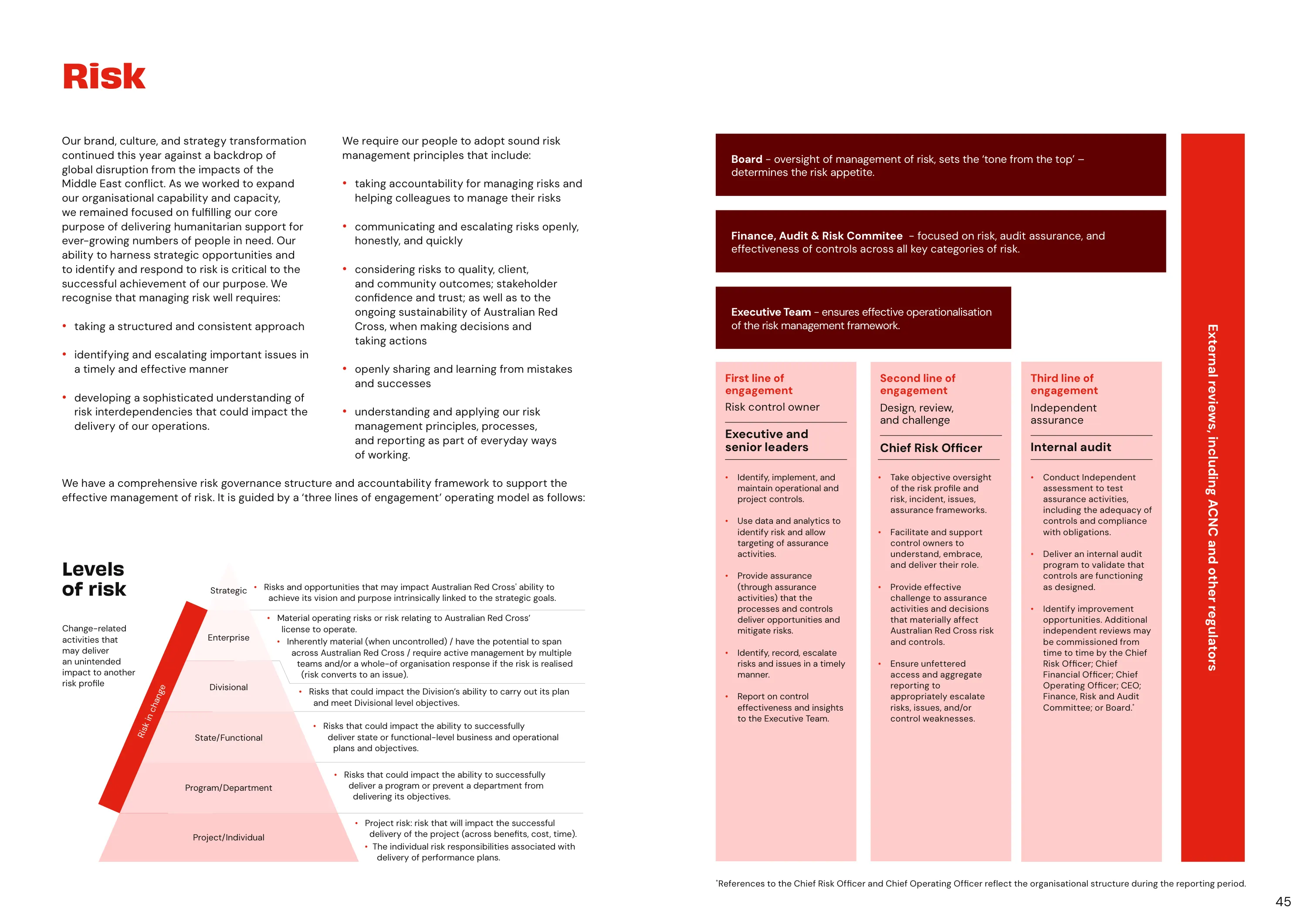
Text of page 45
Risk
Our brand, culture, and strategy transformation continued this year against a backdrop of global disruption from the impacts of the Middle East conflict. As we worked to expand our organisational capability and capacity, we remained focused on fulfilling our core purpose of delivering humanitarian support for ever-growing numbers of people in need. Our ability to harness strategic opportunities and to identify and respond to risk is critical to the successful achievement of our purpose. We recognise that managing risk well requires:
- taking a structured and consistent approach
- identifying and escalating important issues in a timely and effective manner
- developing a sophisticated understanding of risk interdependencies that could impact the delivery of our operations.
We require our people to adopt sound risk management principles that include:
- taking accountability for managing risks and helping colleagues to manage their risks
- communicating and escalating risks openly, honestly, and quickly
- considering risks to quality, client, and community outcomes; stakeholder confidence and trust; as well as to the ongoing sustainability of Australian Red Cross, when making decisions and taking actions
- openly sharing and learning from mistakes and successes
- understanding and applying our risk management principles, processes, and reporting as part of everyday ways of working.
We have a comprehensive risk governance structure and accountability framework to support the effective management of risk. It is guided by a ‘three lines of engagement’ operating model as follows:
Levels of risk
Image description: A pyramid showing six levels of risk, from Strategic at the top to Project/Individual at the base. An arrow labelled ‘Risk in change’ runs up the side, with a note that reads: Change-related activities that may deliver an unintended impact to another risk profile. The levels are listed below.
Strategic
- Risks and opportunities that may impact Australian Red Cross’ ability to achieve its vision and purpose intrinsically linked to the strategic goals.
Enterprise
- Material operating risks or risk relating to Australian Red Cross’ license to operate.
- Inherently material (when uncontrolled) / have the potential to span across Australian Red Cross / require active management by multiple teams and/or a whole-of organisation response if the risk is realised (risk converts to an issue).
Divisional
- Risks that could impact the Division’s ability to carry out its plan and meet Divisional level objectives.
State/Functional
- Risks that could impact the ability to successfully deliver state or functional-level business and operational plans and objectives.
Program/Department
- Risks that could impact the ability to successfully deliver a program or prevent a department from delivering its objectives.
Project/Individual
- Project risk: risk that will impact the successful delivery of the project (across benefits, cost, time).
- The individual risk responsibilities associated with delivery of performance plans.
Three lines of engagement
Image description: A diagram of the risk governance structure. Three oversight bodies sit across the top, the three lines of engagement sit below them, and a bar down the side reads: External reviews, including ACNC and other regulators.
Board - oversight of management of risk, sets the ‘tone from the top’ – determines the risk appetite.
Finance, Audit & Risk Commitee - focused on risk, audit assurance, and effectiveness of controls across all key categories of risk.
Executive Team - ensures effective operationalisation of the risk management framework.
First line of engagement
Risk control owner
Executive and senior leaders
- Identify, implement, and maintain operational and project controls.
- Use data and analytics to identify risk and allow targeting of assurance activities.
- Provide assurance (through assurance activities) that the processes and controls deliver opportunities and mitigate risks.
- Identify, record, escalate risks and issues in a timely manner.
- Report on control effectiveness and insights to the Executive Team.
Second line of engagement
Design, review, and challenge
Chief Risk Officer
- Take objective oversight of the risk profile and risk, incident, issues, assurance frameworks.
- Facilitate and support control owners to understand, embrace, and deliver their role.
- Provide effective challenge to assurance activities and decisions that materially affect Australian Red Cross risk and controls.
- Ensure unfettered access and aggregate reporting to appropriately escalate risks, issues, and/or control weaknesses.
Third line of engagement
Independent assurance
Internal audit
- Conduct Independent assessment to test assurance activities, including the adequacy of controls and compliance with obligations.
- Deliver an internal audit program to validate that controls are functioning as designed.
- Identify improvement opportunities. Additional independent reviews may be commissioned from time to time by the Chief Risk Officer; Chief Financial Officer; Chief Operating Officer; CEO; Finance, Risk and Audit Committee; or Board. *
* References to the Chief Risk Officer and Chief Operating Officer reflect the organisational structure during the reporting period.
-
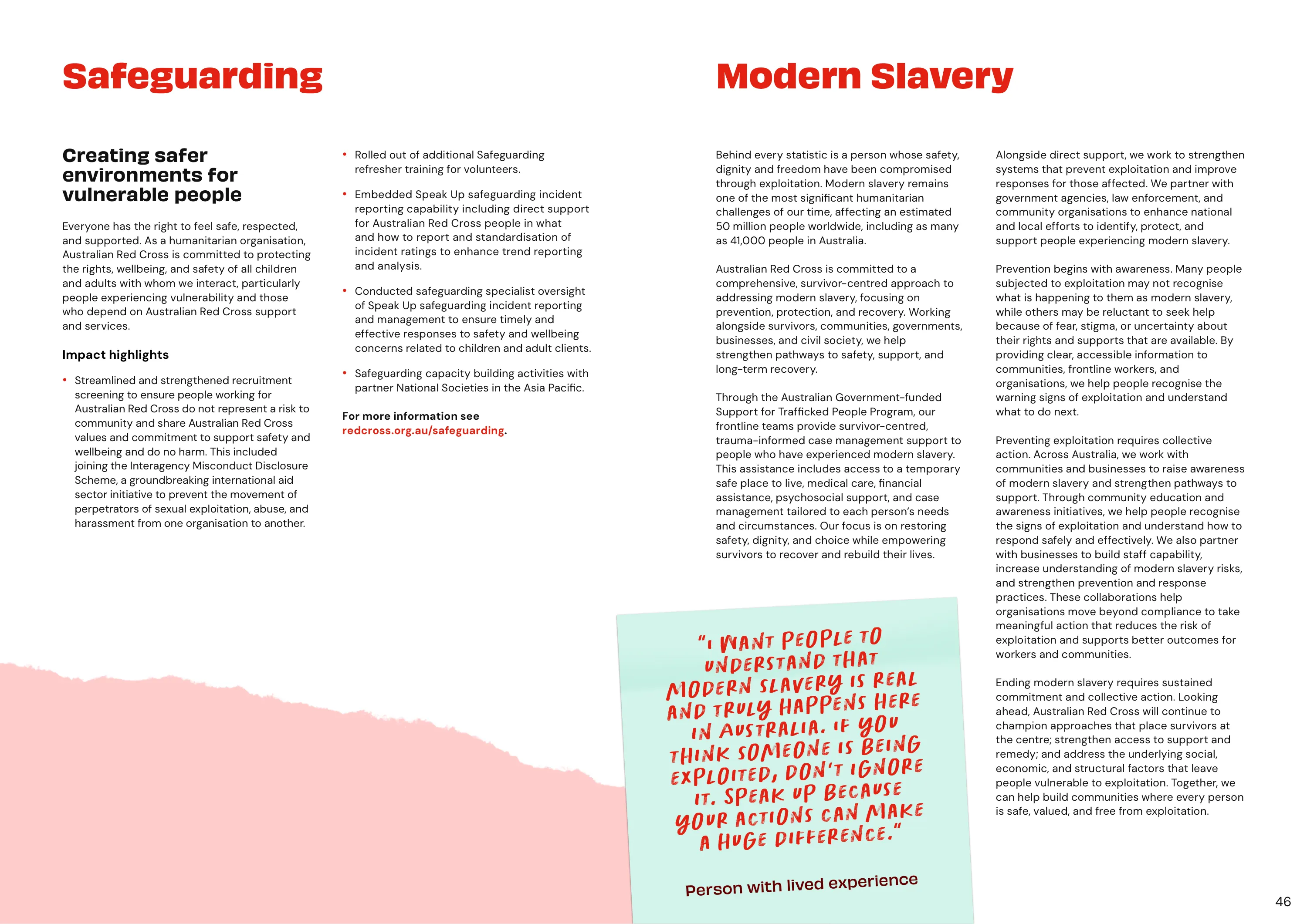
Text of page 46
Safeguarding
Creating safer environments for vulnerable people
Everyone has the right to feel safe, respected, and supported. As a humanitarian organisation, Australian Red Cross is committed to protecting the rights, wellbeing, and safety of all children and adults with whom we interact, particularly people experiencing vulnerability and those who depend on Australian Red Cross support and services.
Impact highlights
- Streamlined and strengthened recruitment screening to ensure people working for Australian Red Cross do not represent a risk to community and share Australian Red Cross values and commitment to support safety and wellbeing and do no harm. This included joining the Interagency Misconduct Disclosure Scheme, a groundbreaking international aid sector initiative to prevent the movement of perpetrators of sexual exploitation, abuse, and harassment from one organisation to another.
- Rolled out of additional Safeguarding refresher training for volunteers.
- Embedded Speak Up safeguarding incident reporting capability including direct support for Australian Red Cross people in what and how to report and standardisation of incident ratings to enhance trend reporting and analysis.
- Conducted safeguarding specialist oversight of Speak Up safeguarding incident reporting and management to ensure timely and effective responses to safety and wellbeing concerns related to children and adult clients.
- Safeguarding capacity building activities with partner National Societies in the Asia Pacific.
For more information see redcross.org.au/safeguarding.
Modern Slavery
Behind every statistic is a person whose safety, dignity and freedom have been compromised through exploitation. Modern slavery remains one of the most significant humanitarian challenges of our time, affecting an estimated 50 million people worldwide, including as many as 41,000 people in Australia.
Australian Red Cross is committed to a comprehensive, survivor-centred approach to addressing modern slavery, focusing on prevention, protection, and recovery. Working alongside survivors, communities, governments, businesses, and civil society, we help strengthen pathways to safety, support, and long-term recovery.
Through the Australian Government-funded Support for Trafficked People Program, our frontline teams provide survivor-centred, trauma-informed case management support to people who have experienced modern slavery. This assistance includes access to a temporary safe place to live, medical care, financial assistance, psychosocial support, and case management tailored to each person’s needs and circumstances. Our focus is on restoring safety, dignity, and choice while empowering survivors to recover and rebuild their lives.
“I want people to understand that modern slavery is real and truly happens here in Australia. If you think someone is being exploited, don’t ignore it. Speak up because your actions can make a huge difference.”
Person with lived experience
Alongside direct support, we work to strengthen systems that prevent exploitation and improve responses for those affected. We partner with government agencies, law enforcement, and community organisations to enhance national and local efforts to identify, protect, and support people experiencing modern slavery.
Prevention begins with awareness. Many people subjected to exploitation may not recognise what is happening to them as modern slavery, while others may be reluctant to seek help because of fear, stigma, or uncertainty about their rights and supports that are available. By providing clear, accessible information to communities, frontline workers, and organisations, we help people recognise the warning signs of exploitation and understand what to do next.
Preventing exploitation requires collective action. Across Australia, we work with communities and businesses to raise awareness of modern slavery and strengthen pathways to support. Through community education and awareness initiatives, we help people recognise the signs of exploitation and understand how to respond safely and effectively. We also partner with businesses to build staff capability, increase understanding of modern slavery risks, and strengthen prevention and response practices. These collaborations help organisations move beyond compliance to take meaningful action that reduces the risk of exploitation and supports better outcomes for workers and communities.
Ending modern slavery requires sustained commitment and collective action. Looking ahead, Australian Red Cross will continue to champion approaches that place survivors at the centre; strengthen access to support and remedy; and address the underlying social, economic, and structural factors that leave people vulnerable to exploitation. Together, we can help build communities where every person is safe, valued, and free from exploitation.
-
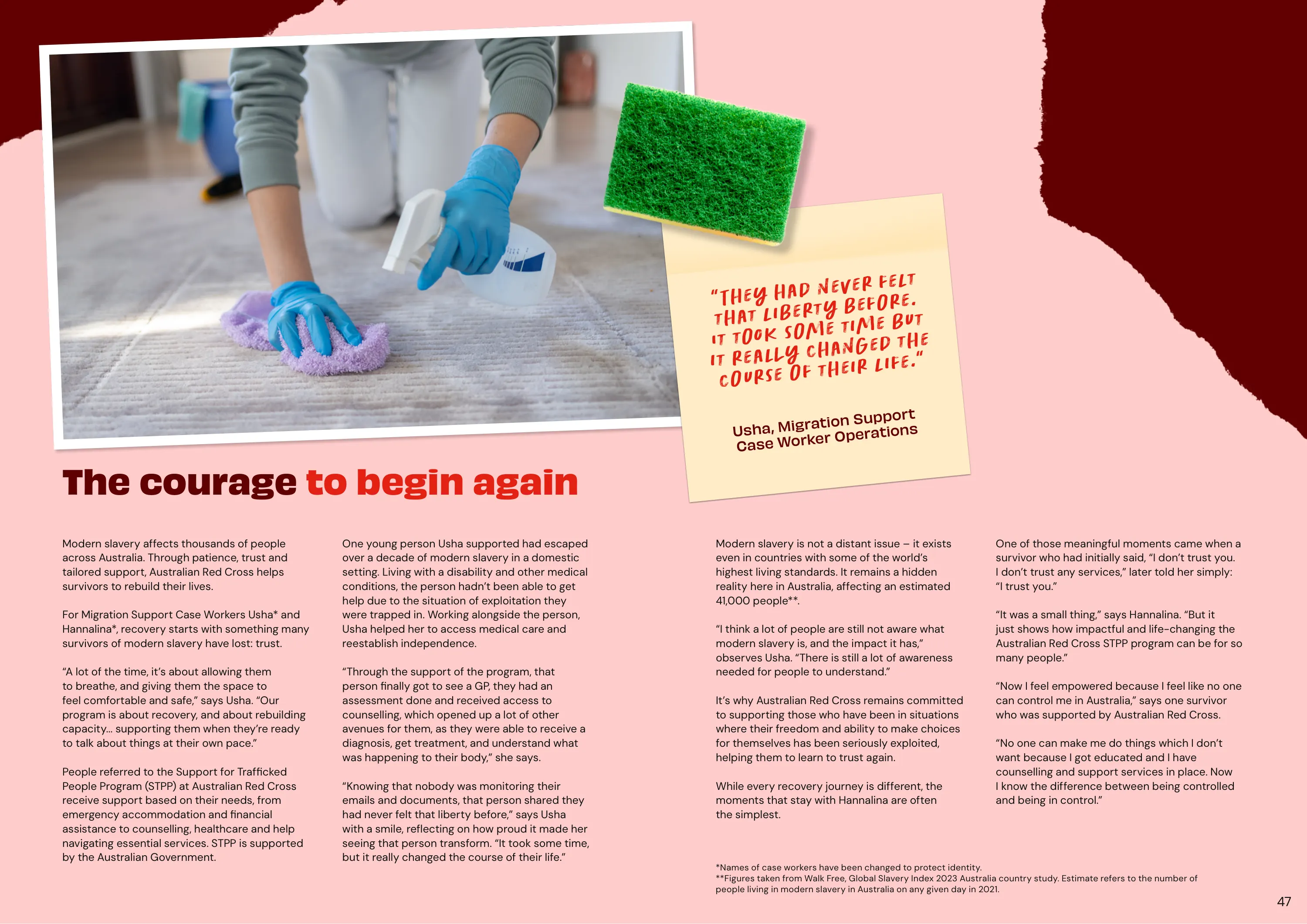
Text of page 47
The courage to begin again
Modern slavery affects thousands of people across Australia. Through patience, trust and tailored support, Australian Red Cross helps survivors to rebuild their lives.
For Migration Support Case Workers Usha* and Hannalina*, recovery starts with something many survivors of modern slavery have lost: trust.
“A lot of the time, it’s about allowing them to breathe, and giving them the space to feel comfortable and safe,” says Usha. “Our program is about recovery, and about rebuilding capacity... supporting them when they’re ready to talk about things at their own pace.”
People referred to the Support for Trafficked People Program (STPP) at Australian Red Cross receive support based on their needs, from emergency accommodation and financial assistance to counselling, healthcare and help navigating essential services. STPP is supported by the Australian Government.
One young person Usha supported had escaped over a decade of modern slavery in a domestic setting. Living with a disability and other medical conditions, the person hadn’t been able to get help due to the situation of exploitation they were trapped in. Working alongside the person, Usha helped her to access medical care and reestablish independence.
“Through the support of the program, that person finally got to see a GP, they had an assessment done and received access to counselling, which opened up a lot of other avenues for them, as they were able to receive a diagnosis, get treatment, and understand what was happening to their body,” she says.
“Knowing that nobody was monitoring their emails and documents, that person shared they had never felt that liberty before,” says Usha with a smile, reflecting on how proud it made her seeing that person transform. “It took some time, but it really changed the course of their life.”
“They had never felt that liberty before. It took some time but it really changed the course of their life.”
Usha, Migration Support Case Worker Operations
Modern slavery is not a distant issue – it exists even in countries with some of the world’s highest living standards. It remains a hidden reality here in Australia, affecting an estimated 41,000 people**.
“I think a lot of people are still not aware what modern slavery is, and the impact it has,” observes Usha. “There is still a lot of awareness needed for people to understand.”
It’s why Australian Red Cross remains committed to supporting those who have been in situations where their freedom and ability to make choices for themselves has been seriously exploited, helping them to learn to trust again.
While every recovery journey is different, the moments that stay with Hannalina are often the simplest.
One of those meaningful moments came when a survivor who had initially said, “I don’t trust you. I don’t trust any services,” later told her simply: “I trust you.”
“It was a small thing,” says Hannalina. “But it just shows how impactful and life-changing the Australian Red Cross STPP program can be for so many people.”
“Now I feel empowered because I feel like no one can control me in Australia,” says one survivor who was supported by Australian Red Cross.
“No one can make me do things which I don’t want because I got educated and I have counselling and support services in place. Now I know the difference between being controlled and being in control.”
*Names of case workers have been changed to protect identity. **Figures taken from Walk Free, Global Slavery Index 2023 Australia country study. Estimate refers to the number of people living in modern slavery in Australia on any given day in 2021.
-
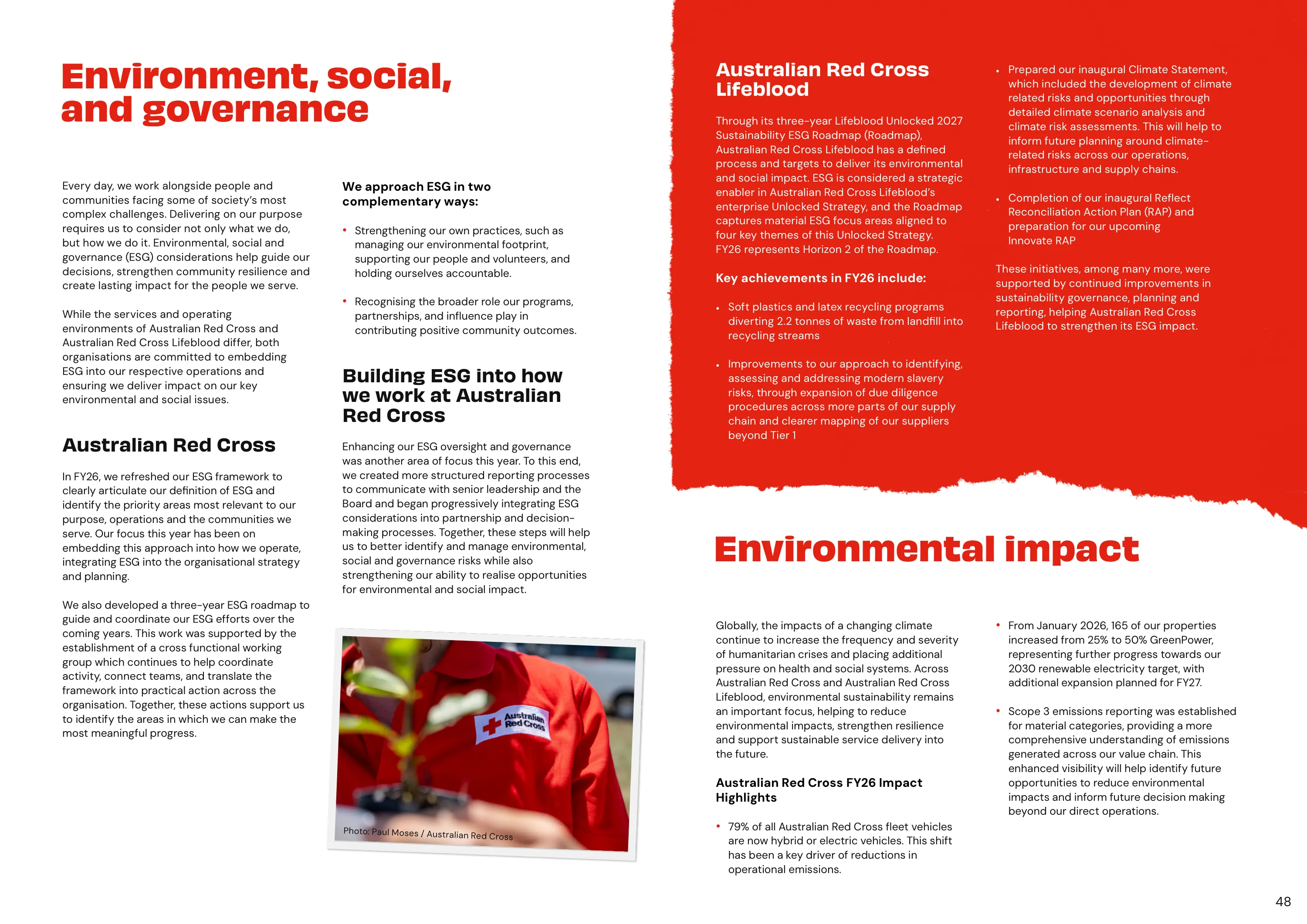
Text of page 48
Environment, social, and governance
Every day, we work alongside people and communities facing some of society’s most complex challenges. Delivering on our purpose requires us to consider not only what we do, but how we do it. Environmental, social and governance (ESG) considerations help guide our decisions, strengthen community resilience and create lasting impact for the people we serve.
While the services and operating environments of Australian Red Cross and Australian Red Cross Lifeblood differ, both organisations are committed to embedding ESG into our respective operations and ensuring we deliver impact on our key environmental and social issues.
Australian Red Cross
In FY26, we refreshed our ESG framework to clearly articulate our definition of ESG and identify the priority areas most relevant to our purpose, operations and the communities we serve. Our focus this year has been on embedding this approach into how we operate, integrating ESG into the organisational strategy and planning.
We also developed a three-year ESG roadmap to guide and coordinate our ESG efforts over the coming years. This work was supported by the establishment of a cross functional working group which continues to help coordinate activity, connect teams, and translate the framework into practical action across the organisation. Together, these actions support us to identify the areas in which we can make the most meaningful progress.
We approach ESG in two complementary ways:
- Strengthening our own practices, such as managing our environmental footprint, supporting our people and volunteers, and holding ourselves accountable.
- Recognising the broader role our programs, partnerships, and influence play in contributing positive community outcomes.
Building ESG into how we work at Australian Red Cross
Enhancing our ESG oversight and governance was another area of focus this year. To this end, we created more structured reporting processes to communicate with senior leadership and the Board and began progressively integrating ESG considerations into partnership and decision-making processes. Together, these steps will help us to better identify and manage environmental, social and governance risks while also strengthening our ability to realise opportunities for environmental and social impact.
Australian Red Cross Lifeblood
Through its three-year Lifeblood Unlocked 2027 Sustainability ESG Roadmap (Roadmap), Australian Red Cross Lifeblood has a defined process and targets to deliver its environmental and social impact. ESG is considered a strategic enabler in Australian Red Cross Lifeblood’s enterprise Unlocked Strategy, and the Roadmap captures material ESG focus areas aligned to four key themes of this Unlocked Strategy. FY26 represents Horizon 2 of the Roadmap.
Key achievements in FY26 include:
- Soft plastics and latex recycling programs diverting 2.2 tonnes of waste from landfill into recycling streams
- Improvements to our approach to identifying, assessing and addressing modern slavery risks, through expansion of due diligence procedures across more parts of our supply chain and clearer mapping of our suppliers beyond Tier 1
- Prepared our inaugural Climate Statement, which included the development of climate related risks and opportunities through detailed climate scenario analysis and climate risk assessments. This will help to inform future planning around climate-related risks across our operations, infrastructure and supply chains.
- Completion of our inaugural Reflect Reconciliation Action Plan (RAP) and preparation for our upcoming Innovate RAP
These initiatives, among many more, were supported by continued improvements in sustainability governance, planning and reporting, helping Australian Red Cross Lifeblood to strengthen its ESG impact.
Environmental impact
Globally, the impacts of a changing climate continue to increase the frequency and severity of humanitarian crises and placing additional pressure on health and social systems. Across Australian Red Cross and Australian Red Cross Lifeblood, environmental sustainability remains an important focus, helping to reduce environmental impacts, strengthen resilience and support sustainable service delivery into the future.
Australian Red Cross FY26 Impact Highlights
- 79% of all Australian Red Cross fleet vehicles are now hybrid or electric vehicles. This shift has been a key driver of reductions in operational emissions.
- From January 2026, 165 of our properties increased from 25% to 50% GreenPower, representing further progress towards our 2030 renewable electricity target, with additional expansion planned for FY27.
- Scope 3 emissions reporting was established for material categories, providing a more comprehensive understanding of emissions generated across our value chain. This enhanced visibility will help identify future opportunities to reduce environmental impacts and inform future decision making beyond our direct operations.
-
Text of page 49
Financials
-
Text of page 50
From the Interim CFO
We are pleased to present our Financial Report for the year ended 30 June 2026, which was a year of continued financial improvement. The Australian Red Cross Society recorded a statutory deficit of $23.9 million, compared with $40.5 million in the previous financial year. Revenue increased by 6.6% to $1.2 billion, while expenditure rose by 4.9% to $1.2 billion.
Net operating cash inflow strengthened to $86.6 million from $33.5 million for the year ended 30 June 2025. Cash and cash equivalents increased to $232.4 million, and Australian Red Cross Society had no borrowings at year end. Net assets were $308.4 million, compared with $332.3 million a year earlier, reflecting the statutory deficit and movements in reserves.
The result reflects two different divisional outcomes: a $2.7 million surplus in Australian Red Cross Humanitarian Services and a $26.6 million deficit in Australian Red Cross Lifeblood. The Australian Red Cross Lifeblood result was largely driven by timing differences between its cash-based NBA funding arrangements and the accounting recognition of expenditure. Together, the results show meaningful improvement while reinforcing the need for continued financial discipline.
Australian Red Cross Lifeblood
Australian Red Cross Lifeblood generated revenue of $928.2 million, up 9.4% from the prior year, and recorded expenditure of $954.9 million. Its statutory deficit improved from $39.5 million in the prior year to $26.6 million.
The Main Operating Program recorded a $0.8 million operating deficit, entirely attributable to the Research and Development grant.
The statutory deficit largely reflects the timing difference between the NBA’s cash-based funding model, which operates on an as-incurred cash basis, and accounting recognition requirements. Australian Red Cross Lifeblood held $315.2 million in cash and investment position, with no borrowings and generated $67.9 million in net operating cash inflow. A $1.1 million provision was also recognised for Corporate Risk Reserve funds above the agreed $25.0 million threshold.
Collections reached a record 1.7 million, 3.9% above the prior year ended 30 June 2025 and above 1.6 million for the fourth consecutive year. Plasma issued increased by 3.9% to 940 tonnes, slightly below the revised target of 951 tonnes, while whole blood collections remained broadly stable amid record as red cell demand reached.
Australian Red Cross Lifeblood continued to strengthen supplier risk management across domestic and global supply chains, mitigating the impacts of inflation, tariffs, geopolitical developments, and supply chain disruptions. Enhanced supplier data collection and collaboration with global blood operator partners improved supply chain risk visibility pressures were managed without interrupting operations.
Australian Red Cross Lifeblood invested $80.6 million of NBA funding in donor centres, facilities, technology, laboratory platforms, cyber security, data, automation and asset replacement to maintain a secure blood supply. Outside the NBA arrangement, Australian Red Cross Lifeblood also provided transplantation and immunogenetics services, pasteurised human milk banking and faecal microbiota transplantation across Australia.
Australian Red Cross Humanitarian Services
Australian Red Cross Humanitarian Services recorded a $2.7 million statutory surplus, improving from a $1.0 million deficit for the year ended 30 June 2025. Revenue was $256.0 million, down 2.5% from the prior year, while expenditure reduced by 3.9% to $253.3 million. The result reflects disciplined cost management and a continued focus on sustainable service delivery.
Revenue included $104.0 million of government funding and $73.1 million from donations, bequests and partnerships. Retail, training and other services also contributed to the division’s funding base. Cash and cash equivalents increased to $99.0 million, while $43.5 million of Specific Purpose Funds remain committed to contracts and appeals to be delivered in future periods.
These resources supported emergency preparedness and response, migration services, community resilience initiatives, First Nations programs, and international aid and development. The full balance of the Disaster Relief and Recovery Fund was distributed during the year, completing the use of funds set aside for that purpose.
The continued support of donors, partners, volunteers and employees remains central to this work. Their contribution enables Australian Red Cross Humanitarian Services to respond to immediate need while investing in the longer-term resilience of communities.
Outlook
Australian Red Cross Society enters the new financial year with stronger financial position, supported by improved operating cash flow, no external borrowings and improved results in both divisions. This provides a stable foundation, while funding pressures, cost growth and rising humanitarian need require us to remain disciplined in how we allocate resources and prioritise impact.
Our focus is clear: maintain financial sustainability, strengthen the systems and services that support our people and direct resources to where they can deliver the greatest humanitarian impact and meaningful outcomes. With the support of our partners, donors, volunteers and employees, the Australian Red Cross Society is well placed to continue its humanitarian purpose across Australia and beyond.
Regards,
Renae Baird
Interim CFO, Australian Red Cross
-
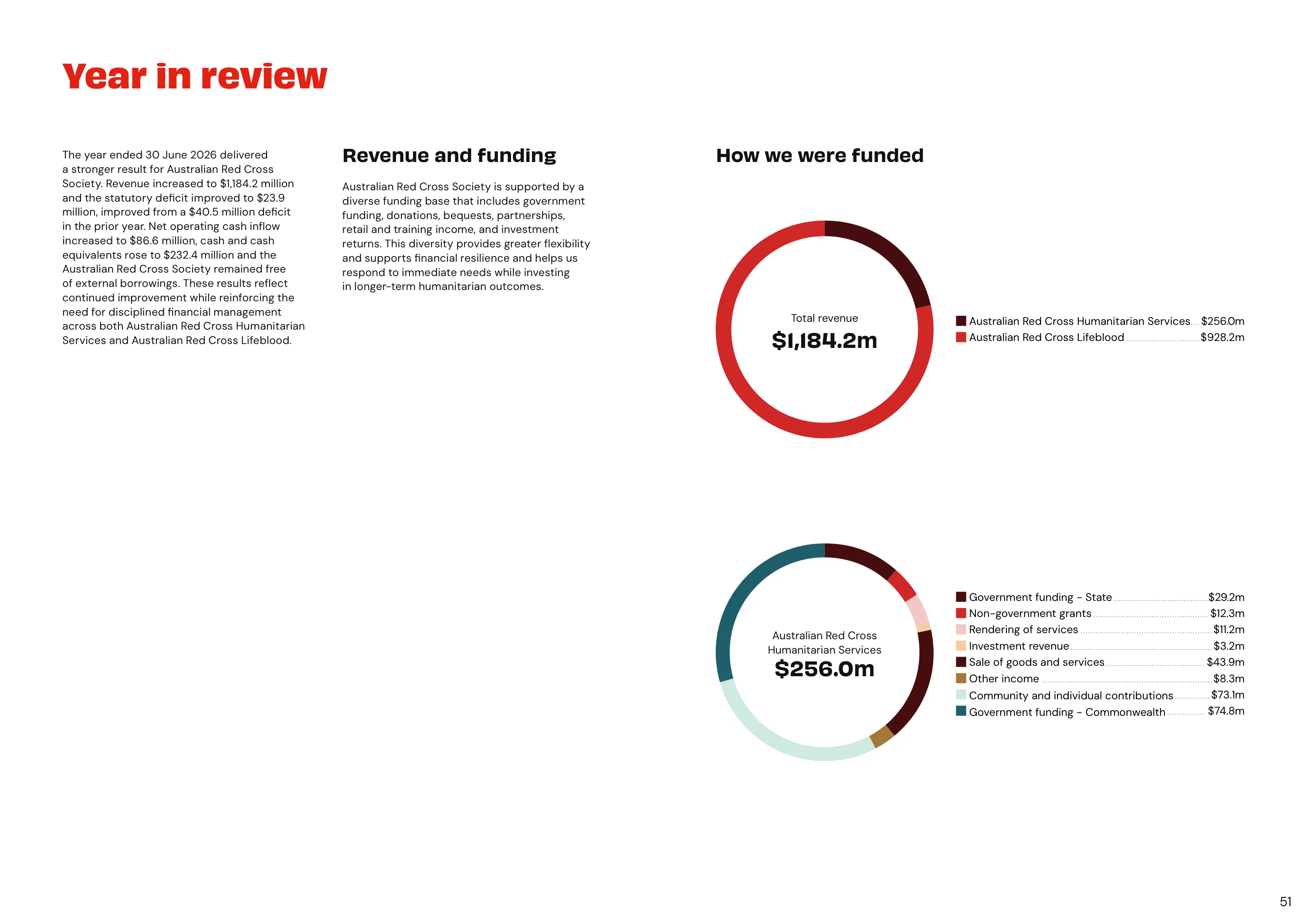
Text of page 51
Year in review
The year ended 30 June 2026 delivered a stronger result for Australian Red Cross Society. Revenue increased to $1,184.2 million and the statutory deficit improved to $23.9 million, improved from a $40.5 million deficit in the prior year. Net operating cash inflow increased to $86.6 million, cash and cash equivalents rose to $232.4 million and the Australian Red Cross Society remained free of external borrowings. These results reflect continued improvement while reinforcing the need for disciplined financial management across both Australian Red Cross Humanitarian Services and Australian Red Cross Lifeblood.
Revenue and funding
Australian Red Cross Society is supported by a diverse funding base that includes government funding, donations, bequests, partnerships, retail and training income, and investment returns. This diversity provides greater flexibility and supports financial resilience and helps us respond to immediate needs while investing in longer-term humanitarian outcomes.
How we were funded
Image description: Two doughnut charts showing how revenue was made up. The figures are listed below.
Total revenue: $1,184.2m
- Australian Red Cross Humanitarian Services: $256.0m
- Australian Red Cross Lifeblood: $928.2m
Australian Red Cross Humanitarian Services: $256.0m
- Government funding - State: $29.2m
- Non-government grants: $12.3m
- Rendering of services: $11.2m
- Investment revenue: $3.2m
- Sale of goods and services: $43.9m
- Other income: $8.3m
- Community and individual contributions: $73.1m
- Government funding - Commonwealth: $74.8m
-
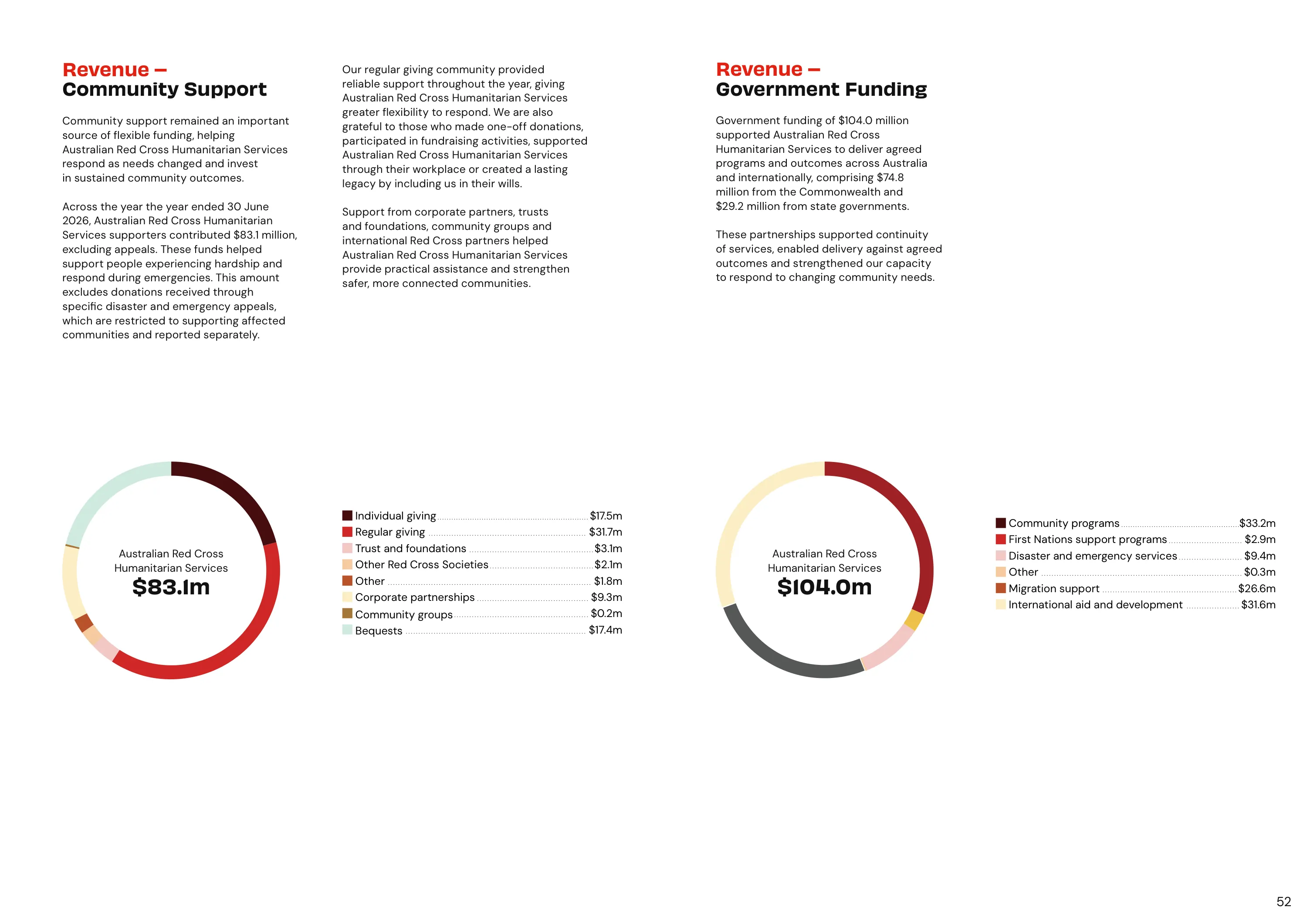
Text of page 52
Revenue – Community Support
Community support remained an important source of flexible funding, helping Australian Red Cross Humanitarian Services respond as needs changed and invest in sustained community outcomes.
Across the year the year ended 30 June 2026, Australian Red Cross Humanitarian Services supporters contributed $83.1 million, excluding appeals. These funds helped support people experiencing hardship and respond during emergencies. This amount excludes donations received through specific disaster and emergency appeals, which are restricted to supporting affected communities and reported separately.
Our regular giving community provided reliable support throughout the year, giving Australian Red Cross Humanitarian Services greater flexibility to respond. We are also grateful to those who made one-off donations, participated in fundraising activities, supported Australian Red Cross Humanitarian Services through their workplace or created a lasting legacy by including us in their wills.
Support from corporate partners, trusts and foundations, community groups and international Red Cross partners helped Australian Red Cross Humanitarian Services provide practical assistance and strengthen safer, more connected communities.
Image description: Doughnut chart of community support for Australian Red Cross Humanitarian Services, totalling $83.1m:
- Individual giving: $17.5m
- Regular giving: $31.7m
- Trust and foundations: $3.1m
- Other Red Cross Societies: $2.1m
- Other: $1.8m
- Corporate partnerships: $9.3m
- Community groups: $0.2m
- Bequests: $17.4m
Revenue – Government Funding
Government funding of $104.0 million supported Australian Red Cross Humanitarian Services to deliver agreed programs and outcomes across Australia and internationally, comprising $74.8 million from the Commonwealth and $29.2 million from state governments.
These partnerships supported continuity of services, enabled delivery against agreed outcomes and strengthened our capacity to respond to changing community needs.
Image description: Doughnut chart of government funding for Australian Red Cross Humanitarian Services, totalling $104.0m:
- Community programs: $33.2m
- First Nations support programs: $2.9m
- Disaster and emergency services: $9.4m
- Other: $0.3m
- Migration support: $26.6m
- International aid and development: $31.6m
-
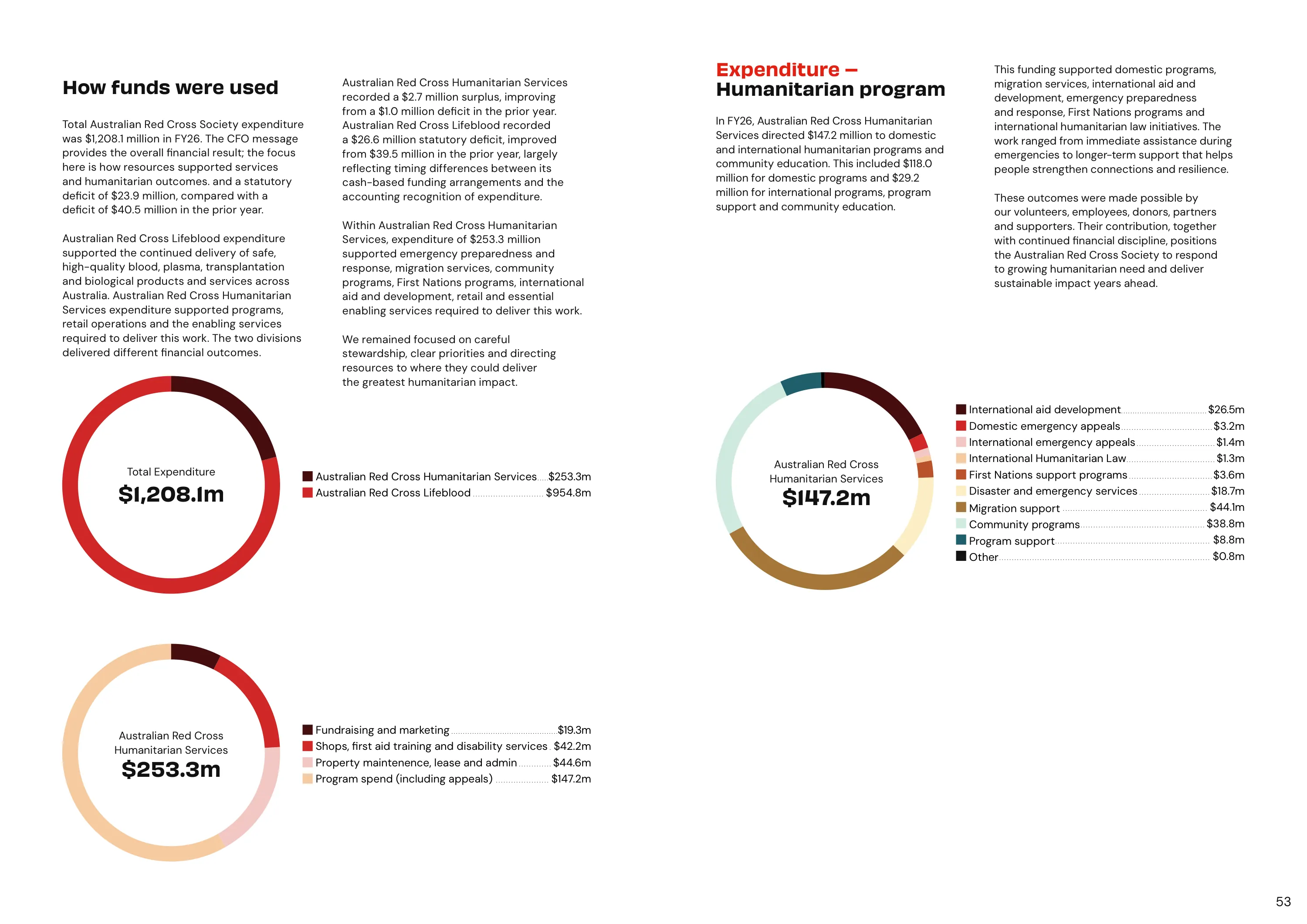
Text of page 53
How funds were used
Total Australian Red Cross Society expenditure was $1,208.1 million in FY26. The CFO message provides the overall financial result; the focus here is how resources supported services and humanitarian outcomes. and a statutory deficit of $23.9 million, compared with a deficit of $40.5 million in the prior year.
Australian Red Cross Lifeblood expenditure supported the continued delivery of safe, high-quality blood, plasma, transplantation and biological products and services across Australia. Australian Red Cross Humanitarian Services expenditure supported programs, retail operations and the enabling services required to deliver this work. The two divisions delivered different financial outcomes.
Australian Red Cross Humanitarian Services recorded a $2.7 million surplus, improving from a $1.0 million deficit in the prior year. Australian Red Cross Lifeblood recorded a $26.6 million statutory deficit, improved from $39.5 million in the prior year, largely reflecting timing differences between its cash-based funding arrangements and the accounting recognition of expenditure.
Within Australian Red Cross Humanitarian Services, expenditure of $253.3 million supported emergency preparedness and response, migration services, community programs, First Nations programs, international aid and development, retail and essential enabling services required to deliver this work.
We remained focused on careful stewardship, clear priorities and directing resources to where they could deliver the greatest humanitarian impact.
Image description: Three doughnut charts showing how money was spent. The figures are listed below.
Total Expenditure: $1,208.1m
- Australian Red Cross Humanitarian Services: $253.3m
- Australian Red Cross Lifeblood: $954.8m
Australian Red Cross Humanitarian Services: $253.3m
- Fundraising and marketing: $19.3m
- Shops, first aid training and disability services: $42.2m
- Property maintenence, lease and admin: $44.6m
- Program spend (including appeals): $147.2m
Expenditure – Humanitarian program
In FY26, Australian Red Cross Humanitarian Services directed $147.2 million to domestic and international humanitarian programs and community education. This included $118.0 million for domestic programs and $29.2 million for international programs, program support and community education.
This funding supported domestic programs, migration services, international aid and development, emergency preparedness and response, First Nations programs and international humanitarian law initiatives. The work ranged from immediate assistance during emergencies to longer-term support that helps people strengthen connections and resilience.
These outcomes were made possible by our volunteers, employees, donors, partners and supporters. Their contribution, together with continued financial discipline, positions the Australian Red Cross Society to respond to growing humanitarian need and deliver sustainable impact years ahead.
Australian Red Cross Humanitarian Services program expenditure: $147.2m
- International aid development: $26.5m
- Domestic emergency appeals: $3.2m
- International emergency appeals: $1.4m
- International Humanitarian Law: $1.3m
- First Nations support programs: $3.6m
- Disaster and emergency services: $18.7m
- Migration support: $44.1m
- Community programs: $38.8m
- Program support: $8.8m
- Other: $0.8m
-
-
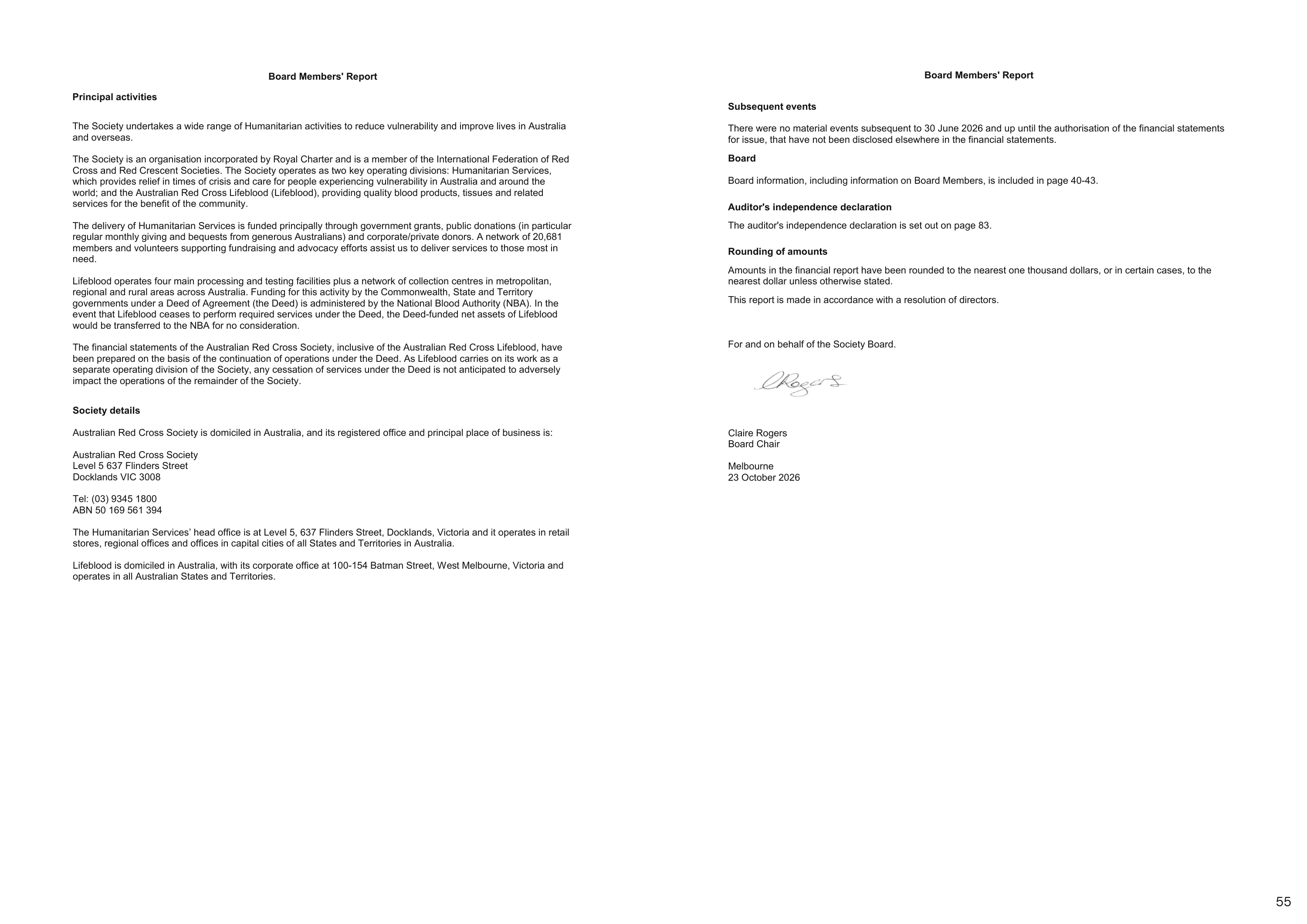
-
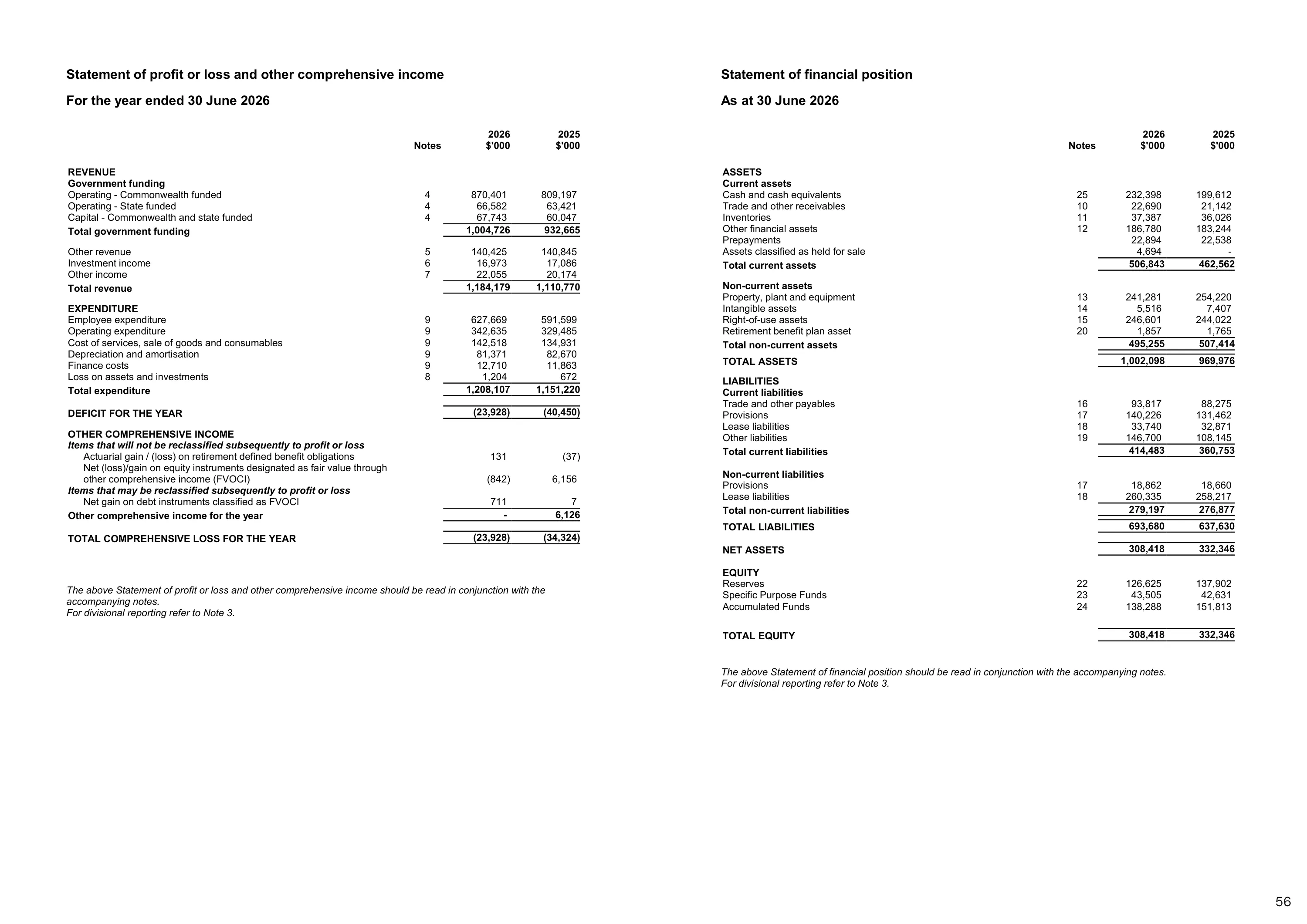
-
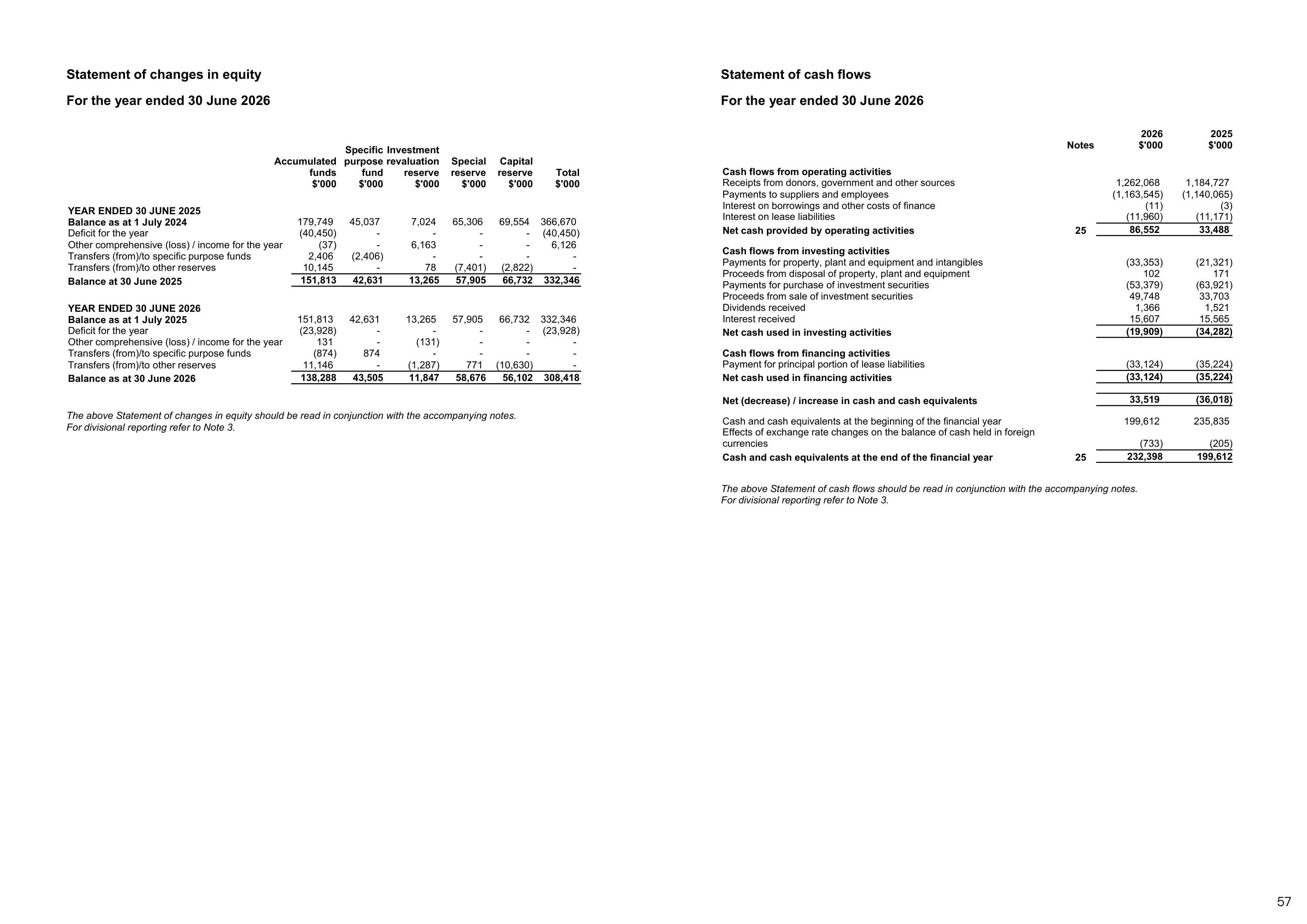
-
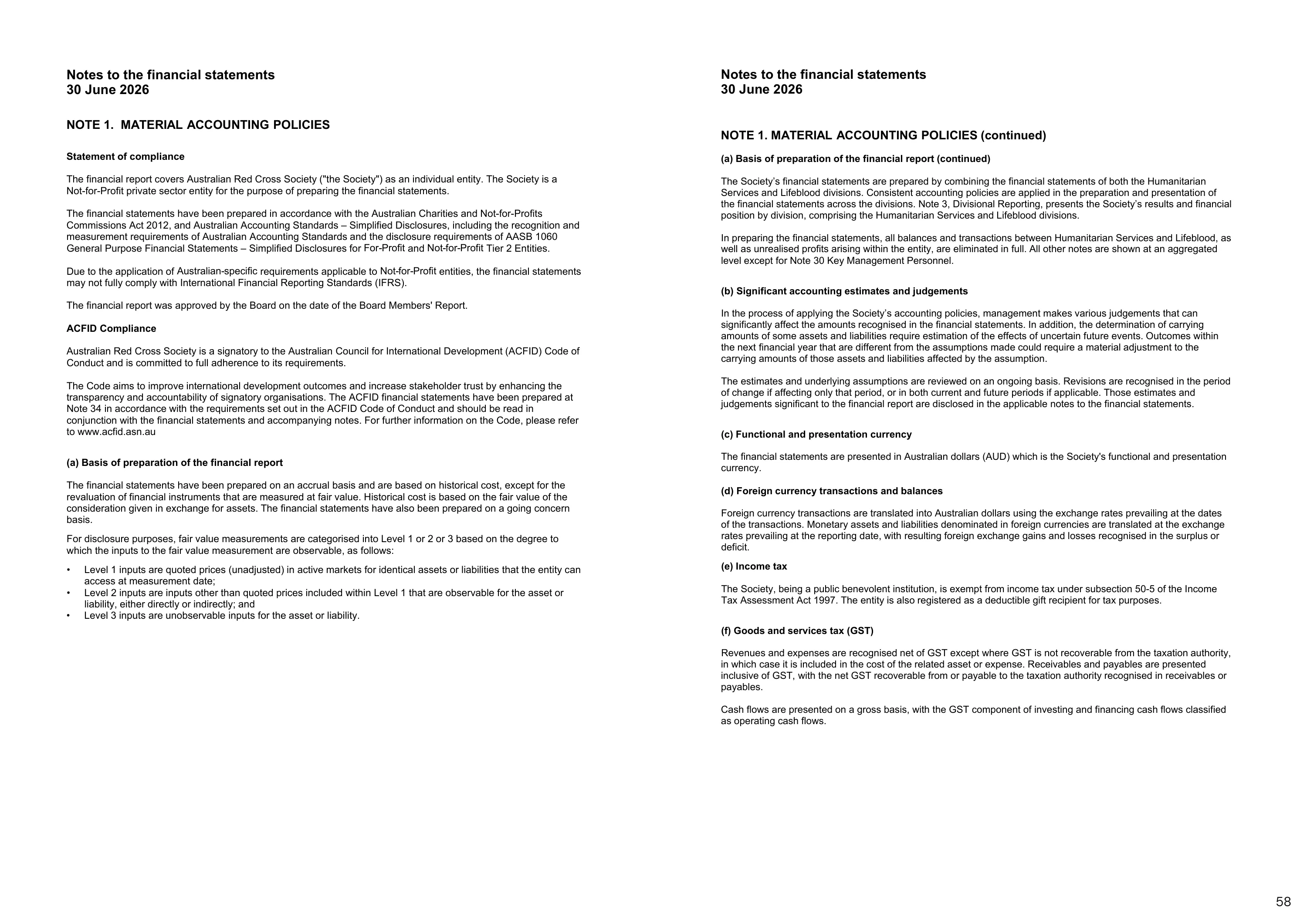
-
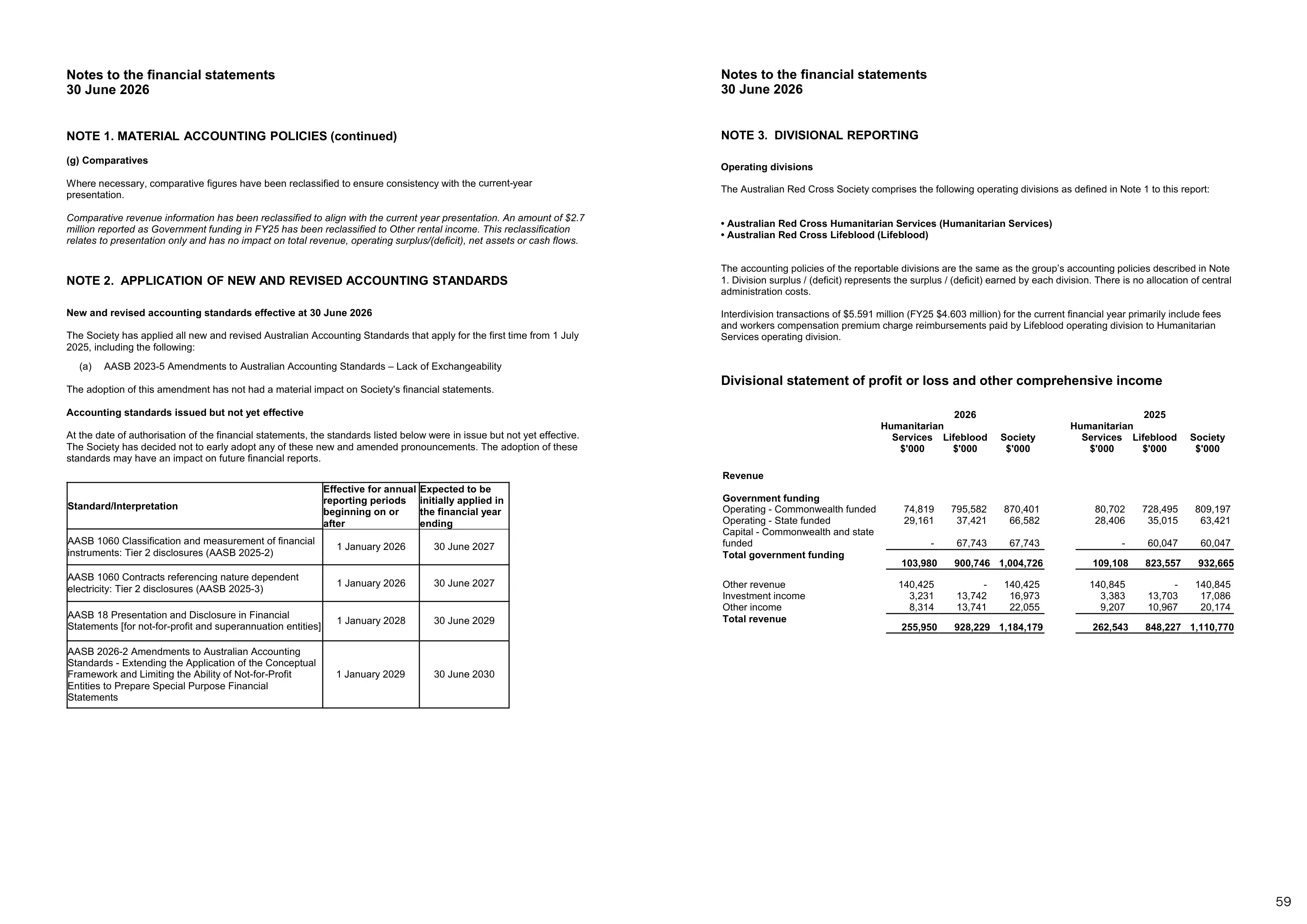
-
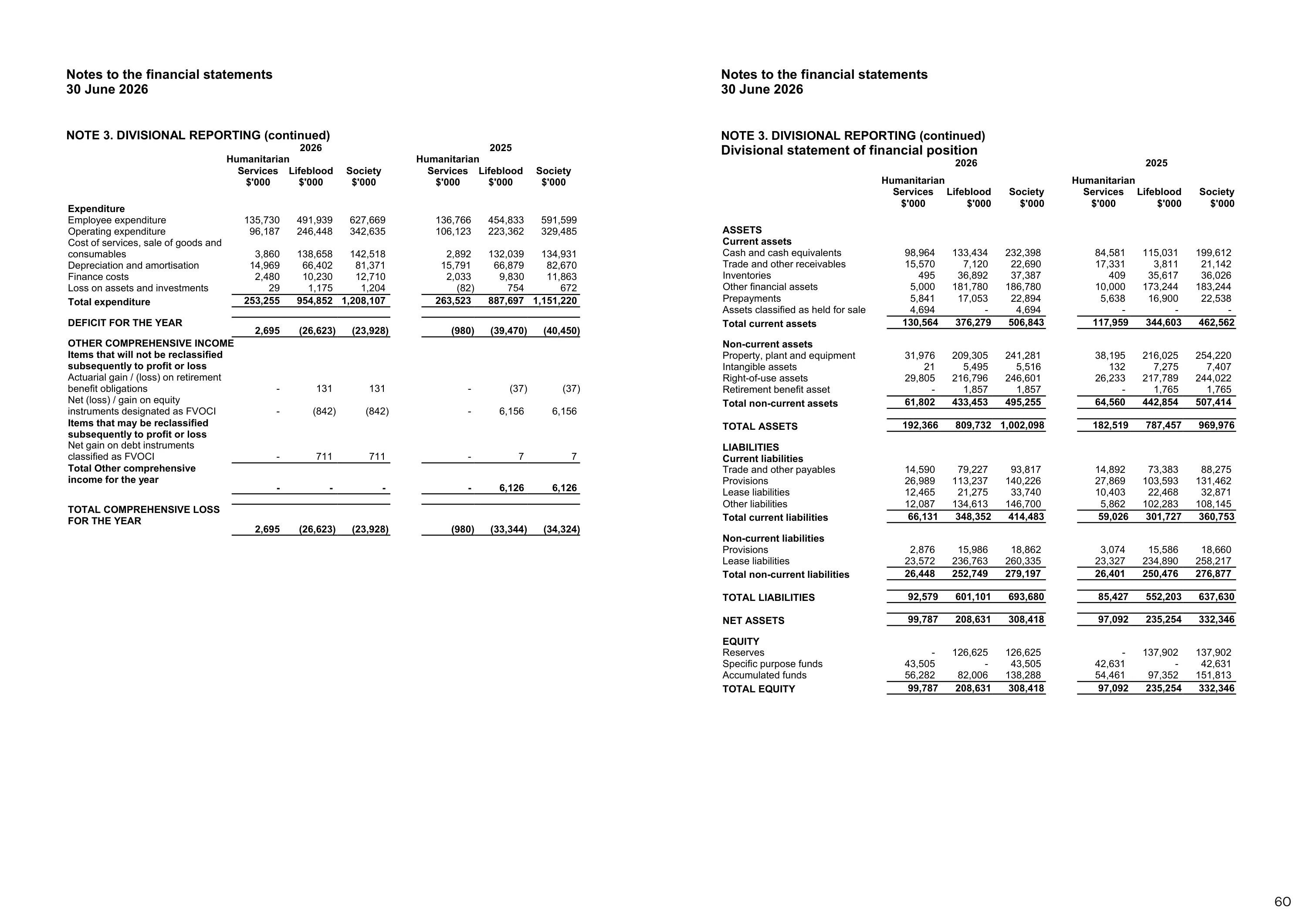
-
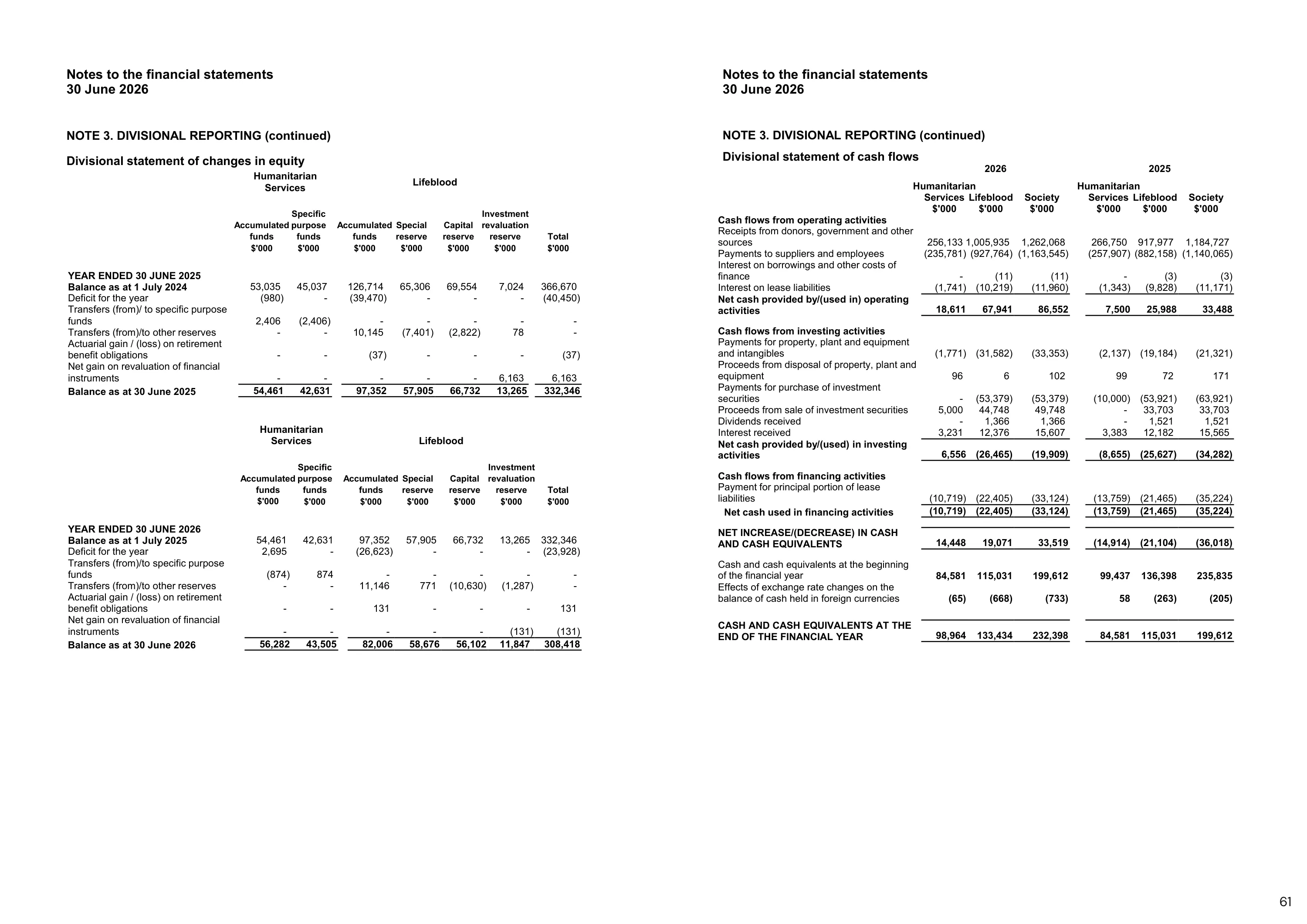
-
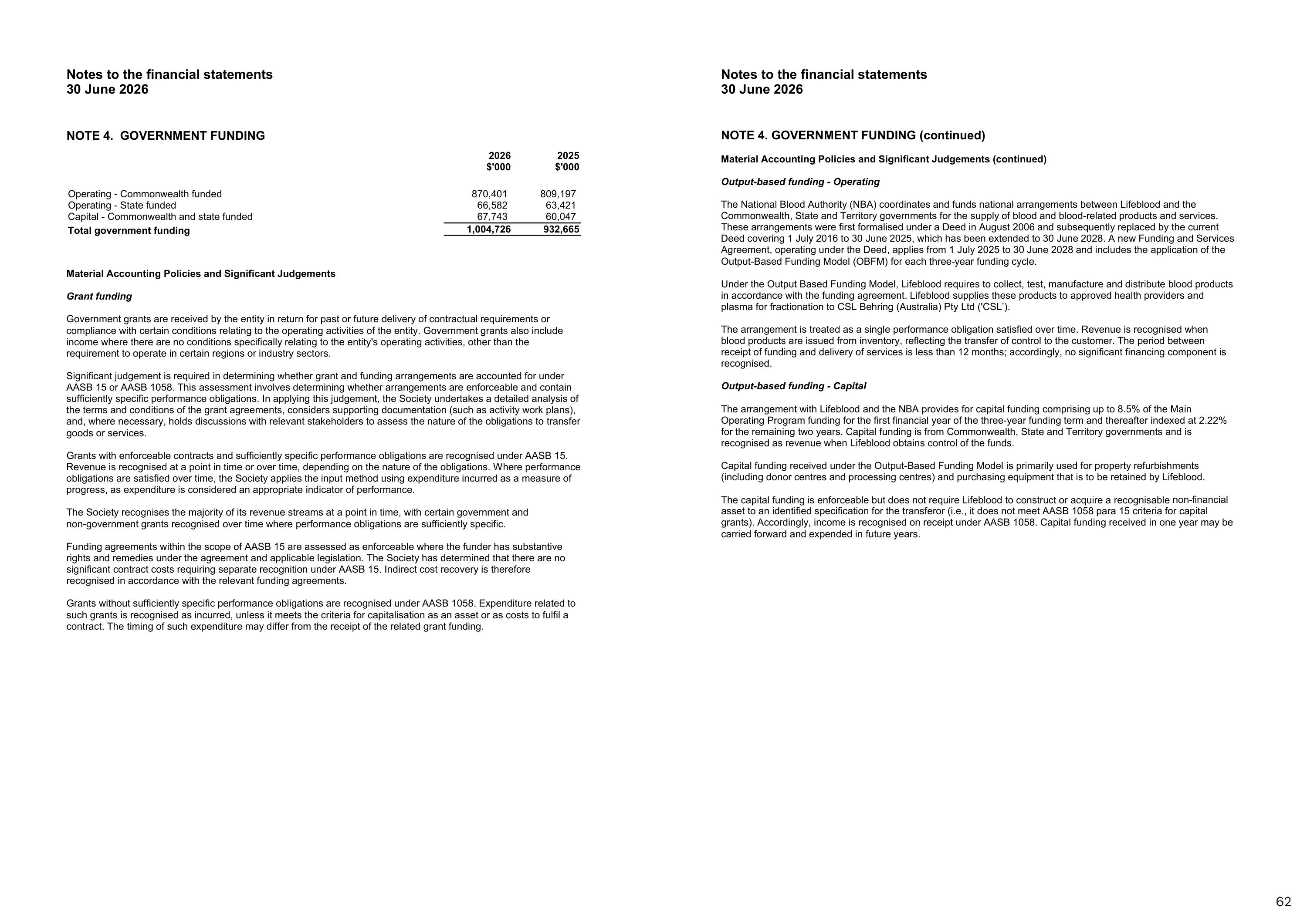
-
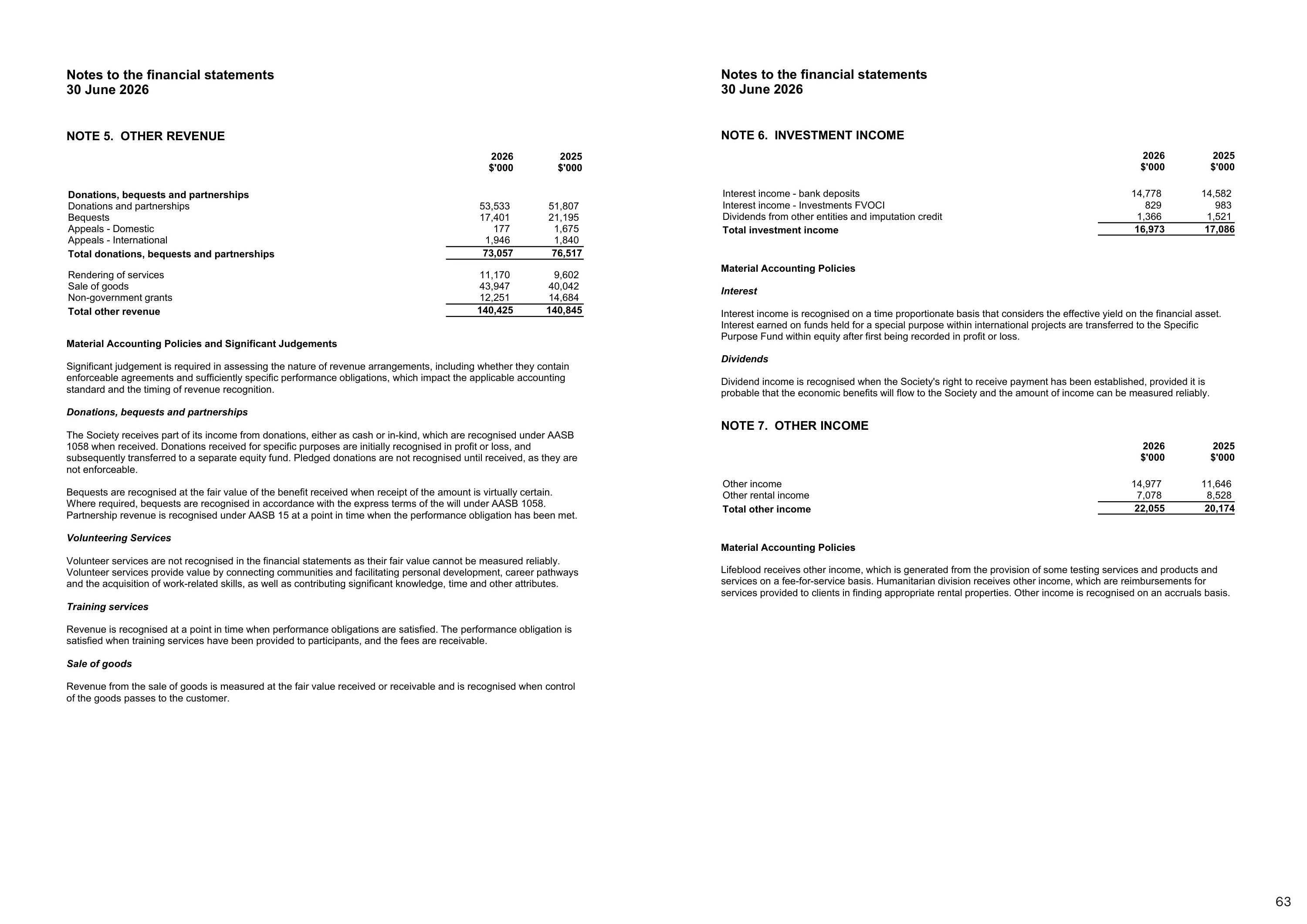
-
-
-
-
-
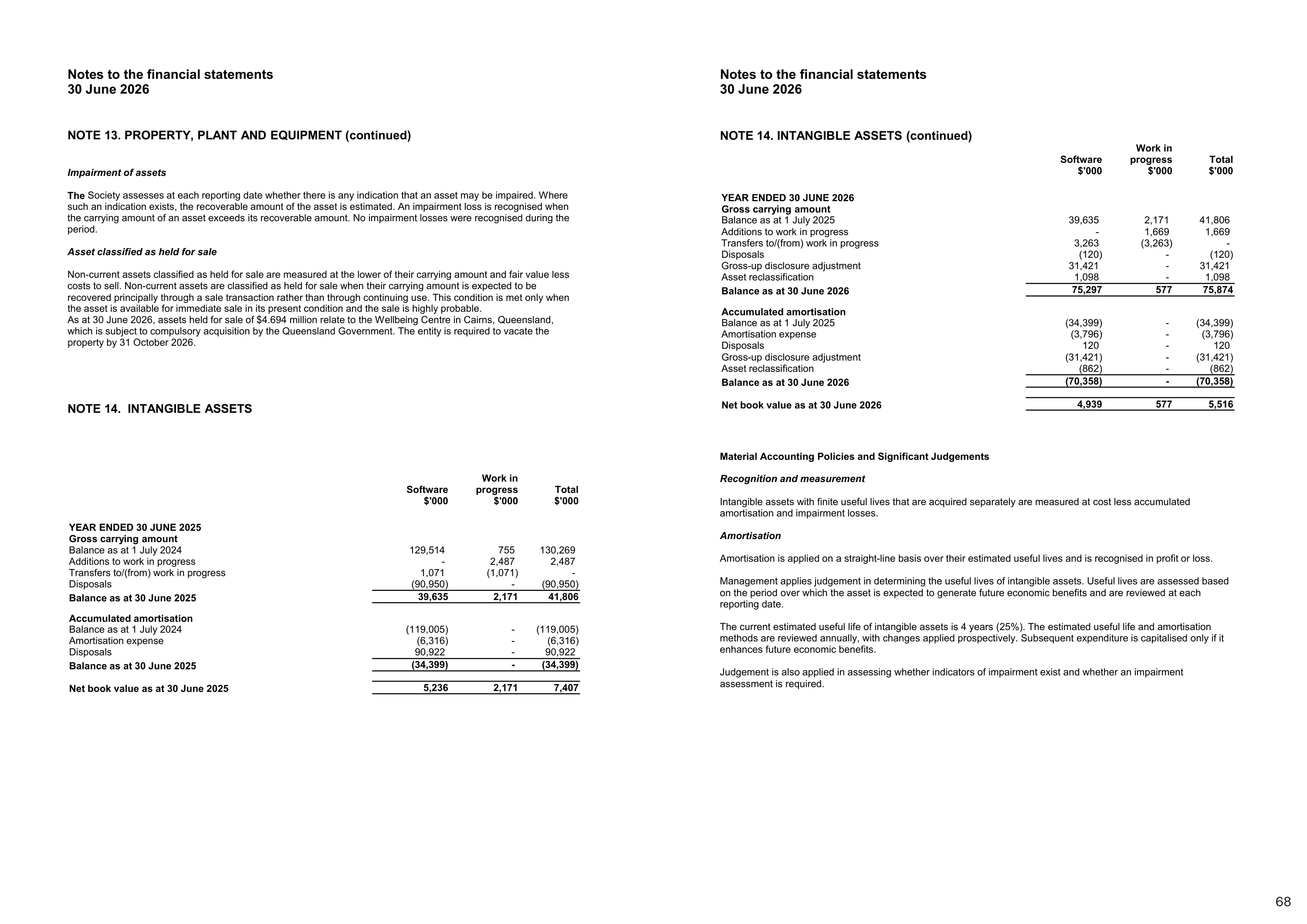
-
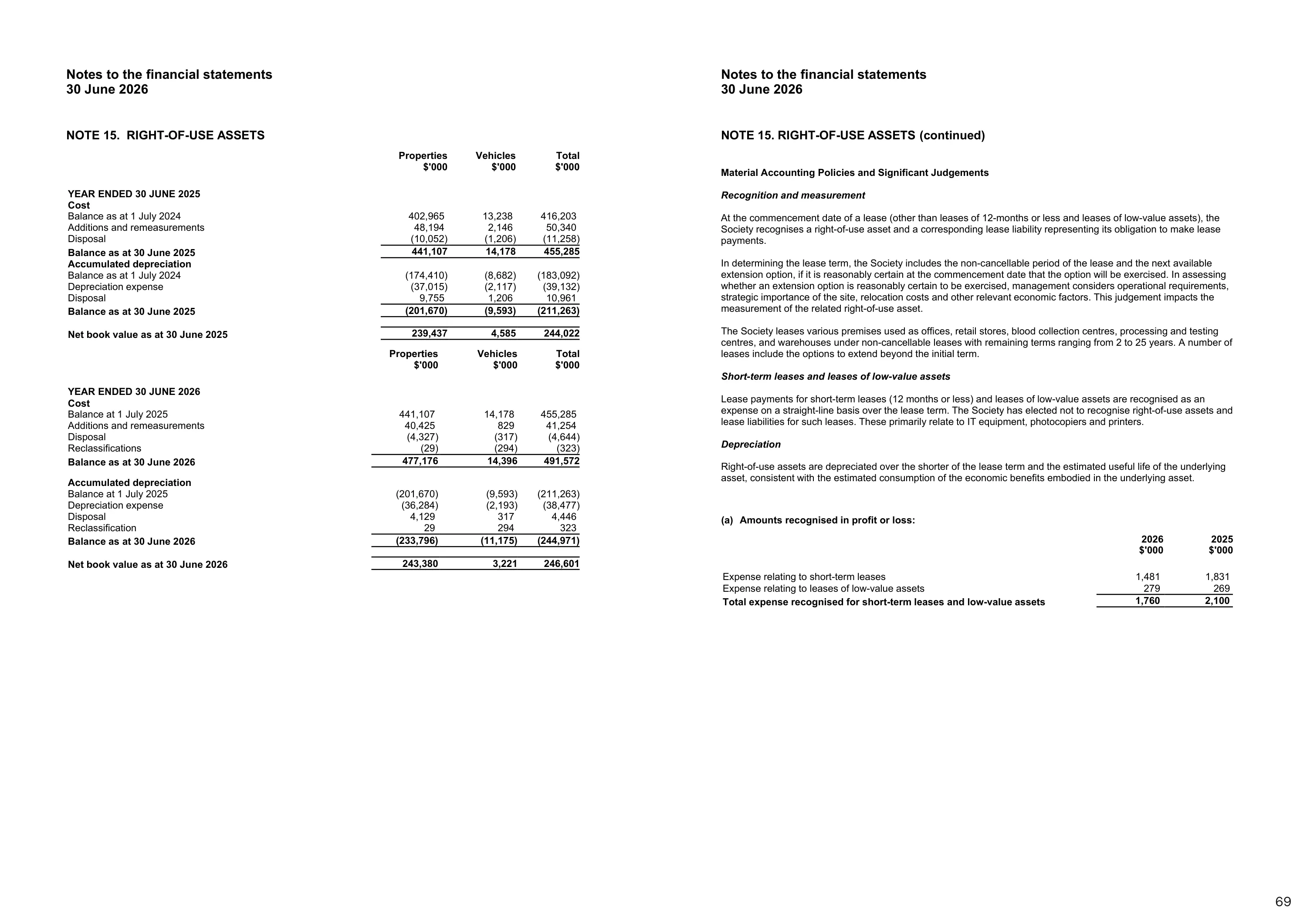
-
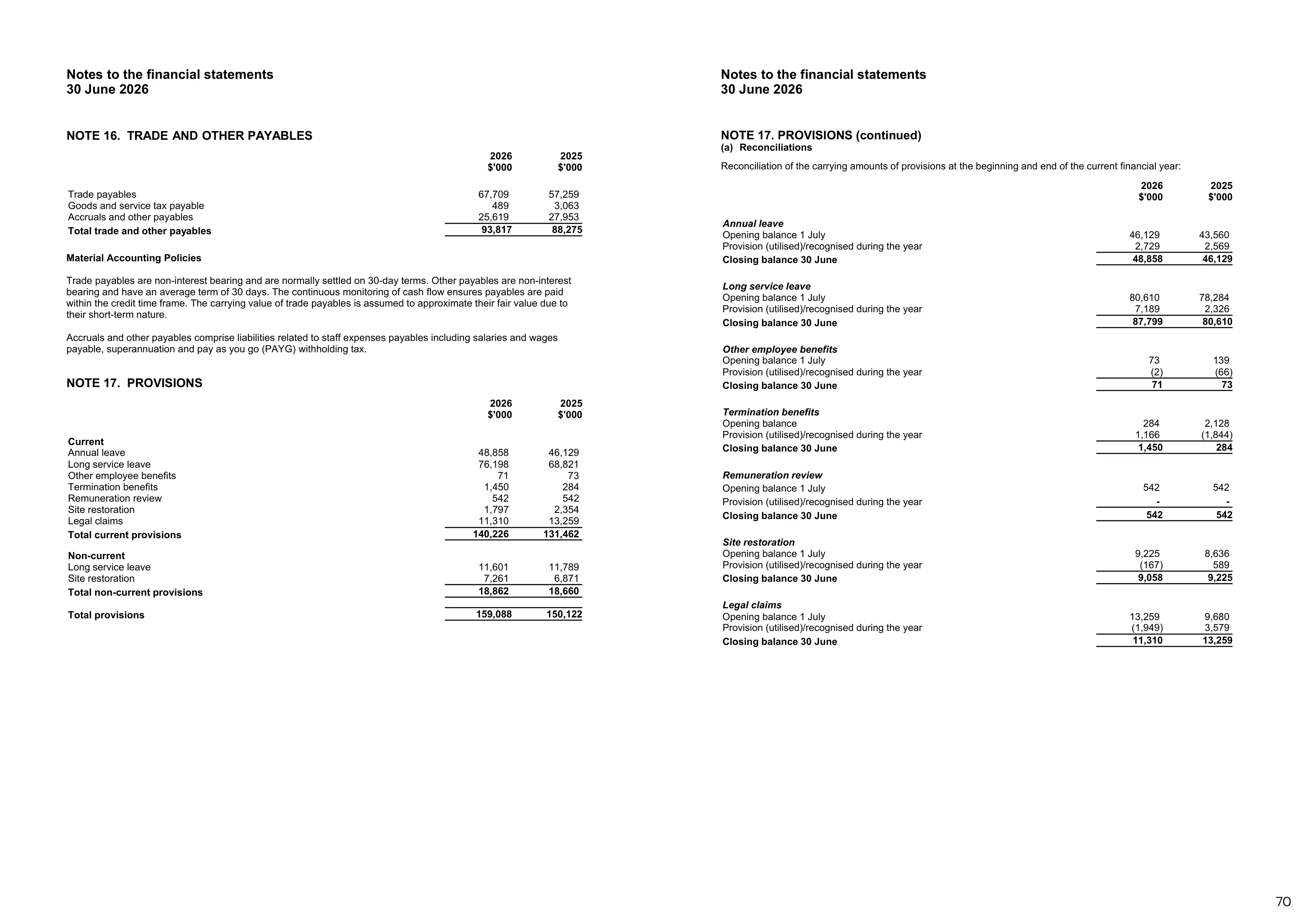
-
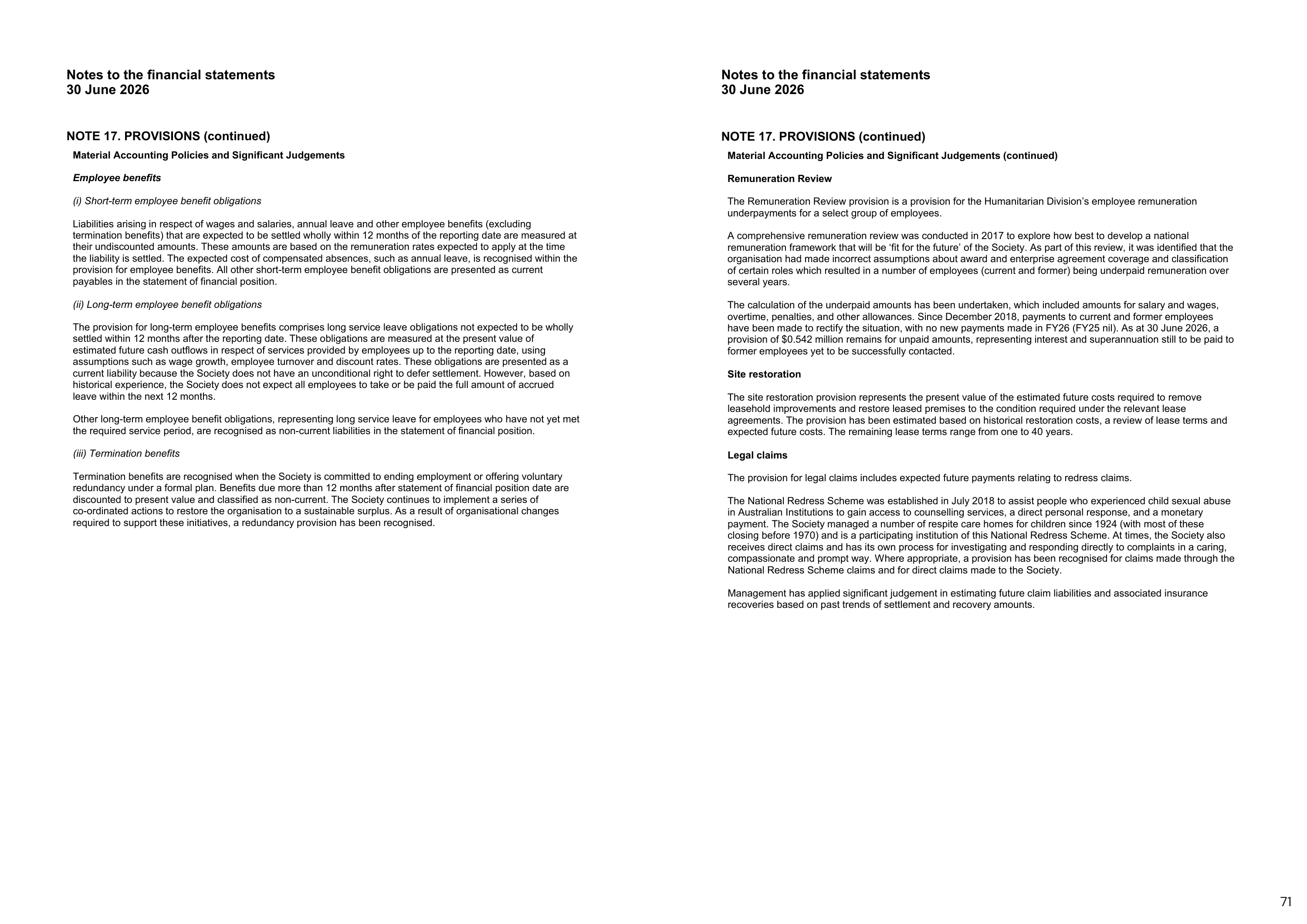
-
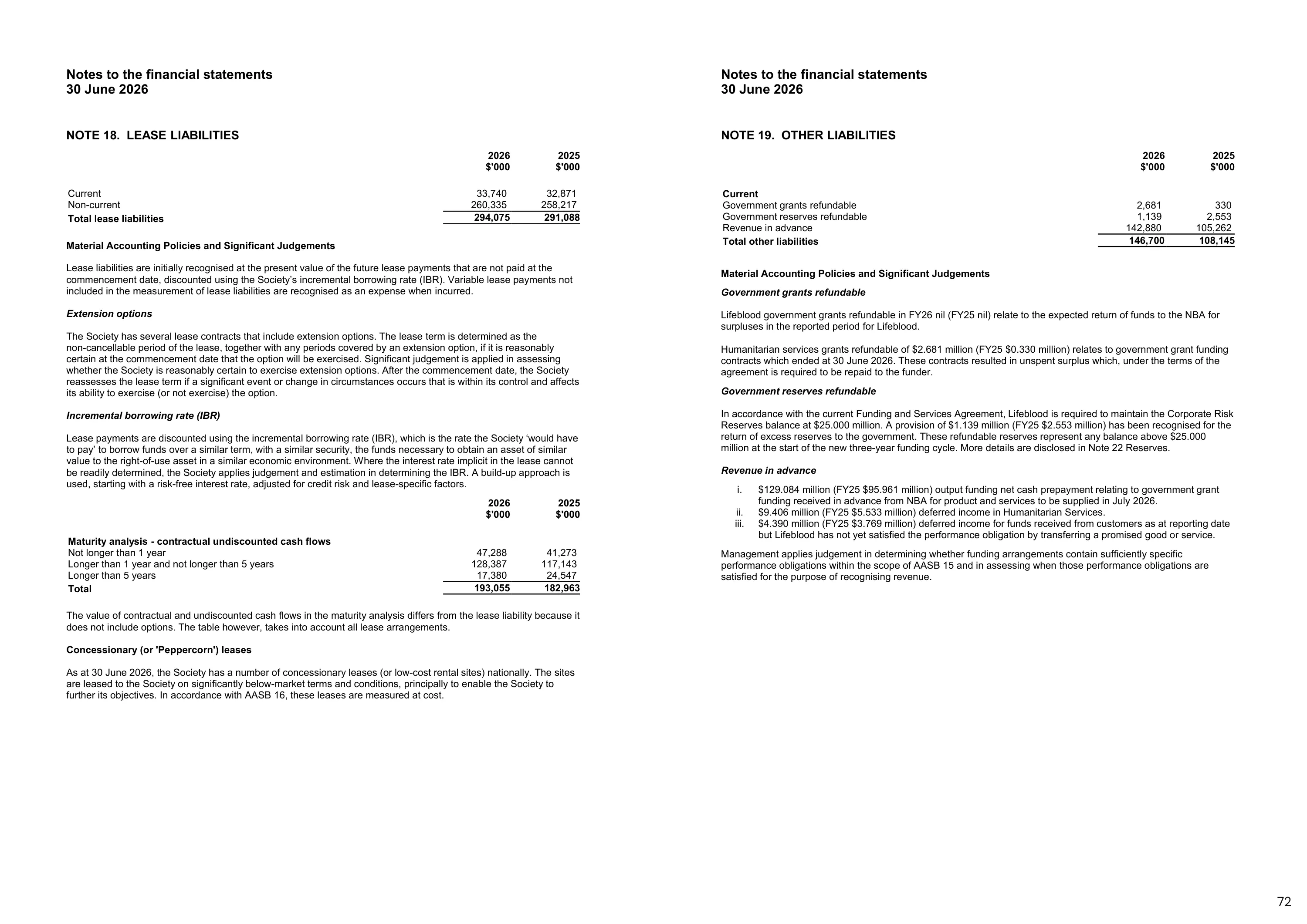
-
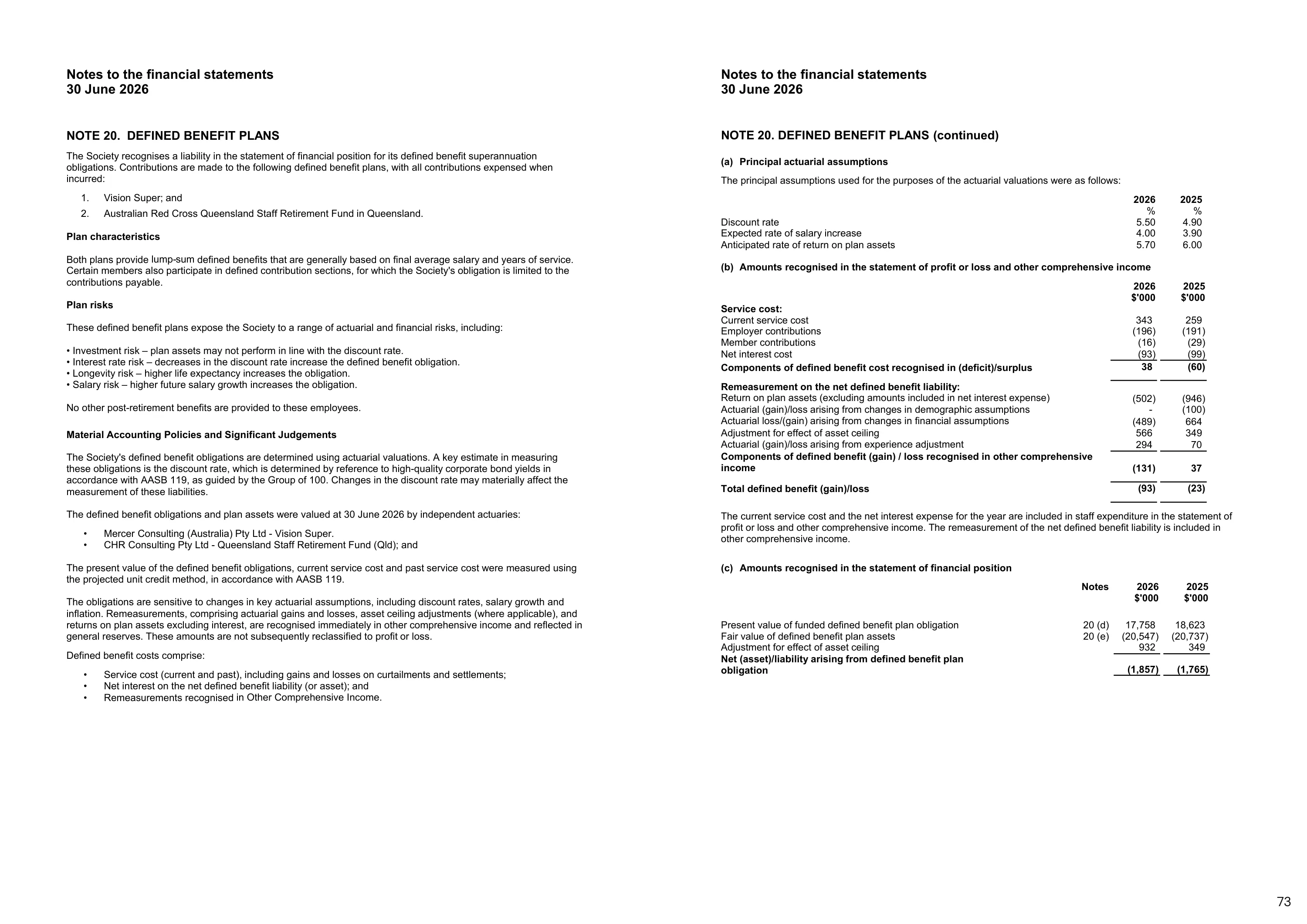
-
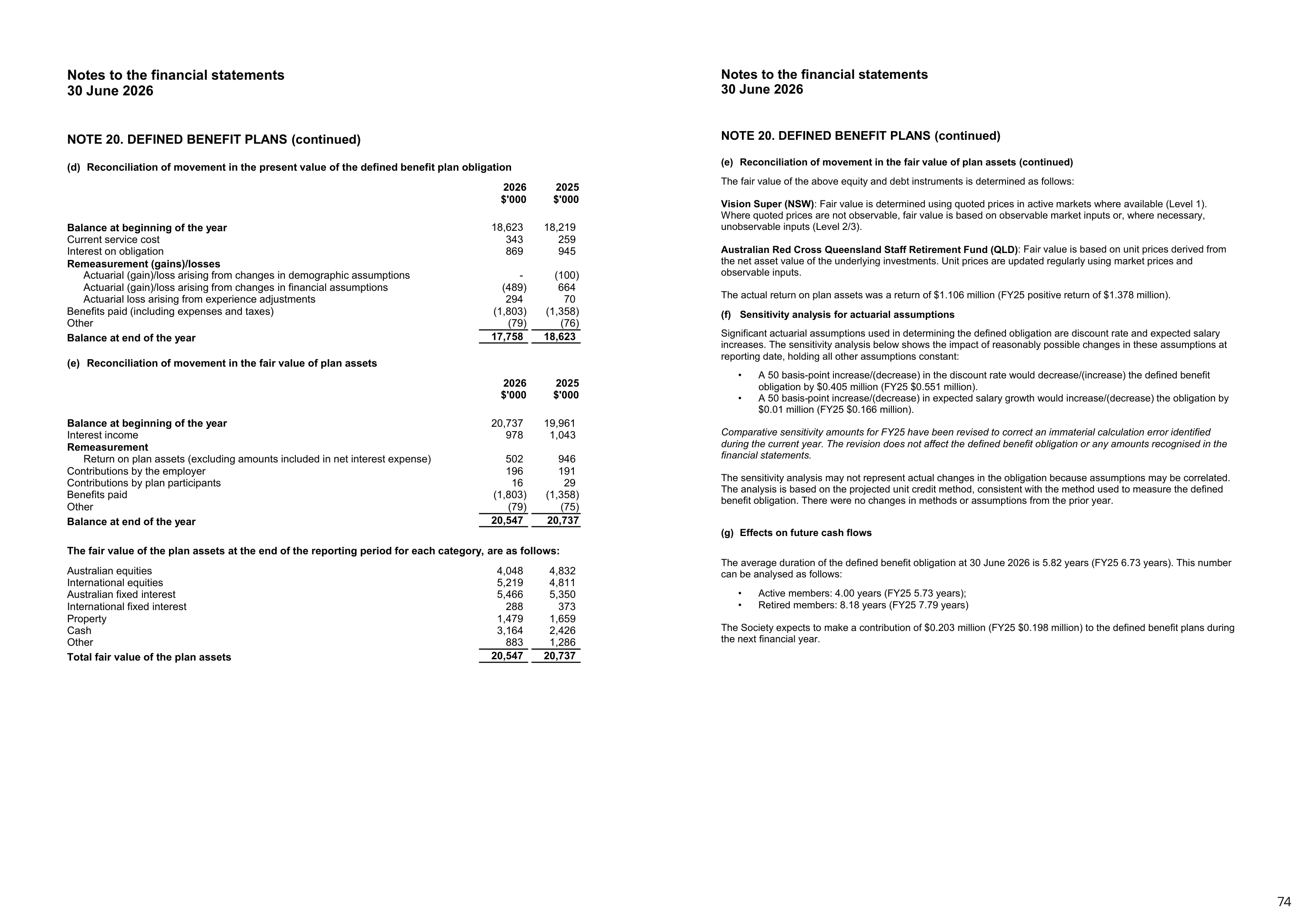
-
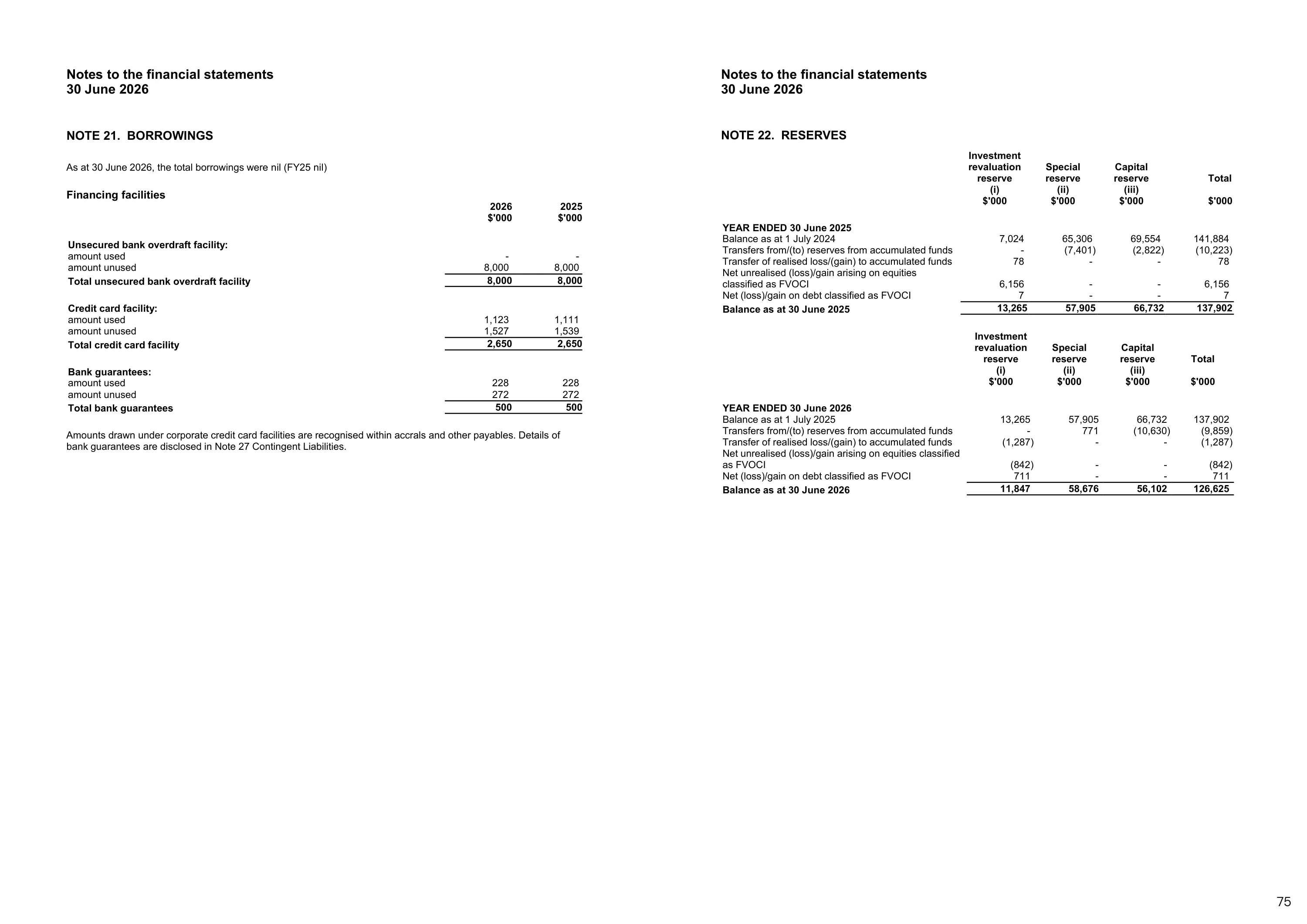
-
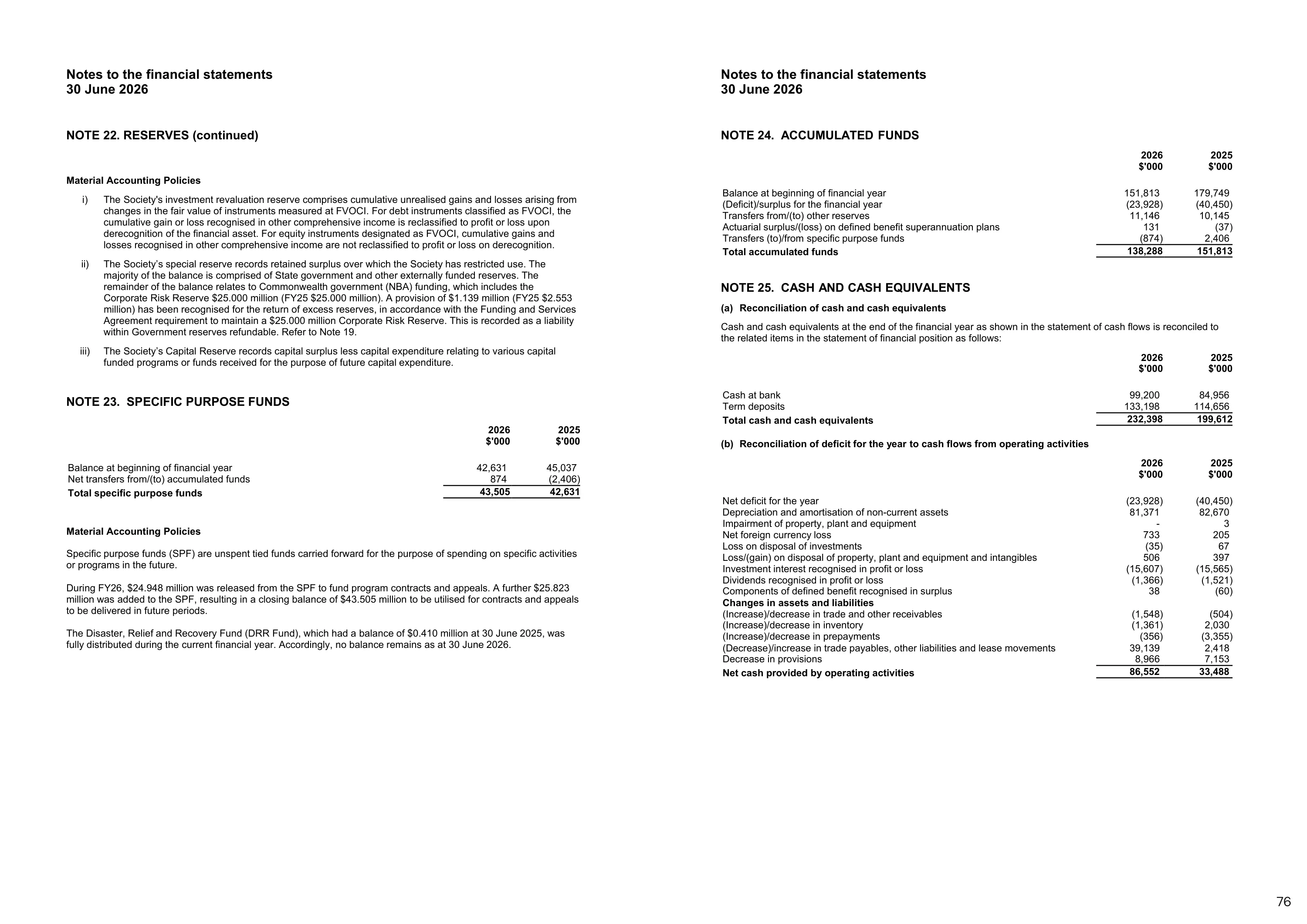
-
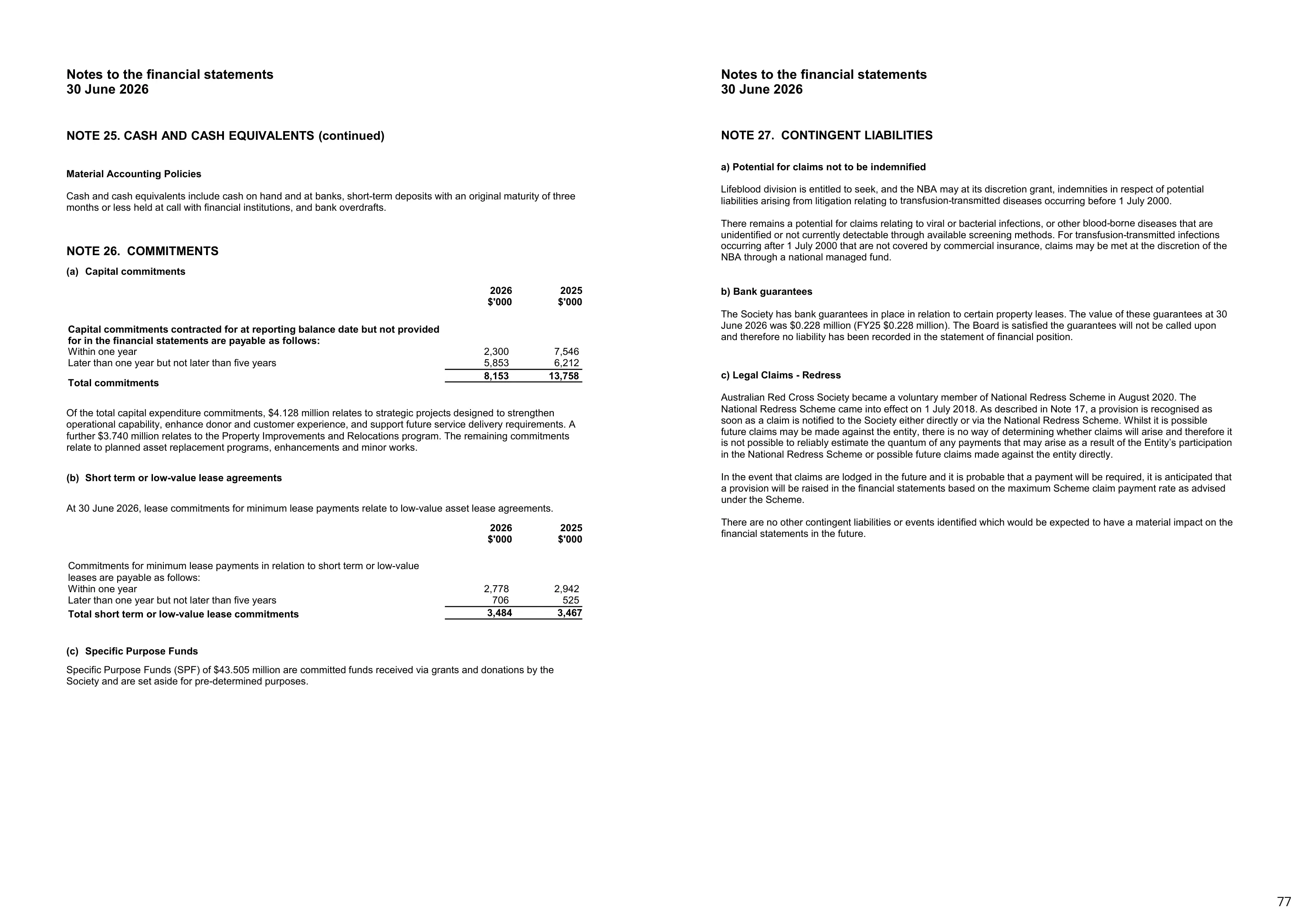
-
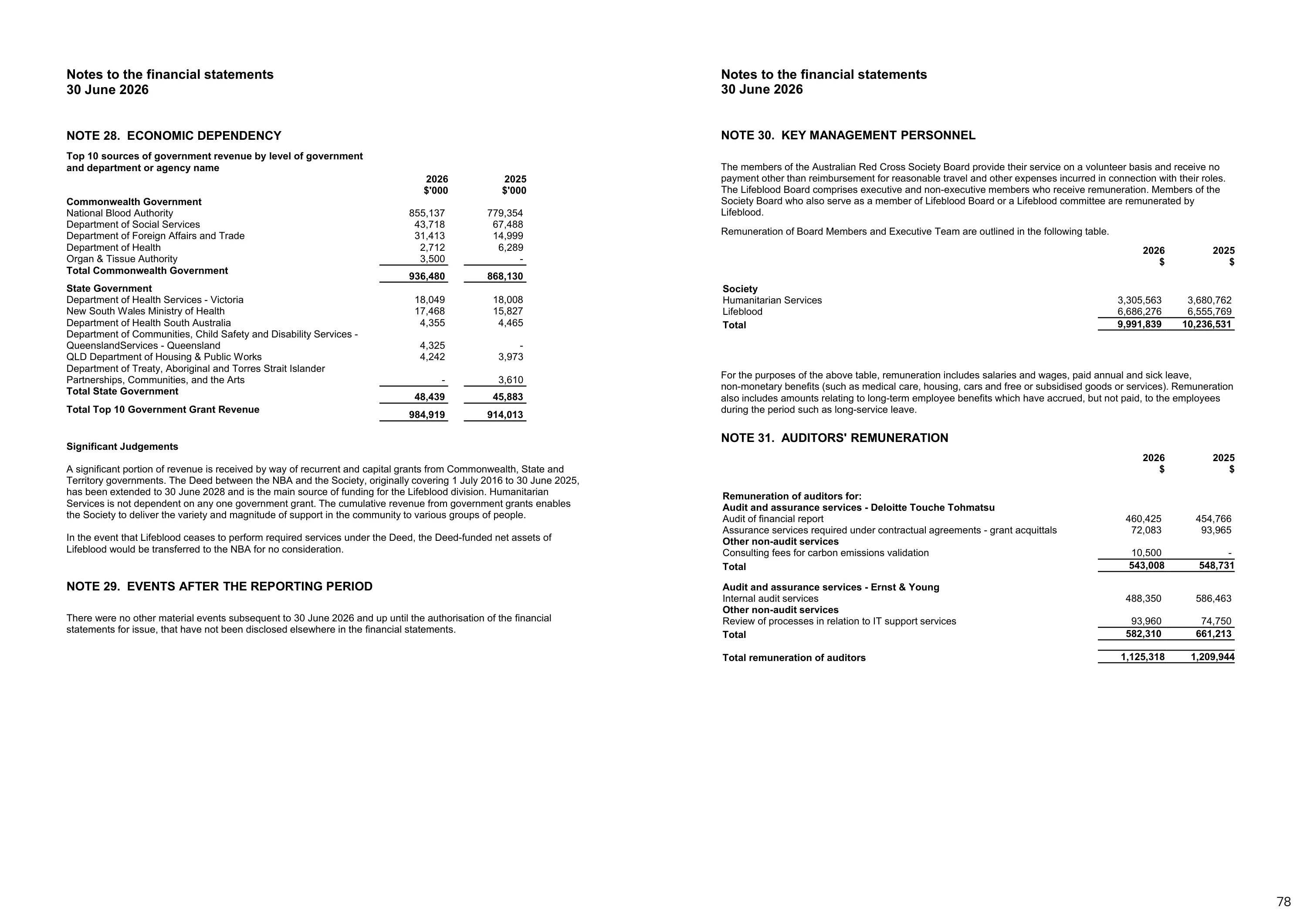
-
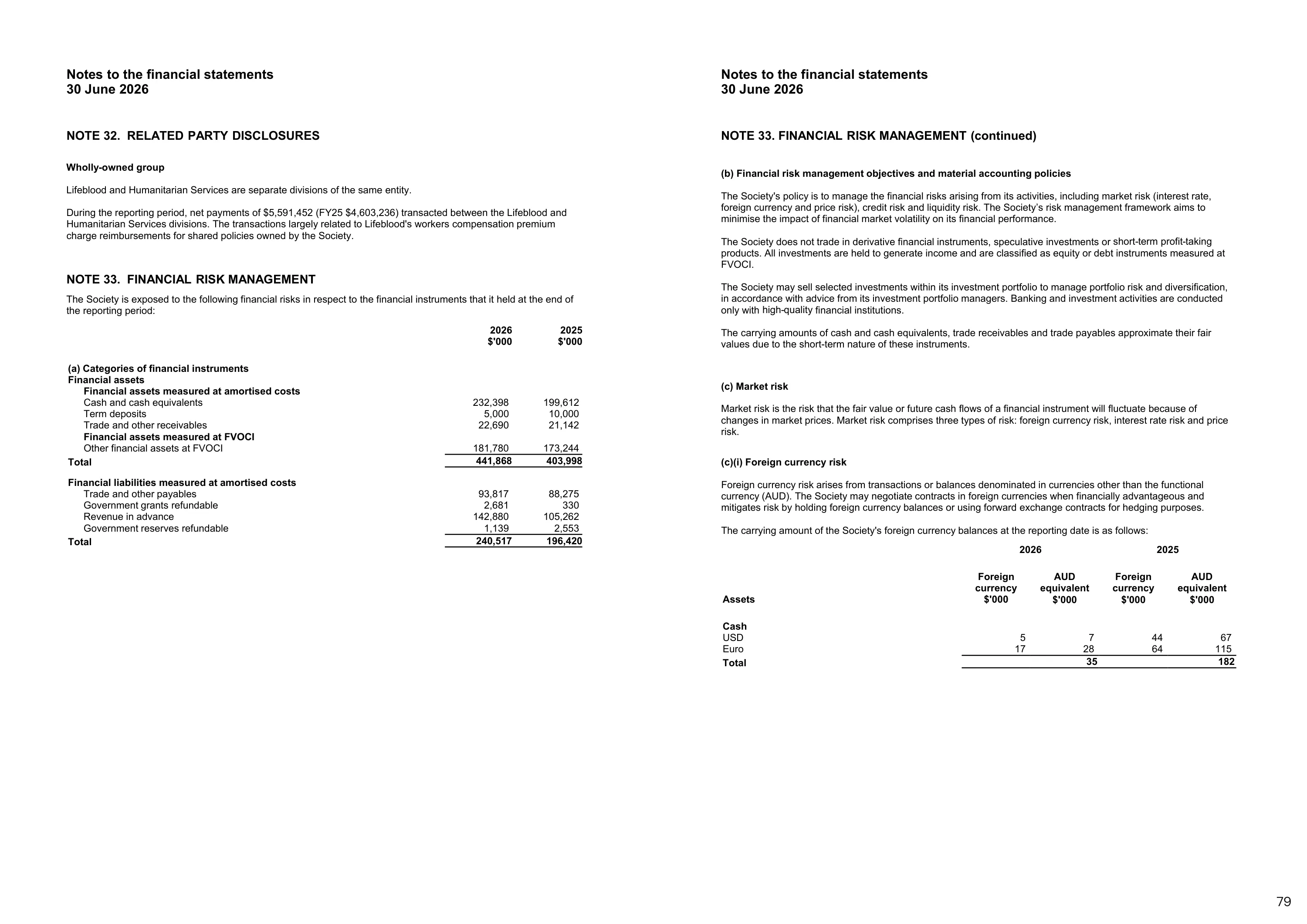
-
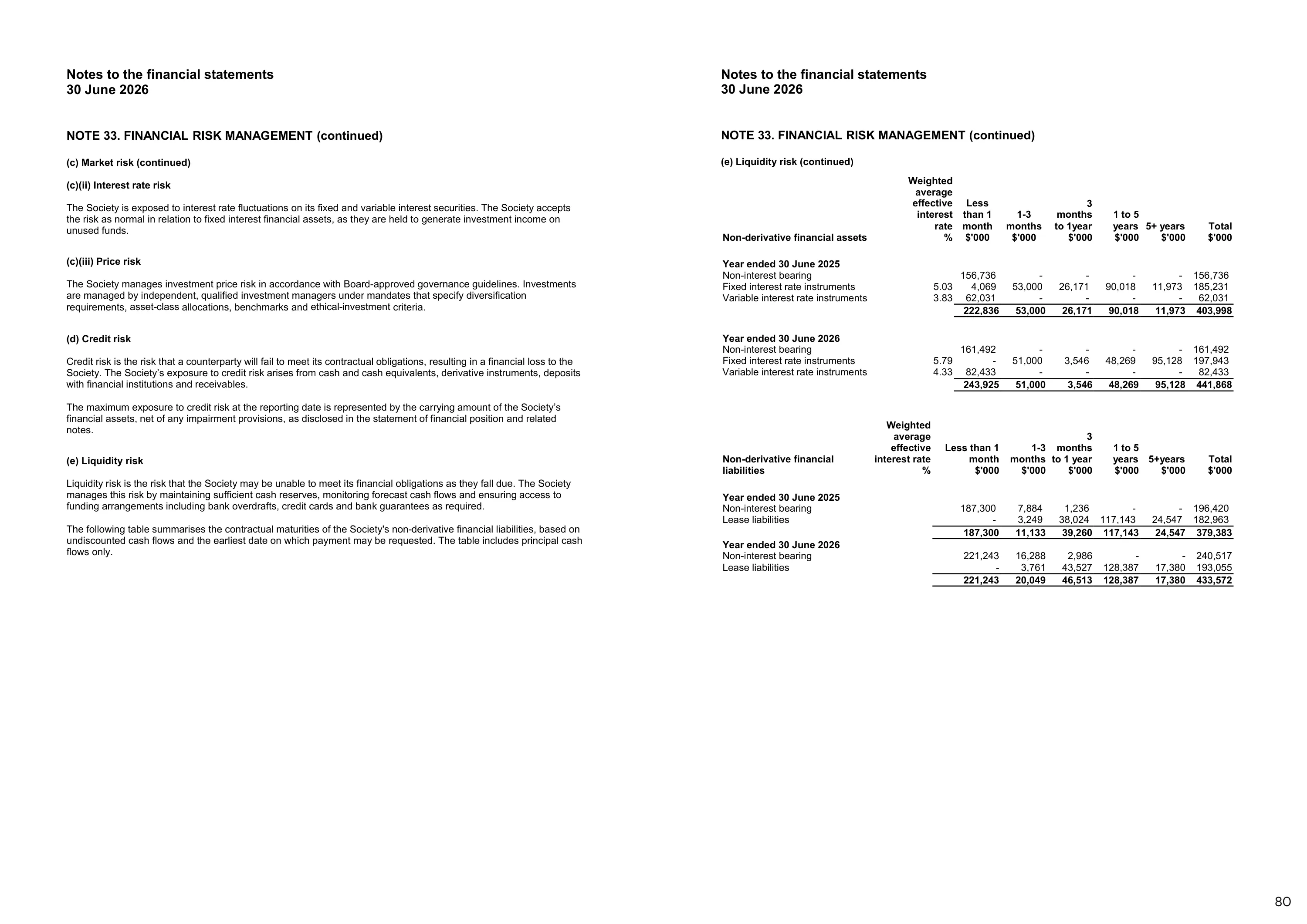
-
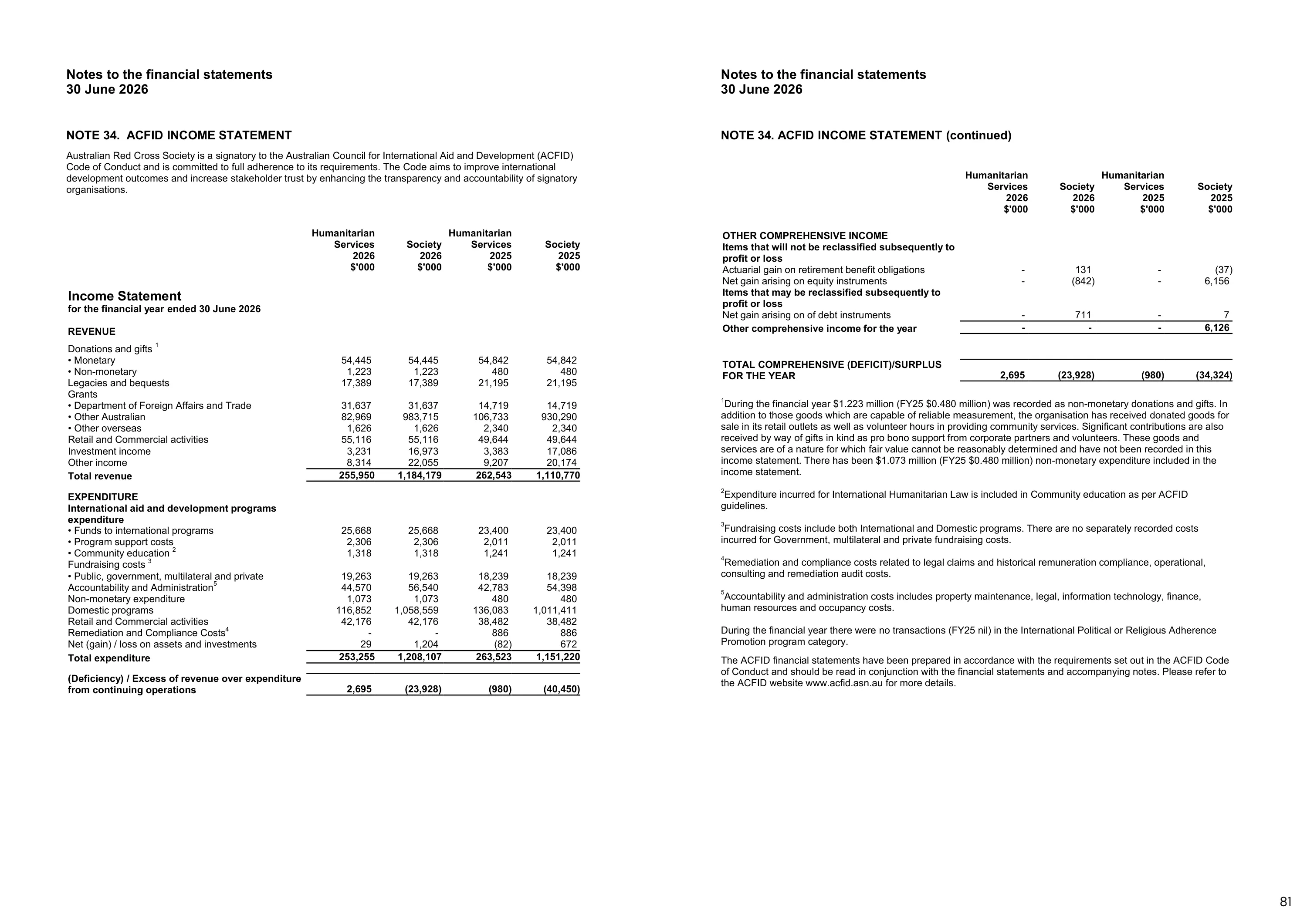
-
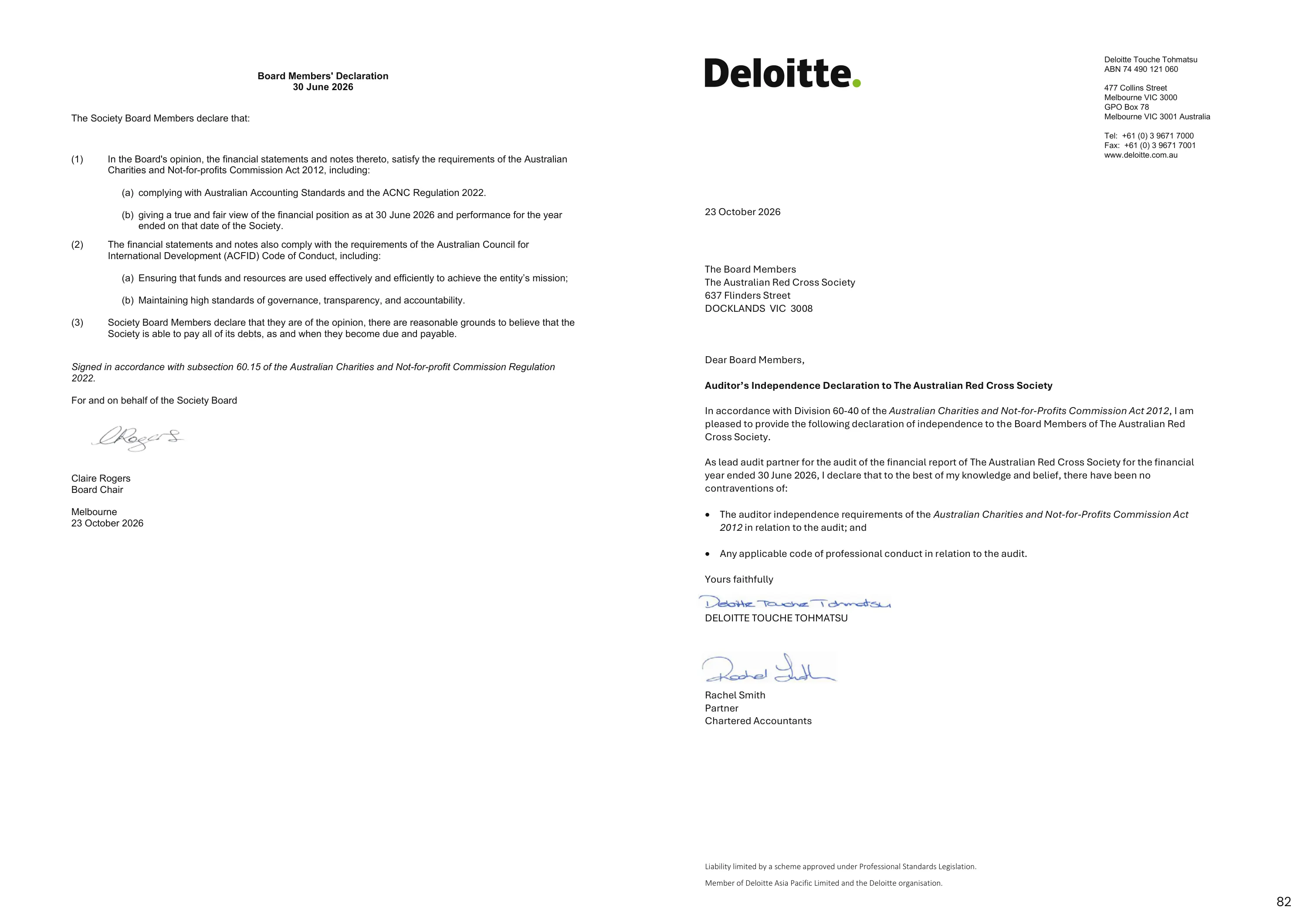
-
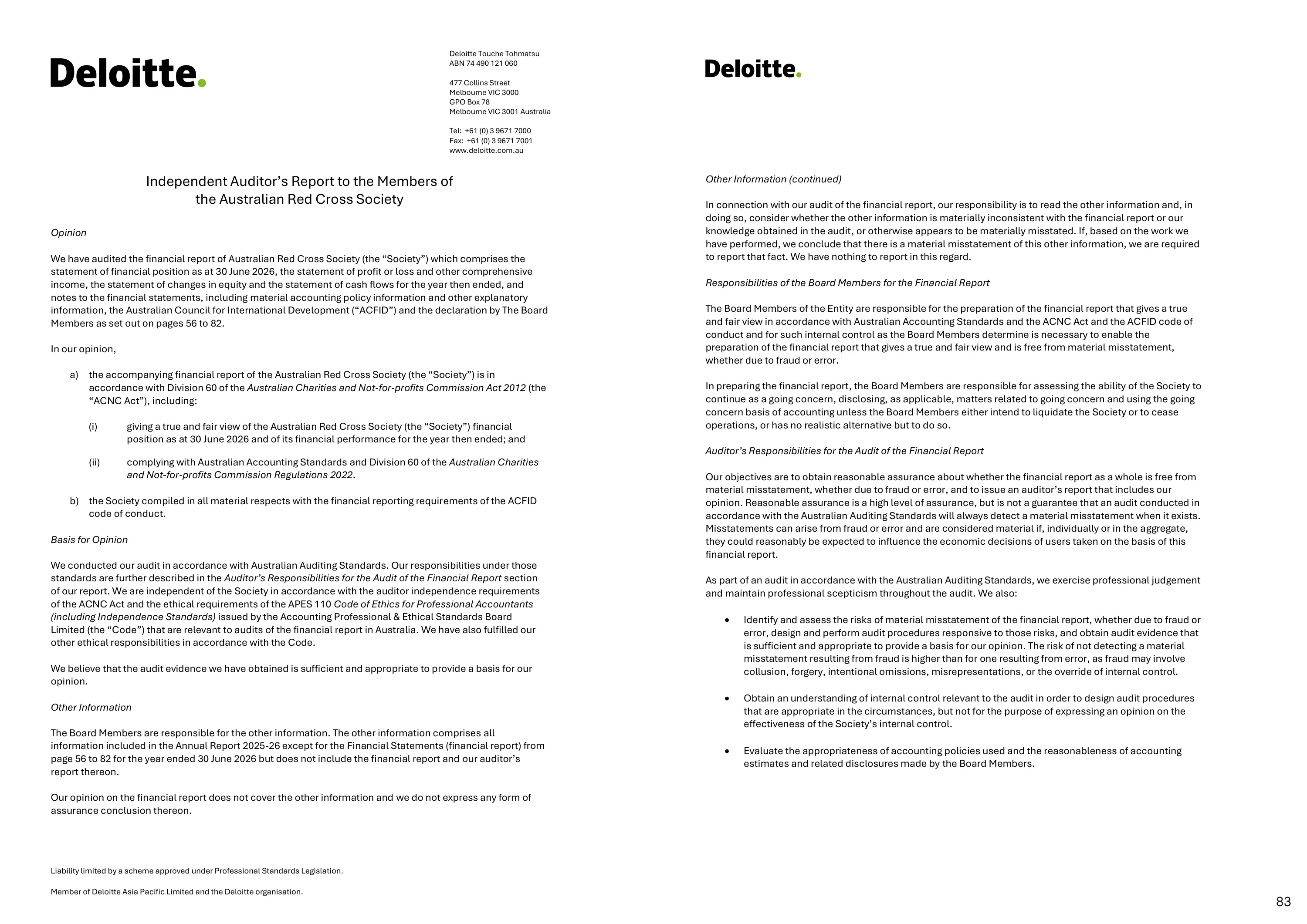
-
-




Australian Red Cross acknowledges the Aboriginal and Torres Strait Islander peoples as the Traditional Owners and Custodians of this land, their ancestors and Elders, past and present.
Learn about our Reconciliation Action Plan and how we can all make reconciliation real.
This website may contain the images, voices or names of people who have passed away.

All donations to Australian Red Cross are tax-deductible in Australia. Site protected by Google Invisible reCAPTCHA. © Australian Red Cross 2026. ABN 50 169 561 394